
CTC vs Take-Home Salary in India: A Guide for Seafarers Moving to Shore Jobs
 Sea and Beyond
10 Mar 2026
918 view
4
0 Comment
Why Salary Structures Ashore Confuse Many Seafarers
For many maritime professionals, moving from sea to a shore-based role is a natural career transition. After years of sailing as officers, engineers, or masters, opportunities open up in marine operations, vetting, ship management, training, and commercial shipping roles.
However, one of the biggest surprises during this transition is how salaries are structured onshore.
At sea, salaries are usually straightforward. You receive a contractual monthly salary, and if you qualify as a non-resident under Indian tax rules, it may also be tax-free.
When sailing, your compensation structure is straightforward:
- Monthly salary
- Paid during contract
- Often tax-free (depending on residency rules)
- No complex deductions
Shore jobs, however, introduce a completely different system. Suddenly you encounter terms such as:
- CTC
- Gross Salary
- Take-Home Salary
- Tax deductions
- Provident Fund (PF)
- Gratuity
Understanding these terms is essential because the number mentioned in a job offer is rarely the amount that reaches your bank account each month.
This guide explains the difference between CTC and take-home salary in India, especially for seafarers transitioning to shore jobs.
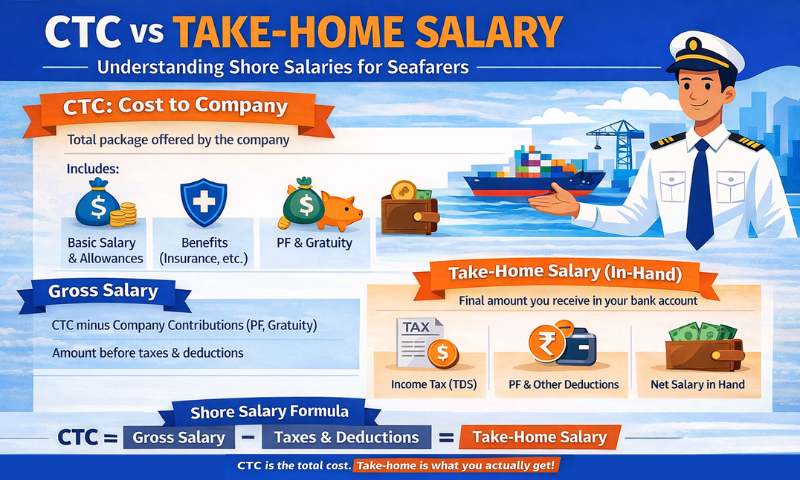
What is CTC (Cost to Company)?
CTC stands for Cost to Company
It represents the total annual amount a company spends to employ you.
Many professionals assume CTC is their salary. In reality, it includes several components beyond what you actually receive as monthly income.
Typical elements included in CTC are:
Direct Salary Components
These are parts of the salary that are paid to you.
- Basic Salary
- House Rent Allowance (HRA)
- Special Allowance
- Leave Travel Allowance (LTA)
- Performance bonuses or incentives
- Medical allowance
Indirect Benefits
Some benefits are included in your CTC but are not paid as cash.
Examples include:
- Health insurance coverage
- Corporate benefits
- Interest-free employee loans
Long-Term Savings Contributions
These are retirement-related contributions made by the company.
Examples include:
- Employee Provident Fund (EPF)
- Gratuity
- Superannuation benefits
All these components together make up the CTC offered by the employer.
What is Gross Salary?
Gross salary is the salary before deductions like income tax and employee contributions.
In many companies:
Gross Salary = CTC – Employer contributions (PF, gratuity, etc.)
Gross salary usually includes:
- Basic salary
- HRA
- Special allowances
- Bonuses
This amount forms the basis for tax calculations.
However, this is still not your final take-home salary.
What is Take-Home Salary (In-Hand Salary)?
Take-home salary is the actual amount credited to your bank account each month.
It is calculated after several deductions are made.
Common deductions include:
- Income tax (TDS – Tax Deducted at Source)
- Employee Provident Fund contribution
- Professional tax (in some states)
- Insurance or company policy deductions
The formula is simple:
Take-Home Salary = Gross Salary – Taxes – Other Deductions
This is the number you should focus on when evaluating a job offer.
Example: CTC vs Take-Home Salary (only for illustration, actual taxes/deduction maybe different)
Let’s consider a simplified example.
If a company offers ₹25 lakh per annum (LPA) CTC, the breakdown could look like this:
| Salary Component | Amount |
|---|---|
| Annual CTC | ₹25,00,000 |
| Basic Salary | ₹12,50,000 |
| PF Contribution | ₹3,00,000 |
| Gratuity | ₹1,22,500 |
| Allowances (HRA, medical, etc.) | ₹8,27,500 |
| Gross Salary | ₹20,77,500 |
After deductions and taxes:
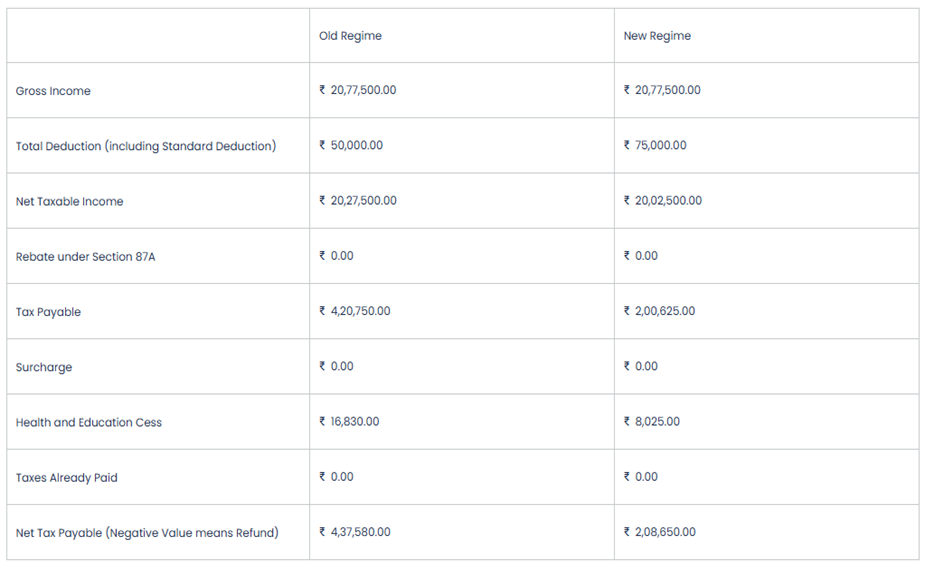
This results in a monthly take-home salary of approximately:
₹1.36 lakh per month to 1.5 lakh per month (depending on old/new regime)
Even though the offered CTC is ₹25 lakh, the amount credited monthly is significantly lower.
Key Things Seafarers Should Check Before Accepting a Shore Job Offer
When evaluating a shore job offer, focus on more than just the headline salary.
1. Ask for the Monthly Take-Home Salary
This helps you understand your real income.
2. Request a Detailed Salary Breakup
Ask the employer to share:
- Basic salary
- Allowances
- PF contribution
- Gratuity
3. Understand the Tax Impact
Higher CTC often means higher tax deductions.
4. Check Variable Pay
Some companies include performance bonuses in CTC, which may not be guaranteed.
5. Evaluate Benefits
Benefits such as medical insurance, retirement contributions, and allowances can add significant value.
Final Thoughts: Understanding Your Shore Salary
Transitioning from sea to shore is an exciting phase in a maritime career. But financially, it requires understanding a new salary structure.
Remember these key points:
- CTC is the total cost of employing you
- Gross salary is before tax deductions
- Take-home salary is the amount you actually receive
For maritime professionals moving ashore, understanding these concepts helps you negotiate better offers, plan your finances, and make informed career decisions.



Sea and Beyond
At Sea and Beyond we strive for authenticity and honesty in our work. Our mission is to help “You take a well informed decision” and we try and support you through our various services like
- Mentoring
- Skill enhancement/Education
- Job Opportunities and
- Your branding (CV and LinkedIn preparation)
We have a team of writers who conduct thorough research to ensure the accuracy of the content and for the clarity in communication. We will be happy to support you wherever required
Leave a comment
View more
Give your career a boost with S&B professional services.
CV Prep/Evaluation Prep Service
 SeaCommerce
Shop maritime books & essentials
DG Medical Examiners
Find approved doctors near you
Tools & Calculators
Free maritime tools for seafarers
More Jobs
Ship management
Mumbai
Vessel Performance Analyst..
Ship management
Mumbai
Vessel Performance Enginee..
Ship management
Mumbai
Voyage Optimisation Manage..
Interview Prep/Mentoring
Find your polestar with the host of experts available on our platform
Know more

Contact Us