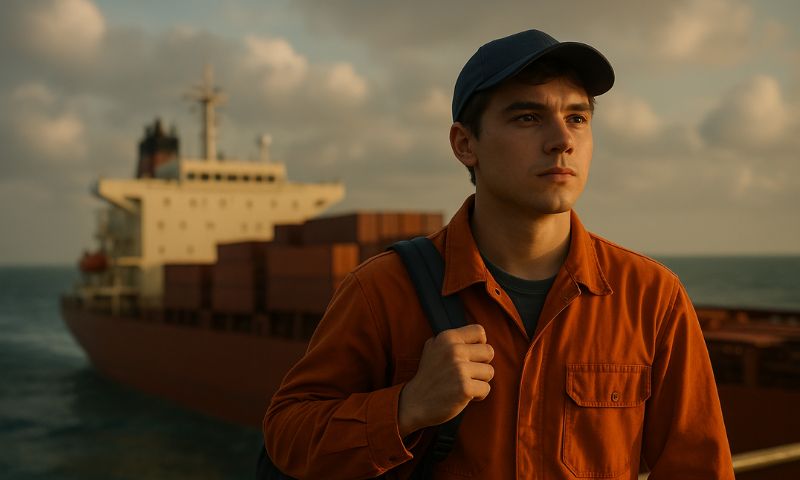
Decoding the Young Generation of Seafarers
 Capt. Debashis Basu
02 Jul 2025
6444 view
4
0 Comment
It was 1998. I was 18 and had just landed on my first ship.
Life was different. Unapologetic work hours, no communication with the outside world and continuous rolling of the North Atlantic winters seemed harsh. Most of the time, our seniors had neither the time nor the intention to speak to us. One day, however, in the morning watch, my Chief Officer empathised. He said,
“Son, your home is this neat, manicured garden. Everybody loves you; it’s prim and proper, you have help when you need it, and you can maintain it the way you want. The ship is like a forest; it is unruly and unapologetic, and many times, you are your own plumber, your own electrician. I have even been my own cobbler. It is not always perfect, but just like a forest, it is beautiful because it is not perfect, it is real, it prepares you for a journey that is far more exciting.
It is not “just another job.”
That analogy stuck with me; it made sense.
The Great Misunderstanding
Life at sea cannot be compared with any other. While shipping still moves 90% of world trade, the perception of a career at sea is shifting—and not in our favour. The present generation very often does not see shipping as a career of choice. But are we giving them the right environment to thrive and succeed in this profession?
Let’s face it—we’ve all heard the whispers: “These young ones don’t have what it takes.” Or maybe—comments about their screen addiction, attention spans and “lack of seriousness.”
What if we never understood their triggers and strengths?
This article is an invitation to step back and take a closer look at what’s really going on. The generational gap isn’t widening, it’s closing. We’re just now learning to speak the same language. Once we do, something remarkable happens.
They thrive, and so do we.
[These are not just ideas; they stem from our in-depth research on this generation, which has led us to create actionable tools that are currently being used by thousands of seafarers.]
The Problem Isn’t Them. It’s Us. (And That’s a Good Thing)
The modern seafarer doesn’t lack passion or intelligence. We lack a structure that suits them.
The systems we have—of leadership, training, reporting, and mentorship—are based on assumptions from the 1980s. Back then, we performed by watching others, sitting through long lectures, and reading massive circulars. Those were the only options. And it worked. Sort of.
Now, we have a generation that is accustomed to the immediate knowledge transfer from YouTube and Google, the constant validation of social media, and video games that reward problem-solving in real-time. They expect purpose, relevance, autonomy, and fairness in the workplace. And when they get pushback, disengagement creeps in.
This isn’t rebellion. It’s a mismatched design.

Five fundamentals we often get wrong
Without being judgmental, let us understand the thought process of the present generation of seafarers and bust a couple of myths that are costing us money, trust and time.
1. We are visual communicators.
One of the biggest myths we perpetuate is that "checklists rock" and "written text is the only way to guide the younger generation in performing. 99% of information conveyed to ships is text-based- Checklists, Manuals, PMS, SMS, Safety Circulars, vetting bulletins, emails and so on. Let’s face it - people don't like to read when audio-visual information is readily available for every other aspect of their lives. Then again, you cannot show an application skill, such as tying a knot, using only text.
Visual performance instructions, using microlearning, storytelling, and mobile-first design, appeal to the young minds and convey a lot more information in a short time.
2. We need smarter mentoring tools
While direct mentorship from a senior is the most effective way to learn, it often doesn't occur due to language barriers, cultural differences, time constraints, busy schedules, or a lack of interest. Today's generation has grown up with instant validation – every like, every blue tick is a dopamine hit when thrown into an environment where a senior shouts at them, they're far less likely to ask questions.
There are smarter ways of knowledge transfer that we can use. We are working on smart apps and AI-based mentoring tools, and already showing incredible results.
3. We Seek Relevance: Let’s Flip the Narrative
The young seafarer is often looking for relevance in the workplace.“Do I matter here?”
Reverse mentoring—where the younger crew shares operational insights with seniors—it often builds mutual respect faster than traditional top-down models. And here’s a bold thought: while we spend hours discussing near misses, what if we spent equal time analysing what went right? A Chief Officer just completed a mooring station in record time with perfect coordination. Let us see what went right here. Can we learn from it?
Celebrating success isn’t vanity; it’s validation. And to the young mariner, that’s cool. Because nothing’s more motivating than knowing you made a difference.
4. We Seek Autonomy: Let Them Choose Their Journey
Holding attention is the most challenging task, isn’t it? How do we grab attention?
This generation has grown up customising everything—from playlists to career paths. Generic, cookie-cutter approaches may not work very well for them. Gen-Z engages better when they have control. In the context of training, self-paced, skill-based development pathways with options to dig deeper where curiosity strikes, and adaptive learning paths—where content evolves based on performance — are far more interesting and compelling. When learning feels like a journey you designed yourself, ownership follows. And with it, absolute mastery.
5. Technology Without Empathy is Just Noise
One of the biggest myths that costs us unproductive time and money is our belief that Technology itself fascinates the younger generation. See, technology amazes us only when we have lived in the era before that tech existed. My two-year-old son is not fascinated by seeing his father on the phone; that is not technology; to him, that's how phones work! So, just because you've spent two million dollars implementing the best Virtual reality glasses, produced a 3D Animation video, or developed an AI assistant, it doesn't make it any more interesting. Without the right context, it can become really boring really soon.
When tech is paired with task-specific use-cases, relevant gamification, and instant application, it clicks. Literally and metaphorically. For Gen Z, it's purpose-driven tech that works.
Why is the industry Resistant?
Smart options to optimise work environments exist. But they are not implemented easily. Not everyone’s ready to throw out the old playbook. Common barriers include:
● Cost concerns (“Is it really mandatory yet?”)
● Cultural inertia (“This is how we’ve always done it”).
● Fear of digital overwhelm (“I am not that tech savvy.”)
We don’t need to overhaul everything overnight. Start with pilots. Use a hybrid model. Empower one department to experiment. You just need the willingness to give it a shot.

The magic potion: A sense of pride & purpose
Here is something that cuts through generations.
When we went out to sea, life was tougher. Calling home was a luxury. We were on floating islands thousands of miles from civilisation. But on those days when we were about to give up, there was something that kept many of us going. It was called a sense poride. This feeling that I was part of a bigger purpose, a small cog in a large machine driving the world economy.
In the age of social media, as the world becomes a smaller place, we feel the need to compare lives and regret what we do not have. I believe in the bargain; it is tough for the younger generation to develop a sense of pride in the profession.
If we make a conscious effort to bring it back, a number of problems could get resolved. If we aspire to build a generation of seafarers who are loyal to the profession, simply paying them more or reducing workload won’t do it. That is extrinsic motivation, and while it has a role, a far more effective approach is to create work environments that are inherently meaningful, where people take pride in their jobs, even if they aren't easy. So,
To the Young Seafarers
If you are a young seafarer reading this, take a step back from your phone for an hour or two during your off-duty hours. Look around. You're hundreds of miles from home, on your own. You're waking up to breathtaking sunrises and sunsets, breathing the freshest air, and having great food. Your quality of life is better than most CEO’s.
You are working with diverse cultures, which supercharges your emotional intelligence. In ten years, you will realise the value of a strong EQ. The challenges you face, while they seem bitter, are moulding you into champions for life. This environment is uncompromising, and just like the ruthless nature of a forest, it is incredibly enriching and fulfilling.
As someone who has spent over 25 years at sea, I can tell you there's no other profession I'd rather be in. When you are on watch, you are in charge of a billion-dollar asset and several lives on board. That is more than any other profession in the world will entrust you with. So, find your own reason to be proud. This profession provides all the ingredients to become a truly well-rounded human being.
Final Thought: We Are All in Transition
The world needs seafarers, but not just any seafarers – we need sharp, passionate, purpose-driven youngsters. So we need to start meeting them where they are. The truth is, Gen Z didn’t change the rules. They just reminded us that systems must evolve.
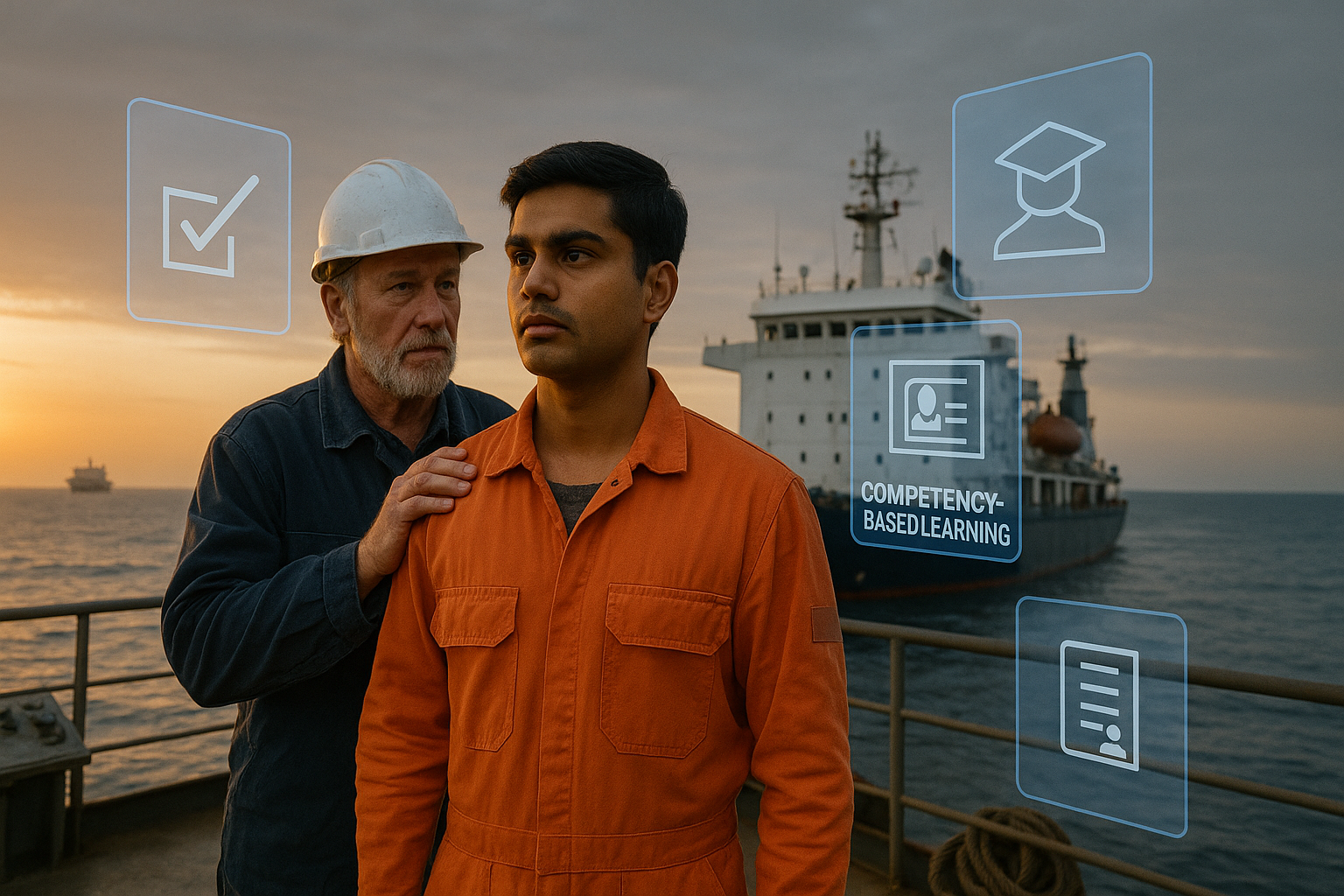
Let’s not try to fit them into our mould. Let’s build a better mold. The future belongs to those who can bridge generations—not by asking Gen-Z to “toughen up,” but by helping the system smarten up. It’s only a matter of time before competence-based onboarding and mentorship systems become the norm. Can we turn this ship around together?
Because, as my Chief Officer made me realise in 1998, it is more than “just another job”.


Capt. Debashis Basu
Capt. Debashis Basu is a maritime innovation leader and founder of Navguide Solutions, a company dedicated to transforming on-the-job training and inspection readiness for seafarers. Since 2019, he has worked closely with QSHE and Training departments across the industry to improve vessel performance in SIRE 2.0, Port State Control, RightShip, and other key audits.
With a passion for connecting training to real-world outcomes, he has pioneered the use of microlearning tools—short videos, games, pictorial modules, and mobile apps—to make learning engaging and effective for today’s mariners. His flagship product, Guide2Inspections, blends mentorship with inspection readiness and has been featured at global platforms including Intertanko, BIMCO, the Indian Ocean MOU, and IMO HTW sessions.
Known for his vision and commitment to elevating maritime competence, he has collaborated with leading organizations like Swire, K-Lines, Mitsui OSK Lines, and IMA Philippines. Beyond inspections, he is driving a broader mission: to modernize maritime training, enhance safety, and help ships remain compliant through meaningful, tech-enabled education.
Leave a comment
View more
Give your career a boost with S&B professional services.
CV Prep/Evaluation Prep Service
 SeaCommerce
Shop maritime books & essentials
DG Medical Examiners
Find approved doctors near you
Tools & Calculators
Free maritime tools for seafarers
More Jobs
Ship management
Gujarat
Operations Executive – Tra..
Agency and Logistics
Mumbai
Vessel Performance Analyst..
Sales and Marketing
Mumbai
Manager – Sales (ISO Tank)..
Interview Prep/Mentoring
Find your polestar with the host of experts available on our platform
Know more

Contact Us