
Land Acquisition for Large Port Projects in India
 Sea and Beyond
26 Feb 2026
660 view
0
0 Comment
Challenges, Past Experience, and the Way Forward to Win the Trust of Project Affected Persons (PAPs)
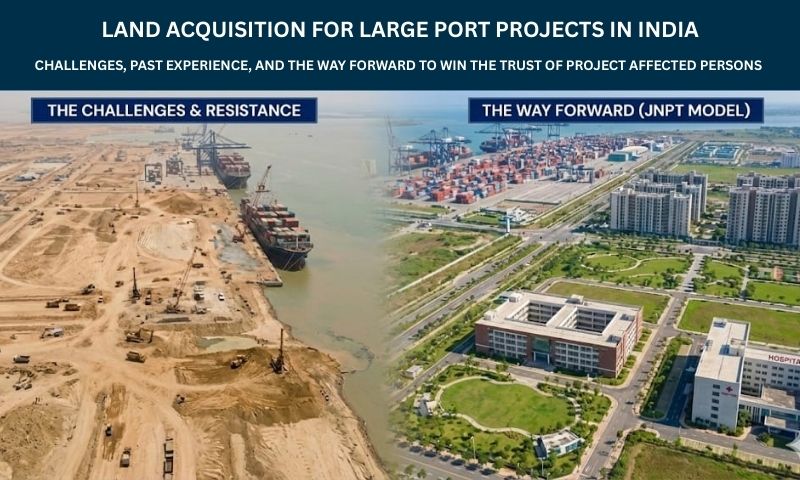
Land acquisition remains one of the most decisive—and sensitive—factors shaping the success of large port projects in India. While ports are engines of trade, employment, and regional development, their gestation is often delayed by social resistance, procedural hurdles, and deep trust deficits with Project Affected Persons (PAPs).
Drawing from India’s broader experience and the lived example of the Jawaharlal Nehru Port Trust (JNPT), this article reflects on why acquisition becomes contentious—and how it can be done better.
The Structural Challenges
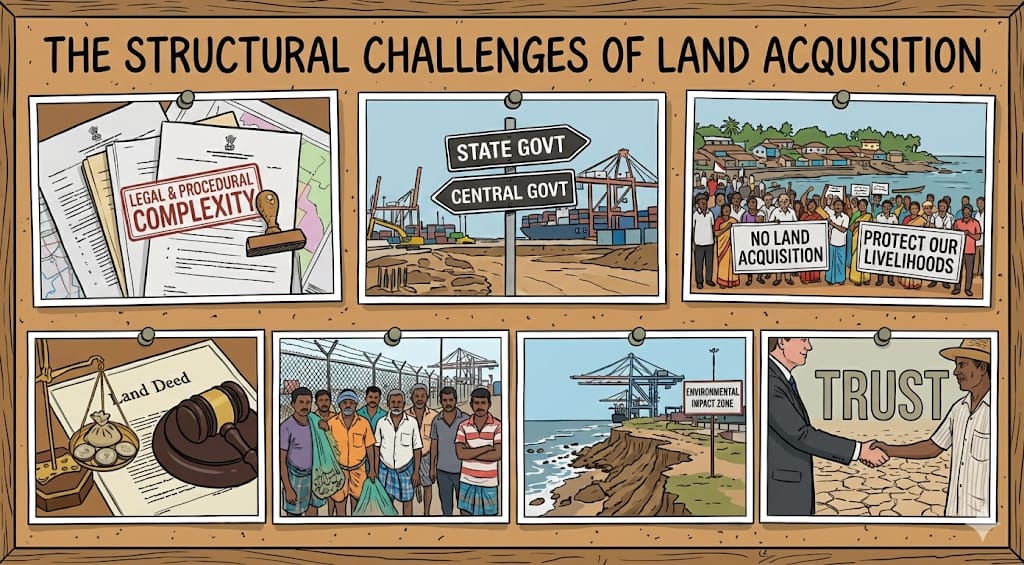
1. Legal and Procedural Complexity
Land acquisition in India is inherently slow. Fragmented landholdings, outdated land records, multiple claimants, and the elaborate requirements of the 2013 Land Acquisition Act—especially Social Impact Assessment (SIA) and consent clauses—extend timelines and uncertainty.
2. State–Centre Coordination Issues
While ports are of national importance, land remains a State subject. Misalignment between Central port authorities and State revenue machinery often results in avoidable delays and diffusion of accountability.
3. Resistance from Affected Communities
Farmers and fisherfolk fear loss of livelihood, cultural disruption, and an uncertain future. These anxieties frequently translate into protests, litigation, and political mobilisation against port projects.
4. Compensation Disputes
The gap between government-notified land values and prevailing market prices continues to be a major flashpoint, triggering opposition and prolonged court cases.
5. Livelihood Loss Beyond Landowners
Ports impact not just title holders but also fishermen, labourers, and small traders. When non-title holders feel excluded from rehabilitation frameworks, resentment deepens.
6. Environmental and Coastal Concerns
Perceived—or real—impacts on shoreline stability, fishing grounds, and coastal ecology amplify resistance, particularly in environmentally sensitive zones.
7. Trust Deficit with Authorities
Past experiences of delayed payments, broken promises, and poorly executed rehabilitation have left a legacy of distrust toward government-led acquisition efforts.
The JNPT Experience: A Different Path
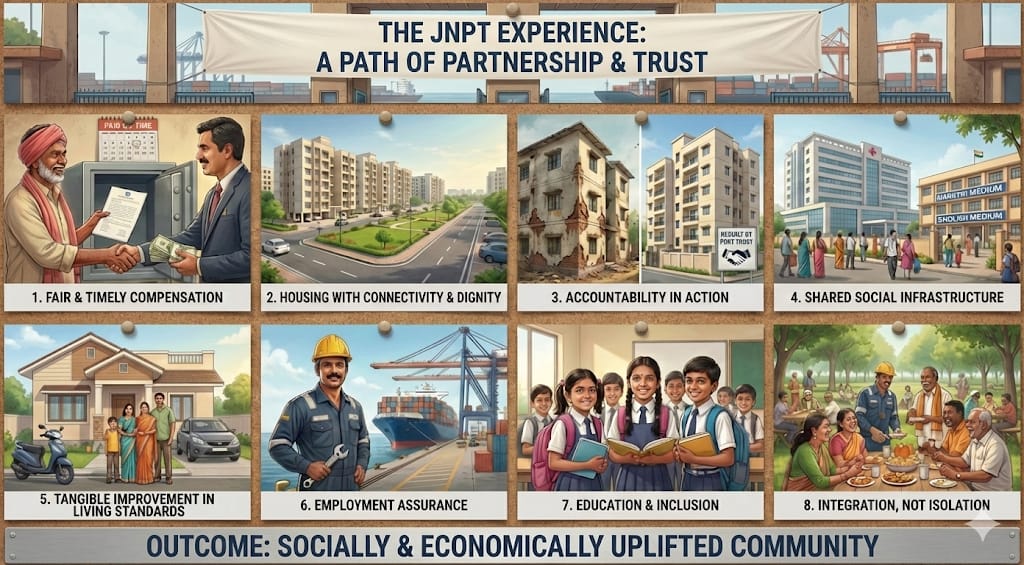
JNPT offers a rare and instructive counter-narrative—one where rehabilitation was treated not as a statutory obligation, but as a long-term social partnership.
Fair and Timely Financial Compensation
Generous compensation, delivered on time, reduced immediate hardship and resistance.
Housing with Connectivity and Dignity
PAPs were provided free housing with proper road connectivity, ensuring continuity of dignified living conditions rather than displacement into isolation.
Accountability in Action
When PAP housing was later found infested with white ants, the Port Trust accepted responsibility, relocated families, and rebuilt the entire housing complex at a new site. This single act did more to build credibility than any policy document ever could.
Shared Social Infrastructure
Hospitals, Marathi-medium schools, and English-medium schools—originally meant for port employees—were made available to PAPs at nominal cost, integrating them into the port township ecosystem.
Tangible Improvement in Living Standards
Every PAP household owned at least a two-wheeler; some even owned cars—clear indicators of economic upliftment after port development.
Employment Assurance
At least one member from each PAP family was provided employment in the port, offering long-term income security rather than one-time compensation.
Education and Inclusion
Every child, including the girl child, attended school—demonstrating genuine, inclusive, and generational social development.
Integration, Not Isolation
PAPs were not treated as outsiders. They became part of the port community, sharing facilities, services, and opportunities.
The outcome was unambiguous: PAPs were socially, economically, and professionally far better off than before the port came up.
Key Lessons
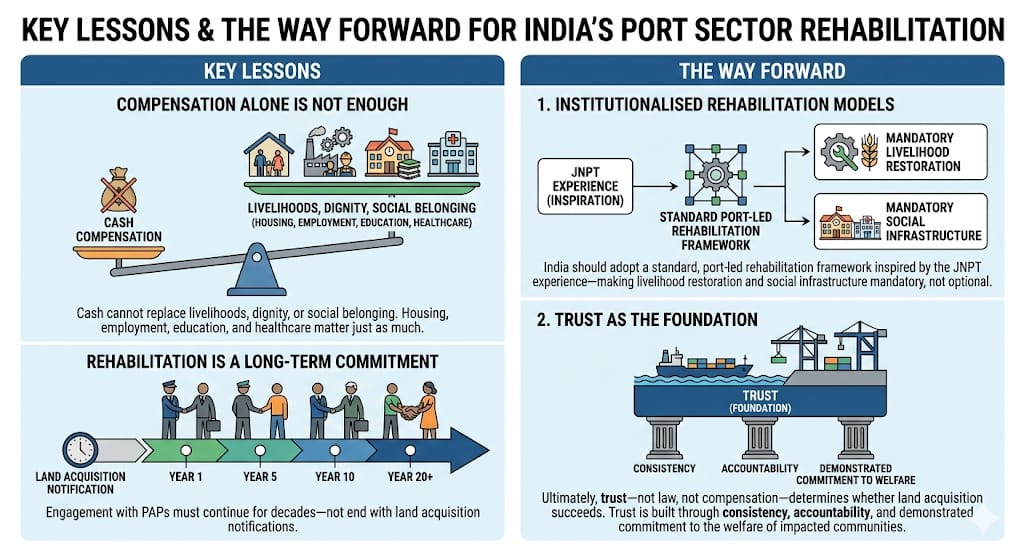
- Compensation Alone Is Not Enough
Cash cannot replace livelihoods, dignity, or social belonging. Housing, employment, education, and healthcare matter just as much. - Rehabilitation Is a Long-Term Commitment
Engagement with PAPs must continue for decades—not end with land acquisition notifications.
The Way Forward for India’s Port Sector
1. Institutionalised Rehabilitation Models
India should adopt a standard, port-led rehabilitation framework inspired by the JNPT experience—making livelihood restoration and social infrastructure mandatory, not optional.
2. Trust as the Foundation
Ultimately, trust—not law, not compensation—determines whether land acquisition succeeds. Trust is built through consistency, accountability, and demonstrated commitment to the welfare of impacted communities.



Sea and Beyond
At Sea and Beyond we strive for authenticity and honesty in our work. Our mission is to help “You take a well informed decision” and we try and support you through our various services like
- Mentoring
- Skill enhancement/Education
- Job Opportunities and
- Your branding (CV and LinkedIn preparation)
We have a team of writers who conduct thorough research to ensure the accuracy of the content and for the clarity in communication. We will be happy to support you wherever required
Leave a comment
View more
Give your career a boost with S&B professional services.
CV Prep/Evaluation Prep Service
 SeaCommerce
Shop maritime books & essentials
DG Medical Examiners
Find approved doctors near you
Tools & Calculators
Free maritime tools for seafarers
More Jobs
Marine tech
Mumbai
Project Engineer – Marine ..
Marine tech
Mumbai
Project Engineer – Mechani..
Ship management
Mumbai
Vessel Performance Analyst..
Interview Prep/Mentoring
Find your polestar with the host of experts available on our platform
Know more

Contact Us