
Maritime vs Aviation Certification: Why One Stays Ahead of Risk
 Capt. M. M Saggi
21 Jan 2026
2321 view
0
0 Comment
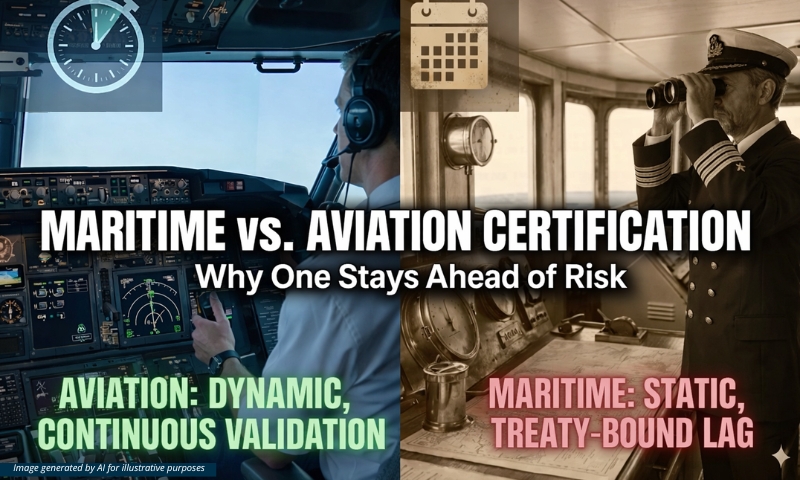
Safety in both shipping and aviation depends on people as much as technology. Yet when we compare how the two industries certify, assess, and maintain competence, a stark difference emerges: aviation operates a dynamic, continuously validated system, while maritime certification remains largely static and treaty-bound. This gap has profound safety implications.
Two Industries, One Goal — Different Architectures
Both sectors share the same purpose: safe operation and protection of life and assets.
However, their regulatory foundations differ fundamentally.
- Maritime certification is governed by the International Maritime Organization through the STCW Convention — a legally binding treaty with slow amendment cycles.
- Aviation certification is shaped by the International Civil Aviation Organization, under the Chicago Convention, using flexible Standards and Recommended Practices (SARPs) that can be updated and enforced within months.
The result: aviation adapts quickly to emerging risks; maritime often lags by a decade or more.
Licensing Philosophy: Static vs Perishable Competence
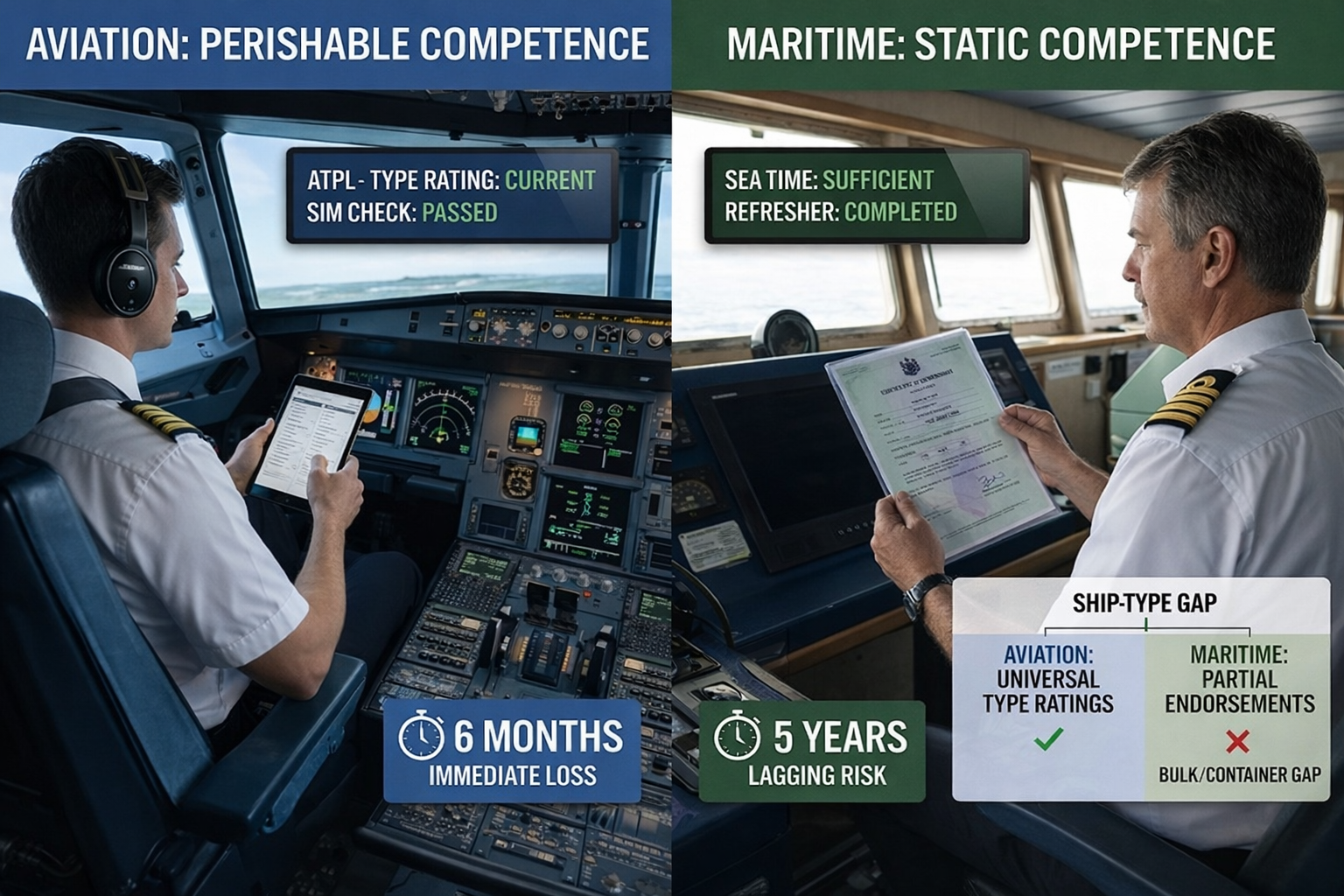
In aviation, competence is treated as perishable:
- Pilots are licensed (PPL, CPL, ATPL) with type ratings for every aircraft.
- Authority depends on recent simulator checks, line checks, and medicals.
- Failure means immediate loss of operational privilege.
In maritime:
- Officers hold a Certificate of Competency (CoC), typically valid for five years.
- Revalidation relies on sea time, medical fitness, and refresher courses.
- Certificates often remain valid despite major changes in ship technology or operating risk.
The Ship-Type Gap: A Critical Weakness
Aviation enforces mandatory type ratings for every complex aircraft.
Maritime does this only partially.
- Tankers, gas ships, DP vessels, and polar ships require endorsements.
- Bulk carriers and container ships — despite huge risk exposure — do not.
This leaves a major competence gap, with ship-specific training often left to employers under the ISM Code, where cost pressure can dilute intent.
Assessment & Revalidation: Frequency Matters
| Area | Aviation | Maritime |
|---|---|---|
| Licence renewal | 6–12 months | 5 years |
| Simulator checks | Mandatory & frequent | Limited / inconsistent |
| Line checks | Mandatory | Rare |
| Loss of privilege on failure | Immediate | Often delayed |
| Integration of new risk | Continuous | Decade-scale |
Aviation maintains real-time alignment between competence and risk.
Maritime allows standards to trail reality by 10–20 years.
Human Factors: Embedded vs Compliance-Driven
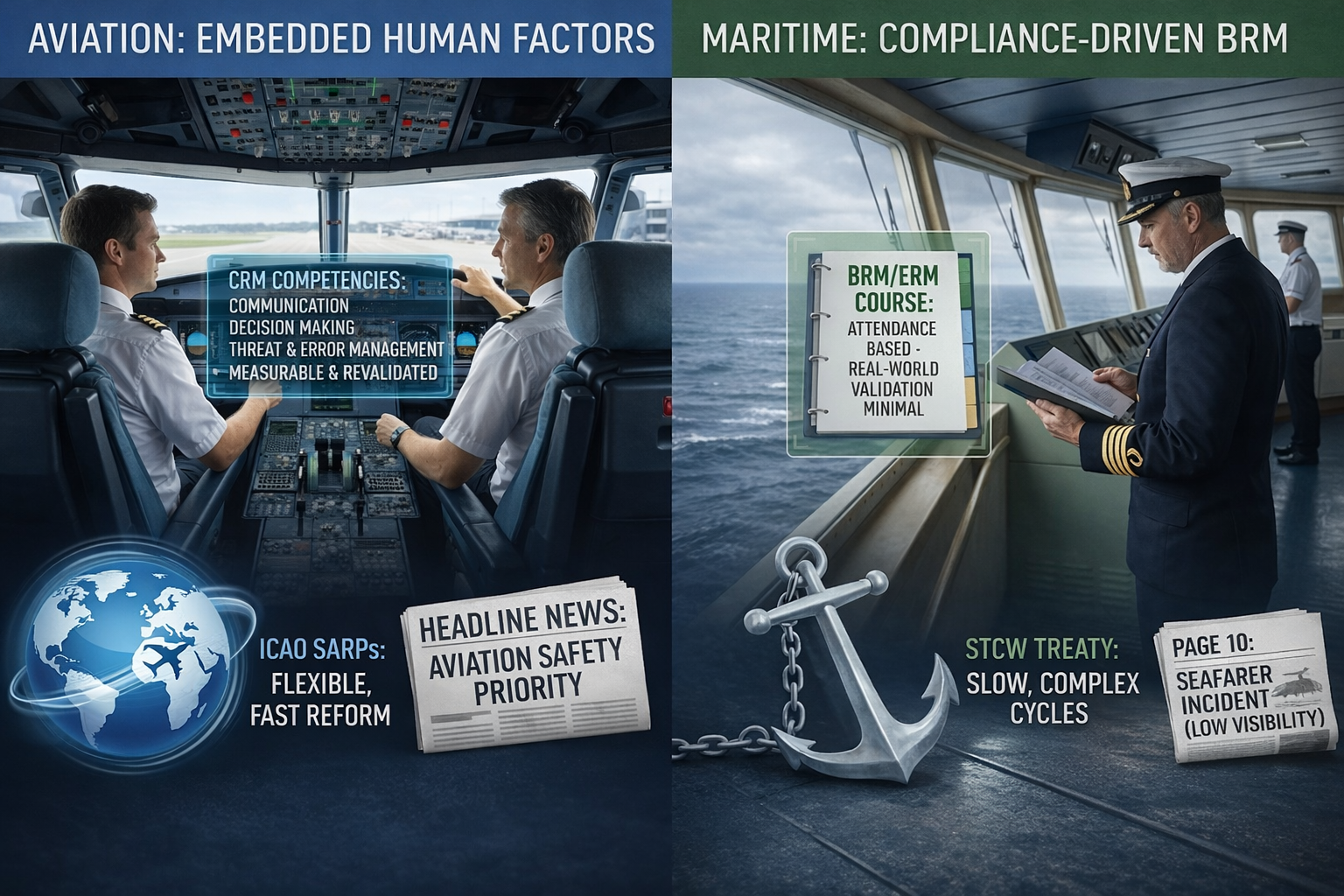
Aviation has fully institutionalised Crew Resource Management (CRM):
- Behavioural skills are trained, assessed, and revalidated.
- Communication, decision-making, authority gradient control, and Threat & Error Management are measurable competencies.
Maritime adopted BRM and ERM from aviation, but:
- Implementation is inconsistent.
- Assessment is largely course-based.
- Real-world behavioural validation remains minimal.
Why Maritime Reform Is So Slow
The reasons are structural:
- Treaty-based regulation (STCW) vs flexible frameworks (ICAO SARPs)
- Slow national legal adoption
- Complex stakeholder landscape (flags, unions, owners, trainers)
- Long certification cycles
- Shipboard-dependent training models
- Lower public visibility of seafarer casualties
In aviation, loss of life makes headlines and ends businesses. Pressure for rapid reform is unavoidable.
The Way Forward
For maritime safety to match aviation’s resilience, certification must evolve:
- From static compliance to dynamic competence management
- From infrequent renewal to high-frequency simulator revalidation
- From course attendance to behavioural assessment
- From partial endorsements to universal ship-type qualification
- With immediate suspension of privileges when competence is not demonstrated
Until then, maritime will continue to operate with a dangerous lag between what officers are certified for and what ships actually demand.



Capt. M. M Saggi
One of the most respected and revered name in the maritime industry who has an holistic overview of how overall shipping functions at the world level as well as within India. Master Mariner (F.G), Extra master and MBA.
Ex-Director at Narottam Morajee Institute of Shipping, Ex-Nautical Advisor to govt. of India, Ex Additional Director General of Shipping, Ex Chief Examiner of mates,masters and extra masters. Ex Country head of casualty investigation. Lead Indian delegation to Maritime Safety Committee of IMO and International Oil Pollution Compensation fund meetings. Ex Trustee Mumbai, JNPT and Kandla Port
Leave a comment
View more
Give your career a boost with S&B professional services.
CV Prep/Evaluation Prep Service
 SeaCommerce
Shop maritime books & essentials
DG Medical Examiners
Find approved doctors near you
Tools & Calculators
Free maritime tools for seafarers
More Jobs
Ship management
Gujarat
Operations Executive – Tra..
Agency and Logistics
Mumbai
Vessel Performance Analyst..
Sales and Marketing
Mumbai
Manager – Sales (ISO Tank)..
Interview Prep/Mentoring
Find your polestar with the host of experts available on our platform
Know more

Contact Us