
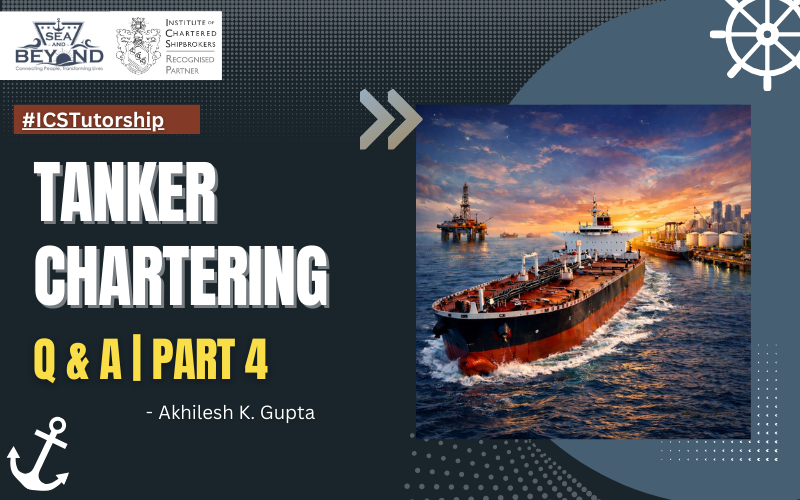
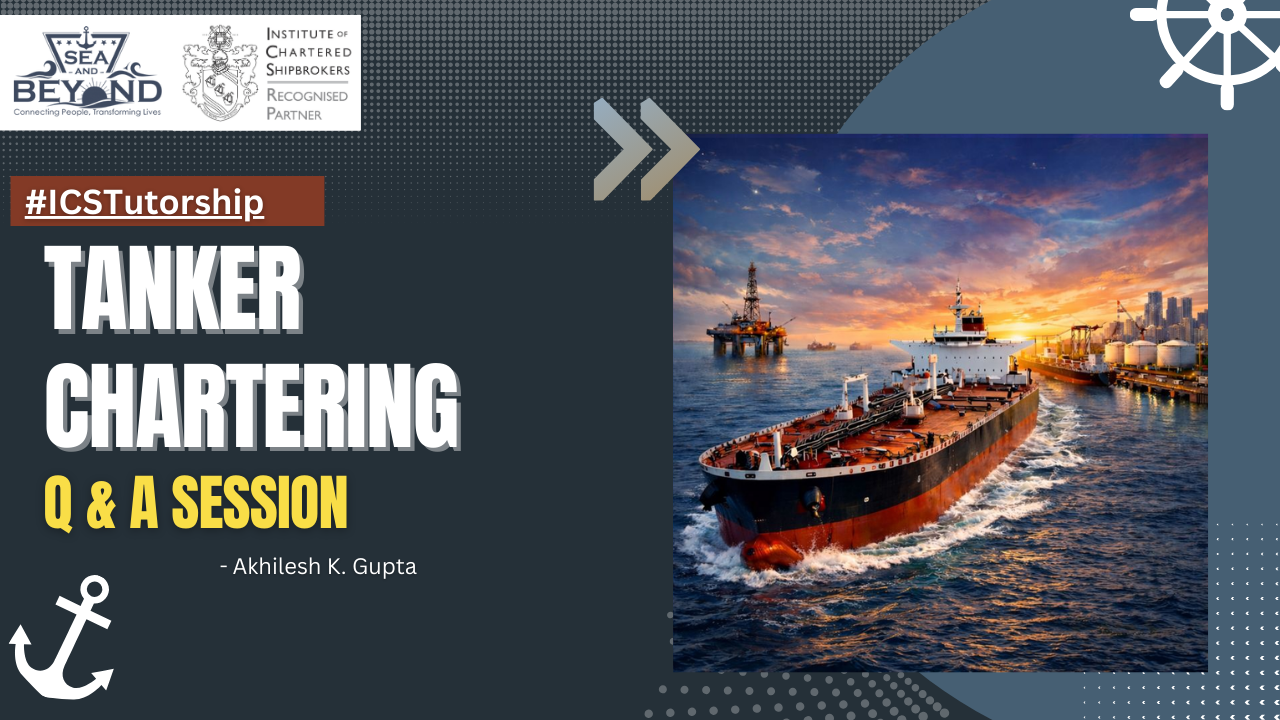
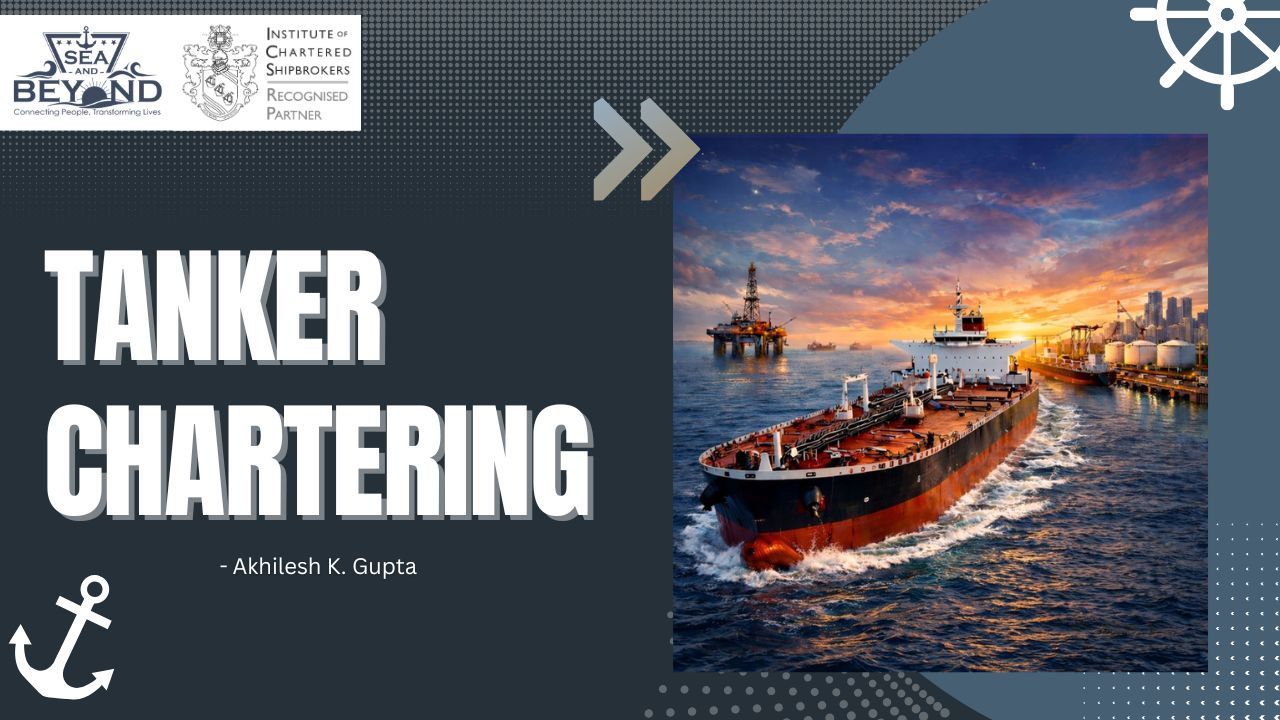
The ICS Tutorship on Tanker Chartering, conducted by Capt. Akhilesh Gupta, is a structured video-based learning programme designed specifically for students preparing for the Institute of Chartered Shipbrokers (ICS) examinations.
This ICS Tanker Chartering course is ideal for aspiring shipbrokers, seafarers transitioning to shore-based commercial roles, and maritime professionals seeking a clear, exam-focused understanding of tanker chartering and oil market operations.
Delivered through 10 comprehensive recorded video chapters, along with 4 dedicated videos on answer-writing guidance, the course ensures complete coverage of the official ICS Tanker Chartering syllabus, while making complex commercial and regulatory concepts easy to grasp through practical, real-world explanations.
To succeed in the ICS Tanker Chartering exam, candidates must bridge the gap between theoretical regulations and the fast-paced realities of the global oil market. This course, led by Capt. Akhilesh Gupta, is designed to transform students into practitioners by providing the commercial logic, context, and professional perspective that ICS examiners look for.
Your Learning Journey in This Tanker Chartering Course
Here is an overview of your learning journey through the Tanker Chartering modules, designed to prepare you for the ICS Tanker Chartering examination.
The Pulse of the Oil Market
Your journey begins with the big picture. You won’t just learn about oil; you’ll understand the geopolitical forces that move it.
- Global Flow: Explore the major trade routes and the critical chokepoints, such as Hormuz and Malacca, that define global energy security.
- Refining & Regulation: Understand the distillation process from crude to clean products and how environmental legislation such as MARPOL and OPA 90 reshaped the tanker industry.
The Vessel: Design, Capacity, and Vetting
A tanker is a specialized commercial tool, and a charterer must understand exactly what that tool can deliver.
- Ship Architecture: Learn vessel construction basics, size classifications from Panamax to VLCC, and cargo capacity planning.
- Vetting: Understand SIRE inspections and oil company vetting procedures that determine whether a vessel is commercially acceptable.
The Math of Profit: Worldscale and Estimating
In tanker chartering, freight is measured through Worldscale rather than flat rates.
- Worldscale Explained: Learn how base rates and differentials are calculated and applied in tanker fixtures.
- Voyage Estimation: Understand Time Charter Equivalent (TCE), break-even analysis, and voyage profitability calculations.
The Contractual Framework (Charter Parties)
The ICS examination places strong emphasis on charter party clauses and their commercial interpretation.
- Voyage Charters: Detailed study of ASBATANKVOY, including Laycan, Notice of Readiness, and owner–charterer obligations.
- Time Charters: In-depth analysis of SHELLTIME 4, covering hire, off-hire, performance, and dispute handling.
- Bareboat and Specialised Trades: Overview of BARECON and the commercial requirements of chemical and gas tanker operations.
The Art of the Deal and Execution
The course follows the complete commercial lifecycle of a tanker fixture.
- Negotiation: Learn firm offers, counter-offers, and the standard abbreviations used in tanker brokerage.
- Post-Fixture Operations: Understand laytime, demurrage, Statements of Facts, and dispute resolution at ports.
How This Course Helps You Ace the ICS Exam
- Professional Perspective: Learn to write answers with commercial reasoning rather than textbook repetition.
- Real Case Application: Practical examples make charter party clauses easier to understand and explain.
- Exam-Focused Coverage: Priority is given to high-scoring syllabus areas such as Worldscale, vetting, charter parties, and laytime.
This course is not just an exam preparation tool; it is a professional mentorship that equips candidates with the confidence and commercial mindset expected of tanker chartering professionals.

Akhilesh K. Gupta
Akhilesh K. Gupta is a tanker chartering and commercial shipping professional with over 20 years of diversified experience of Shipboard operations, Tanker Chartering support, Demurrage & Claims, Voyage economics, and Digital Innovation.
In recent years, Akhilesh has led next-generation Digital platforms covering:
- Laytime & demurrage, Charter party
- Scoring framework for asset optimization
- Data-driven decision-making tools for stakeholders
He currently works at the intersection of tanker commercial operations, voyage management, and digital maritime risk platforms, giving an excellent combination of pre fixture, post fixture, ship management, and data-driven decision making for business transformation.
Teaching & Tutorship Strength
As a Tanker Chartering Tutor, his approach is:
- Subject and practice-driven
- Strong focus on tanker CP clauses, recaps, case studies, and dispute resolution discussion
- Bridging vessel and clause understanding, to enhance chartering perspective
Rating:
Price:
₹ 14999
Language:
English
Length:
11:51:00
Intended for:
Reference:
Topics:
11 Sections . 32 lectures . 11h 51m total length
20 min
1.1 Chapter 1 | Oil Tanker, Oil Trade, Marpol
Oil tanker trade routes, Geography of Oil trade, consumers and producers of Oil, Chokepoints, cyclical nature of oil trade, Case study-price action, Future trends, Marpol Overview, OPA 90, Legislation impact on Oil trade,
7 min
1.2 Chapter 1 | Crude Oil, Fractional distillation
Extraction and refining of Crude Oil, Fractional distillation, Products from Crude Oil

9 min
2.1 Chapter 2 | Tanker trades, construction, tonnages
Tanker trades, construction, tonnages, Size classification, VLCC trade route,
21 min
2.2 Chapter 2 | Capacity plans & General Arrangement plans
Capacity plans and General Arrangement plans-Tankers
Case studies
14 min
2.3 Chapter 2 | Ship dimensions, DWAT and DWCC
Basic ship dimensions, DWAT and DWCC (deadweight cargo capacity), Gross and Net tonnage (GT & NT), Panamax tanker,Crude oil carriage, Crude oil tanker pumper systems, Safety systems in Crude oil trade,
Ship classification, SIRE inspections, Oil companies acceptance criteria,
20 min
2.4 Chapter 2 | SIRE inspections, Oil companies, vetting inspections
SIRE inspections, Oil companies acceptance criteria, Focus areas, commercial and safety impact of vetting inspections, Classification certification
20 min
3.1 Chapter 3 | Chemical tanker, tank coatings & cargoes, IMO
Chemical tanker, tank coatings and cargoes, Type of IMO class tanker (Chemical), chemical tanker case studies, Oil tanker cargoes, Product tankers, requirements for dirty cargoes, clean cargoes, LNG & LPG cargoes, Gas tankers, Cargo tank construction,
24 min
4.1 Chapter 4 | Shipping market stakeholders, Charterers
Shipping market stakeholders, Charterers, Ship owners, Operators, Oil companies, Trading companies, Broker’s role in chartering, One broker system, External factors affecting tanker market, Case studies,
30 min
5.1 Chapter 5 | Worldscale, Freight Calculation, Voyage
Worldscale and Freight calculation
Introduction to worldscale, WS structure & features, Freight calculation using WS, Adjustments & considerations,
Voyage Estimation, example of calculation, Key dispute resolution clauses, BIMCO Arbitration clause, Jurisdiction clause, Case study, Arbitration vs Litigation
28 min
5.2 Chapter 5 | Worldscale structure & purpose, Standard vessel
Worldscale(WS) structure & purpose, usage of WS, contents of WS flat rate calculations, Assumptions for- Distance, Standard vessel, speed, fuel consumption, port ops duration and consumptions, Port costs, Canal dues, Bunker pricing, Voyage structure, Cargo Qty, Financial parameters, OPEX, Loadline/Draft, Crewing/Manning,
Real vs WS model ship, Freight Formula, Different uses of WS by Owners & charterers, Limitations of WS,
Case study 1 to 5, Summary
19 min
5.3 Chapter 5 | Voyage Estimation in detail, Vessel particulars
Voyage Estimation in detail, Overview, Voyage definition, Vessel particulars, Voyage Distance, Voyage time, Fuel consumption, Port & Canal costs, Revenue calculation, Break even WS calculation,
Case study, Step by Step calculations for TCE, WS break even calculation, Summary
27 min
6.1 Chapter 6 | Tanker Time Charter party, SHELLTIME 4
Tanker Time Charter party in detail, SHELLTIME 4, TCP clauses,
Preamble, Vessel description, certificates, Duty to Maintain, Period of Hire, trading limits, Safe Places,Laydays,
46 min
6.2 Chapter 6 | Owners & Charterers to provide, Rate of hire
Tanker Time Charter party continued, Owners to provide, Charterers to provide, Rate of hire/Payment, Ballast, spaces available, Bill of Lading, Bunker delivery and redelivery, Pilots/tugs and stevedors, Sub-letting, Final voyage, Loss of vessel, Off hire, Drydocking,
37 min
6.3 Chapter 6 | SHELLTIME 4, Ship Inspection, speed & performance
Tanker Time Charter party, SHELLTIME 4, clause 23 onwards, Ship Inspection, speed and performance clause, salvage, Lien, Exceptions, Injurious cargoes, bunker grades, Laying up vessel, War/Addn’l war expenses, war risks, Both to blame clause, Jason Clause, Clause paramount, Insurance/ ITOPF clause, Oil major acceptability, Pollution emergency response, ISPS code, Law & litigation,
10 min
7.1 Chapter 7 | Tanker Voyage charter, Preamble, Laydays
Tanker Voyage charter C/P, Introduction, Preamble,
Part 1- Vessel description and other details incl Laydays, Freight, commission etc.
20 min
7.2 Chapter 7 | Warranty, Freight, Deadfreight, Laydays
Tanker Voyage charter C/P, Part 2- Warranty, Freight, Deadfreight, Load and Discharge port, Laydays, Notice of readiness, cargo Operation time, Demurrage, Shifting between berths, Loading/ Unloading rates, Mooring at Sea terminals, Dues, Taxes, Wharfage, Ice & Ice Impact, Consider two ports as one, Quarantine, Tank cleaning,
19 min
7.3 Chapter 7 | Gen Exceptions, Bills of lading terms
Tanker Voyage charter C/P, Gen Exceptions, Bill of lading terms, Clause Paramount, General Average, Both to Blame collision clause, Reference to COGSA, Lien, Breach of C/P, Arbitration costs and Jurisdiction, Right to Sublet, Oil Pollution clause, B/L details
17 min
8.1 Chapter 8 | Bareboat chartering, Demise charter
Introduction to Bareboat chartering, Key features of Demise charter, Comparison between Bareboat/time & voyage charter
Barecon 2001 and 2017, Case studies related to Bareboat charter, Key takeaways and Best practices
15 min
8.2 Chapter 8 | Owner’s cost base, Capital costs, OPEX
Owner’s & Disponent owners, definitions, Owner’s cost base, Capital costs, OPEX, OPEX benchmarks, Voyage costs,
Disponent Owner overview, Disponent owner cost base, Voyage costs, Commissions,
Break even calculations, WS break even calculations, commercial interpretation, Case study 1 to 5, Cost impact,
12 min
9.1 Chapter 9 | Tanker fixing process, offers & negotiations
Tanker fixing process, offers & negotiations, Voyage charter offer,Time charter offer, Case studies,
25 min
9.2 Chapter 9 | Tanker fixture negotiations, Cargo Details, laycan
Tanker fixture negotiations, Details required, Cargo Details, Load/Disch port details, laycan, Limitations, Port rotations, Documents needed, Vessel requirement, CP terms, Preparing a Quote, Process of Voyage estimation, Case study
14 min
9.3 Chapter 9 | Offer negotiations, communication samples
Offer negotiations, communication samples, offer and counter offers, Subjects and Recaps,
17 min
9.4 Chapter 9 | Offer Negotiations, Example Firm Offer
Offer Negotiations, Example Firm Offer, Rejection offer, Counter Offer, Accept/Except, Acceptance,Order Issued, Firm offer, Re-offer, Recap Sent, Example of Calculation,
20 min
9.5 Chapter 9 | Customary Abbreviations
Customary Abbreviations used in Tanker chartering and Negotiations, with examples,
11 min
9.6 Chapter 9 | Legal requirements, Tactical requirements
Legal requirements in tanker chartering, Tactical requirements, Ethical requirements, Broker’s responsibility, Breach of warranty of authority,
12 min
9.7 Chapter 9 | Effect of E-commerce in shipping, Digital solutions
Effect of E-commerce in shipping, electronic solutions for brokers, Digital solutions, case studies,
Cargo delivery and Bill of Lading, wrongful delivery,
25 min
10.1 Chapter 10 | Notice of readiness clauses, Statement of Facts
Notice of readiness (NOR) clauses, Key elements of a well drafted NOR clause, NOR Best practices, Issues & disputes, Case study
Statement of Facts (SOF), content of SOF, Laytime statement & calculations, Demurrage clauses & calculations,
32 min
10.2 Chapter 10 | Freight, Hire calculations, Charter agreements
Freight & Hire calculations, Types of charter agreements, World scale calculations, TC hire calculations, off hire deductions, Bareboat charter hire calculations, COA hire calculations, Comparison of Freight & hire systems, Timing of payments and due dates, Case study- World scale calculation, Hire default, Freight agreement dispute
Additional payments, deadfreight, Demurrage, Bunker payments, Ballast Bonus,
Commissions and brokerage, types of commissions, calculation of commission, Commission payment responsibility, Case studies-Brokerage
27 min
11.1 Q & A | Discussing Nov 2024 Question papers
Discussing Nov 2024 Question papers (Que 1 to 4)
Que 1- Default on hire payment by charterer, actions to follow?
Que 2- Compare the terms between COA and TC agreements?
Que 3- Making and labelling of LNG carrier cross section diagram. 2 main LNG trade routes to explain.
Que 4- Drafting Voy charter firm offer- Naphtha cargo
34 min
11.2 Q & A | Nov 2024 Question papers continued
Nov 2024 Question papers continued (Que 5 to 8)
Que 5:explain trading of 4 different grades of cargoes for tankers? Crude oil, Dirty petroleum, CPP, LPG
Que 6: Prepare detailed market report for crude oil trading, for your Principal:
Que 7: Prepare a firm offer for VLCC using WSHTC? Voyage US gulf to South Korea.
Que 8: When will a tanker be considered to be an arrived ship?
39 min
11.3 Q & A | Discussing May 2025 Question papers
Discussing May 2025 Question papers (Que 1 to 4)
Que 1: Draft firm offer for trip time charter, Suezmax
Que 2: Draft a cargo retention clause and describe why its needed?
Que 3: Compile a recap for VLCC, basis worldscale terms and conditions?
Que 4: Draw and label profile & cross section for a 90,000 MT CPP cargo tanker (LR2 Aframax vessel). Planned route and bunker ports/seca zone?
40 min
11.4 Q & A | May 2025 Question papers continued
Discussing May 2025 Question papers (Que 5 to 8)
Que 5: For a cargo of butane (VLGC), identify voyage estimate contents and Net daily surplus//TCE and break even rates
Que 6: Make a firm offer for Handymax tanker, 2-year TC and explain why long term charters are preferred?
Que 7: Prepare a market report for Shipowner about rapid increase in ship supply within LNG sector?
Que 8: Role of Bill of lading in a Jet fuel voyage? CP clauses supporting compliance with Hague-Visby rules
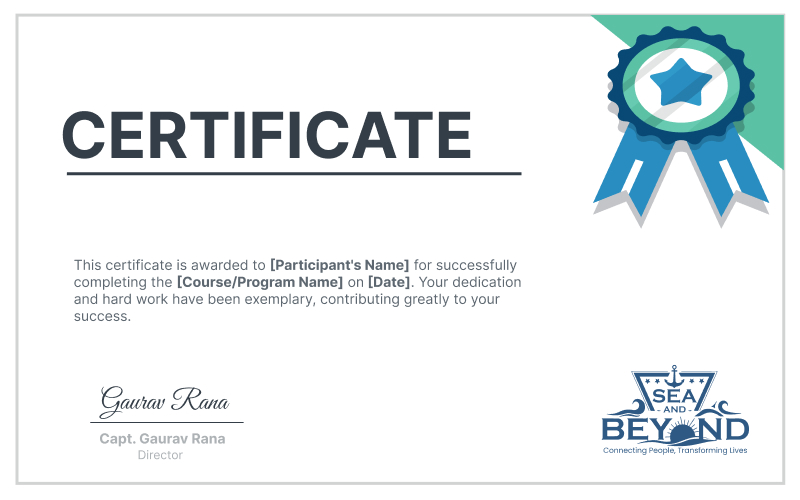
Successful completion of this course will earn you a certificate of completion from Sea and Beyond. This certificate will be emailed to you and you could also share and show it on LinkedIn Please click on the button below to purchase the certificate.
Similar Courses



Reviews...
Ravi Kapoor On Mar 6th 2026
I recently watched the vi....
Rachel Lee On Mar 17th 2026
Really very engaging sess....