
Shore Leave: The Vanishing Lifeline in Global Shipping

 Capt. Shawn Sequeira
19 Aug 2025
13750 view
0
0 Comment
Shore Leave: The Vanishing Lifeline in Global Shipping
Global trade thrives on speed, scale, and efficiency—but beneath this relentless drive is a largely unseen workforce of seafarers, whose sacrifices and silence sustain 90% of world commerce. Their welfare, long overlooked in policy discussions, now demands urgent and deliberate attention.
Yet, even as automation, digitalisation, and vessel sizes advance, one fundamental aspect of seafarer welfare is under unprecedented strain: shore leave.
Once a routine respite from life at sea, shore leave has become increasingly rare, caught in the crosscurrents of port security, geopolitical tensions, commercial pressures, and systemic shifts in port infrastructure. As this crucial right diminishes, the consequences are being felt acutely—not just in crew morale, but in mental health statistics, safety records, and legal compliance across the sector.
A Systemic Erosion of a Basic Right
Historically, shore leave has served as a vital decompression period, allowing seafarers to reconnect with normal life, seek medical attention, and enjoy fresh air beyond the steel confines of a vessel. But today, it is becoming a privilege few can count on.
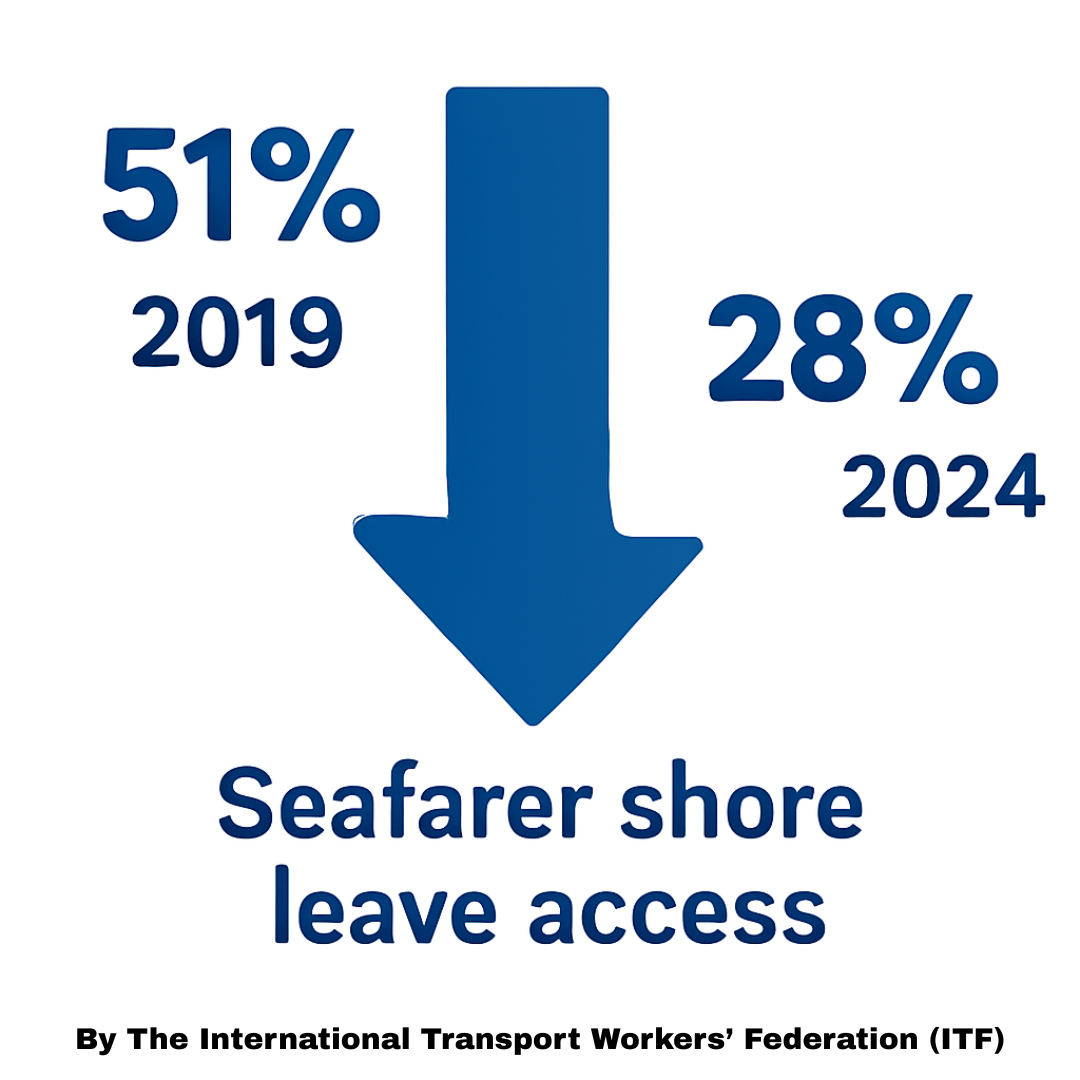
The International Transport Workers’ Federation (ITF) reported in late 2024 that only 28% of seafarers were regularly able to go ashore—a dramatic decline from 51% in 2019, before the pandemic. While COVID-19 restrictions catalysed the initial decline, the trend has persisted due to more entrenched factors:
- Accelerated port turnaround times, driven by tighter shipping schedules and just-in-time supply chain demands, leave little room for crew rest.
- Increased in-port operational demands, such as inspections, bunkering, and maintenance, often require seafarers to stay onboard.
- Mega-port development has shifted key terminals far from city centres, making shore leave logistically difficult and time-consuming.
- Stringent visa requirements and restrictive port state controls, especially in regions like the U.S. and China, have added bureaucratic and legal obstacles.
- Geo-political tensions, including piracy threats and regional instability (e.g., the Red Sea crisis or the Russia-Ukraine conflict), have prompted additional security protocols limiting crew mobility.
These aren’t temporary hiccups—they reflect deep structural changes in the shipping ecosystem that deprioritise crew welfare in pursuit of efficiency
The Hidden Human Cost
The implications of restricted shore leave reach far beyond rest and recreation. According to a 2024 global mental health study by the International Seafarers’ Welfare and Assistance Network (ISWAN), 56% of seafarers reported symptoms of anxiety or depression, with lack of shore leave cited as one of the top contributing factors. Alarmingly, the Seafarers Hospital Society also found that seafarers are twice as likely as shore-based workers to suffer from poor mental health.
One Chief Officer interviewed in a 2025 Seafarers’ Rights International (SRI) report put it bluntly: “I haven’t stepped foot on land for 142 days. It feels like the world outside has forgotten us.”
This is not just about emotional strain. Lack of shore leave contributes to:
- Increased fatigue and reduced alertness, linked to higher incident rates. The UK MAIB (Marine Accident Investigation Branch) has consistently flagged fatigue as a causal factor in maritime accidents.
- Delayed access to medical care, with potentially serious health outcomes. A 2023 study in The Lancet Global Health found untreated health conditions among seafarers increased by 37% during voyages with limited port access.
- Lower retention rates, especially among younger crew members, who cite mental health strain and isolation as key reasons for leaving the industry.
Shore leave Happiness Scores (2020-2025) - Data from the Seafarers Happiness Index (SHI) over the past five years (2020-2025), focusing specifically on shore leave trends and key issues affecting seafarers' access to and satisfaction with shore leave.
- The analysis reveals that shore leave has consistently been one of the lowest-scoring aspects of seafarer happiness, with significant fluctuations related to the COVID-19 pandemic and its aftermath. While there have been improvements since the height of the pandemic, persistent barriers to shore leave continue to negatively impact seafarer wellbeing.

- The COVID Legacy and Post-Pandemic Challenges
- While the COVID-19 pandemic intensified shore leave restrictions, many of those limitations remain in place today. Health protocols, reduced port call durations, and crew change crises have normalized conditions where shore leave is seen as “optional” rather than essential. Some ports, especially in Asia and the Middle East, still impose quarantine requirements or deny shore leave outright.
- Its surprising to note that where shore leave is concerned USA and Singapore are one of the bigger defaulters- when is comes to access to shore leave, a large number number of terminals are private terminals due to which only limited access to shore is allowed.
- The result? A generation of seafarers who have served contracts of up to 12 months without ever setting foot ashore.
Industry and Regulatory Response
Organizations like the ITF, ICS, and IMO continue to advocate for better conditions:
- The IMO’s 2023 "Fair Treatment of Seafarers" guidelines emphasize the right to shore leave as part of decent working conditions.
- Ports like Rotterdam and Manila have implemented seafarer welfare hubs, allowing secure, monitored access to port cities.
- Global Maritime bodies should ensure compliance of MLC consistently.
- Several shipping companies now encourage shorter contracts (4–6 months) and prioritize port calls that permit shore access.
Still, enforcement remains inconsistent, and many seafarers are at the mercy of local authorities and port security policies.
What Needs to Change
For the industry to truly value its workforce, concrete action is needed:
- Standardized Global Policies: A uniform, enforceable framework for shore leave rights across jurisdictions.
- Digital Shore Leave Clearance: Using blockchain or digital ID systems to streamline port entry for vetted seafarers, across the globe.
- Increased Advocacy: Greater pressure from charterers, shipowners, and flag states to ensure compliance with MLC regulations at sea and in ports.
- Investment in Port Welfare: Building and maintaining seafarers’ centres that provide services, transport, and recreational activities. The MLC recommends that welfare boards are established at port, regional or national levels, as appropriate, to assist in the co-ordination of welfare services.
Prioritizing Seafarer’s : Shipowners should look at the staff onboard as a long term investment and prioritize their well being.

What the Industry Must Remember
Shore leave isn’t a fringe issue—it’s central to the safety, health, and dignity of the maritime workforce. If shipping is the engine of global trade, seafarers are its oil. And they are burning out.
Here's what the industry must do:
- Enforce the MLC consistently: No more grey zones.
- Coordinate across borders: Visa reform and simplified shore passes.
- Treat wellness as ROI: Healthier crews mean fewer errors and accidents.
- Listen to the crews: They know what works. Just ask them.
Conclusion
In an industry increasingly defined by automation and efficiency, it is vital not to lose sight of the people behind the progress. Shore leave is not a perk. It is a lifeline—for physical health, mental resilience, and operational safety.
If global shipping wants to retain its workforce, reduce safety risks, and maintain its social license to operate, it must confront the hard truth: denying shore leave is not only counterproductive—it is unethical.
The industry owes its workforce more than a paycheck. It owes them humanity, dignity, and a chance—however brief—to step ashore and breathe.
The five-year analysis of shore leave data from the Seafarers Happiness Index reveals that while there has been recovery from the pandemic lows, shore leave remains a persistent challenge for seafarers worldwide. The scores have improved from the pandemic nadir of 4.14 to hover around 6.0-6.7, but have shown a concerning downward trend in the most recent quarters of 2024-2025. Failure to do so risks not just the health of individual seafarers, but the sustainability and safety of the entire shipping industry.
Lastly while the Maritime Industry focusses on de-carbonization and green corridors, ports should also proactively develop have safe access corridors for crew shore leave, sign on/sign off facilities. Since a vast majority of readers are from the Maritime domain, it will definitely make an impact if we raise our voice at various forums including the IMO for the sometime voiceless (seafarer’s).



Capt. Shawn Sequeira
Capt. Shawn Sequeira is a distinguished maritime professional with extensive leadership and industry contributions across Europe. He currently serves as the Chairman of the Netherlands Branch of The Nautical Institute and as a Board Member of the Institute of Chartered Shipbrokers (ICS), Netherlands Branch. In addition to his professional roles, Capt. Sequeira is deeply committed to the well-being of seafarers, volunteering with ISWAN (International Seafarers’ Welfare and Assistance Network), Europe. With his expertise and dedication, he plays a pivotal role in advancing maritime knowledge, professional development, and seafarer welfare globally.
Leave a comment
View more
Give your career a boost with S&B professional services.
CV Prep/Evaluation Prep Service
 SeaCommerce
Shop maritime books & essentials
DG Medical Examiners
Find approved doctors near you
Tools & Calculators
Free maritime tools for seafarers
More Jobs
Ship management
Gujarat
Operations Executive – Tra..
Agency and Logistics
Mumbai
Vessel Performance Analyst..
Sales and Marketing
Mumbai
Manager – Sales (ISO Tank)..
Interview Prep/Mentoring
Find your polestar with the host of experts available on our platform
Know more

Contact Us