
⚓ Tonnage Tax Regime and the New Provisions under the Merchant Shipping Act, 2025
 Capt. M. M Saggi
13 Oct 2025
3867 view
0
0 Comment
🌊 Understanding the Tonnage Tax Regime (TTR)
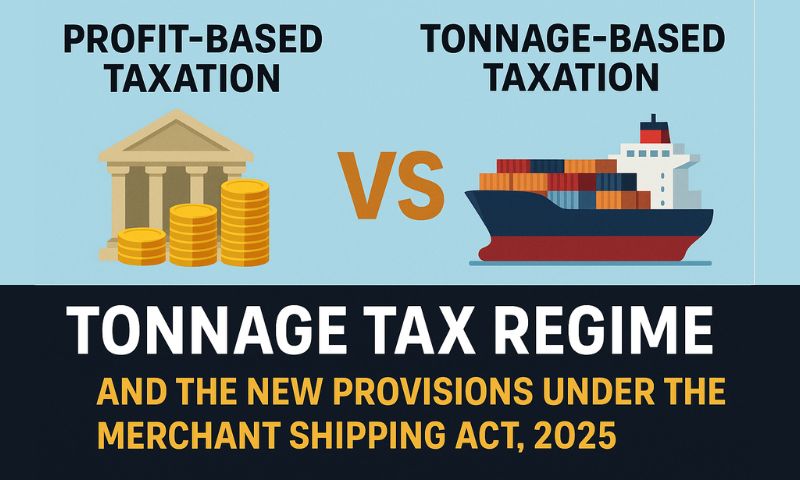
The Tonnage Tax Regime (TTR) is a landmark fiscal policy introduced to strengthen India’s maritime competitiveness. Unlike traditional corporate tax systems that tax profits, TTR allows qualifying Indian shipping companies to be taxed based on the tonnage (carrying capacity) of their ships — a simpler, predictable, and internationally recognized framework.
⚙️ How It Works
Under this system, instead of calculating taxes on actual earnings, a presumptive income is computed based on the size of the vessel. This results in a much lower effective tax rate — around 1–2%, compared to corporate rates exceeding 30% earlier.
Shipping companies can choose to opt into the TTR or continue under the normal tax regime.
The Rakesh Mohan Committee (2002) had first recommended this framework, emphasizing the need for a “conducive fiscal regime” to make Indian shipping globally competitive.
It was formally enacted under the Finance (No. 2) Act, 2004, as Chapter XII-G of the Income Tax Act, 1961, and became operational from Assessment Year 2005–06.
📈 Impact on Indian Tonnage Growth
Before 2004, India’s registered fleet was nearly stagnant — around 7 million gross tonnage (GT) for years. The introduction of TTR triggered renewed interest and investment.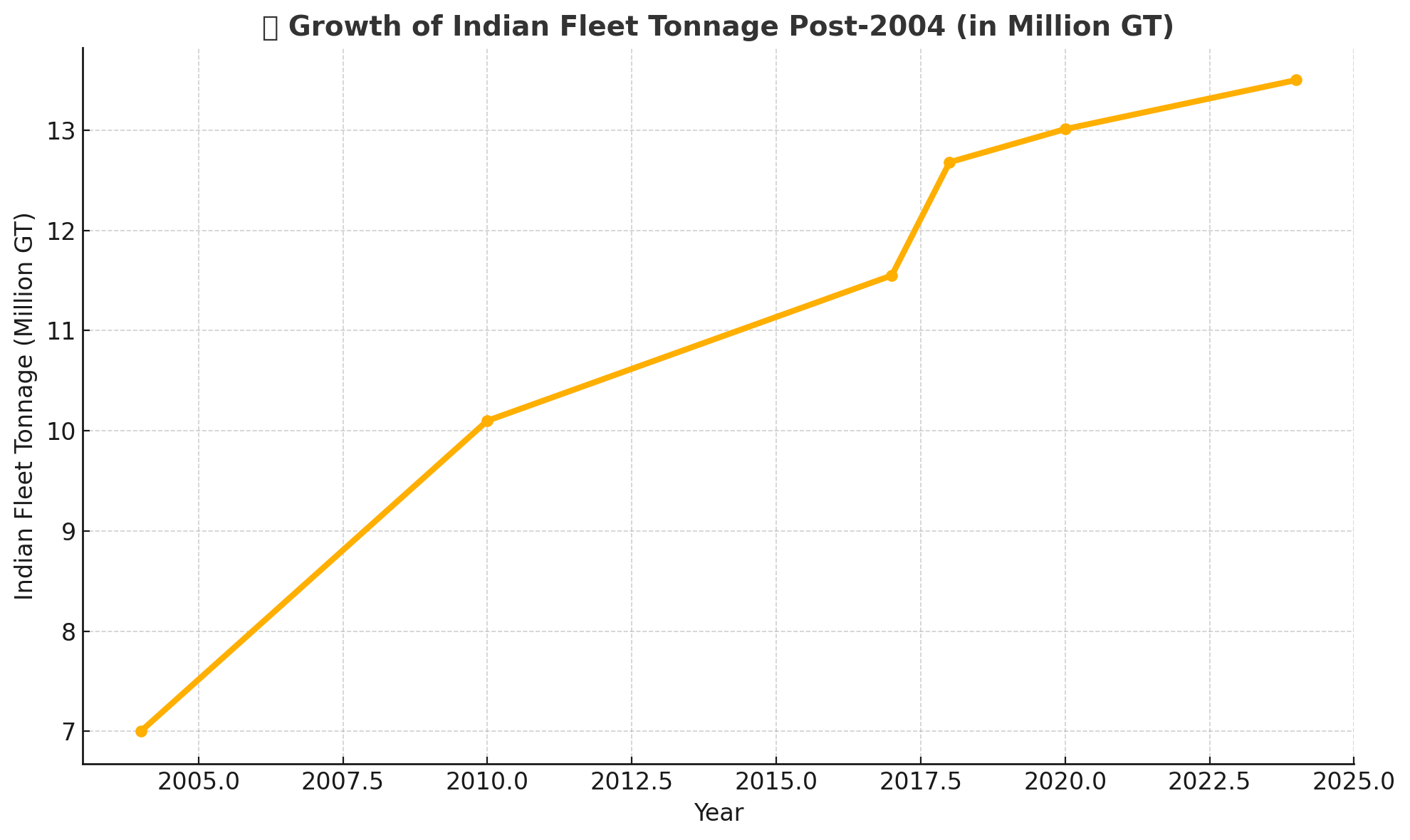
Year |
Indian Fleet Tonnage (GT) |
|---|---|
| 2004 | 7.0 million |
| 2010 | 10.1 million |
| 2017 | 11.55 million |
| 2018 | 12.68 million |
| 2020 | 13.01 million |
| 2024 | 13.50 million |
This growth reflects how tax reform directly supported tonnage expansion, although progress has plateaued in recent years.
🚢 Why It Matters
By simplifying taxation, India made its fleet more competitive globally. Shipowners benefited from reduced tax outgo, allowing reinvestment in fleet renewal and operations.
However, despite the fiscal advantage, non-tax challenges continued to limit faster expansion:
- High operational and financing costs
- Complex regulatory procedures
- Duties on ship imports and crew taxation
- Aging fleet and limited access to affordable capital
Thus, while the TTR provided the foundation for competitiveness, further policy action was needed.
🧭 Training Obligations under TTR
A key condition for companies availing TTR is training Indian seafarers.
Under the Tonnage Tax (Training) Rules, 2004, each company must:
- Provide mandatory onboard training for cadets/officers.
- Submit annual compliance certification to the Directorate General of Shipping (DGS).
Failure to comply may lead to denial of TTR benefits or monetary penalties.
This ensures that while companies enjoy fiscal relief, they also invest in developing maritime manpower — India’s greatest shipping strength.
⚖️ The Merchant Shipping (MS) Act, 2025 — New Provisions for Growth
The MS Act, 2025 introduces forward-looking reforms designed to expand Indian tonnage, streamline registration, and attract global participation in the Indian flag.
1. Expanded Ownership Eligibility
- Who can own ships: Indian citizens, Indian companies, LLPs, NRIs, OCIs, co-operatives, and government-notified entities.
- Why it matters: Encourages diaspora and institutional investment, broadens ownership base, and invites capital inflow.
2. Registration of Bareboat-Chartered Vessels (BBCD)
- Provision: Foreign vessels chartered on bareboat charter-cum-demise terms can now be registered under the Indian flag.
- Impact: Allows Indian operators to boost tonnage without large upfront capital investments.
3. Simplified & Digital Ship Registration
- Provision: Online registration, digital certificates, and e-transfer of ownership.
- Impact: Streamlines bureaucracy, reduces turnaround time, and brings India closer to global “open registries”.
4. Provisional & Temporary Registration
- Provision: Enables early registration for vessels under construction or recycling.
- Impact: Helps capture tonnage early and improves transparency in ship ownership records.
5. Extension of Tonnage Tax to Inland Vessels
- Provision (Budget 2025): Extends TTR benefits to inland vessels registered under the Inland Vessels Act, 2021.
- Impact: Integrates inland/coastal fleets into national tonnage and strengthens India’s multimodal transport ecosystem.
6. Simplified Coastal Shipping Rules
- Provision: Removes general trading licence requirement for coastal trade.
- Impact: Reduces red tape, boosts coastal cargo movement, and enhances utilisation of Indian-flag vessels.
⚠️ Persistent Constraints
Despite these forward-looking reforms, several structural challenges remain:
- High operational costs compared to global peers
- Limited ship financing options in India
- Crew taxation and welfare issues
- Regulatory frictions across agencies
Unless these are systematically addressed, India’s tonnage growth may again stagnate — even with a strong legal and fiscal framework.
🌐 The Way Forward
The synergy between the Tonnage Tax Regime and MS Act 2025 could mark a new phase for India’s maritime ecosystem — one that balances fiscal incentives with operational efficiency.
If complemented with easier financing, competitive shipbuilding policies, and digital maritime governance, India can emerge as a leading flag state in the Indo-Pacific region.
⚓ Conclusion
The Tonnage Tax Regime has proven its worth in giving Indian shipping a competitive edge, and the Merchant Shipping Act, 2025 builds upon that foundation with reforms aimed at inclusivity, digitalization, and growth.
While the seas ahead still have regulatory and financial waves to navigate, the direction is clear — a stronger, more resilient, and globally competitive Indian fleet.



Capt. M. M Saggi
One of the most respected and revered name in the maritime industry who has an holistic overview of how overall shipping functions at the world level as well as within India. Master Mariner (F.G), Extra master and MBA.
Ex-Director at Narottam Morajee Institute of Shipping, Ex-Nautical Advisor to govt. of India, Ex Additional Director General of Shipping, Ex Chief Examiner of mates,masters and extra masters. Ex Country head of casualty investigation. Lead Indian delegation to Maritime Safety Committee of IMO and International Oil Pollution Compensation fund meetings. Ex Trustee Mumbai, JNPT and Kandla Port
Leave a comment
View more
Give your career a boost with S&B professional services.
CV Prep/Evaluation Prep Service
 SeaCommerce
Shop maritime books & essentials
DG Medical Examiners
Find approved doctors near you
Tools & Calculators
Free maritime tools for seafarers
More Jobs
Agency and Logistics
Tanzania
Commercial Manager – Tanza..
Misc
Mumbai
Front Desk Executive – Mum..
Sales and Marketing
Mumbai
Sales Manager
Interview Prep/Mentoring
Find your polestar with the host of experts available on our platform
Know more