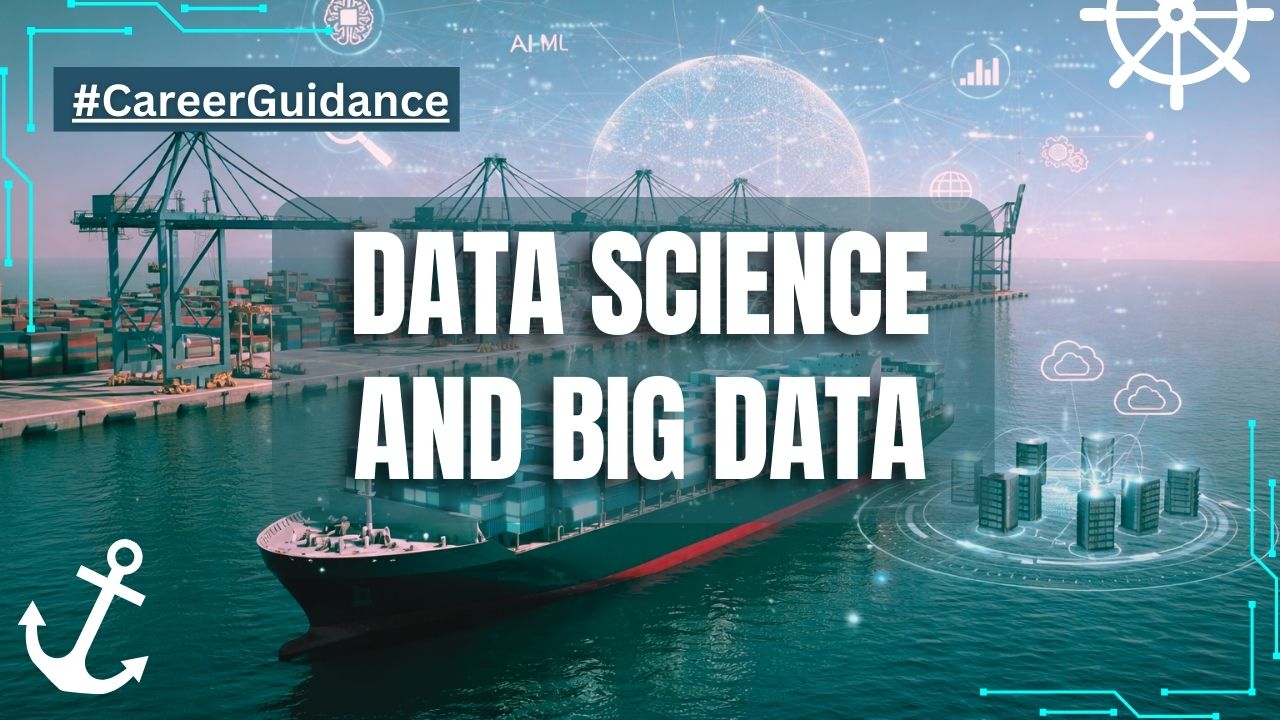
The Data Science and Big Data Video Course for Maritime Professionals, prepared by Mr. Venkat Krishna in conjunction with Sea and Beyond, is designed to empower mariners, marine engineers, shipping professionals, and analysts to make informed, auditable decisions using data. The curriculum bridges the gap between traditional maritime expertise and modern technologies by progressing from foundational statistics to advanced AI and machine learning applications relevant to the shipping industry.
A unique feature of this maritime data analytics course is its focus on real-world use cases from the maritime environment. By utilizing raw data from main engine parameters, the program allows maritime professionals to directly relate to the data modelling process. This practical approach is integrated throughout the modules, where students apply advanced algorithms such as Random Forest regression and classification specifically to marine datasets, helping them evaluate predictions and improve operational decision-making.
The course is structured into four primary phases:
Foundations and Statistical Analysis
The journey begins with the data lifecycle, covering collection from IoT devices, cleaning, and Exploratory Data Analysis (EDA). Participants master essential statistical tools such as hypothesis testing, p-values, Z-scores, and probability distributions (PDF and CDF) to infer population characteristics from sample data.
Core Machine Learning Theory
Learners are introduced to Supervised and Unsupervised learning. The curriculum covers linear and multiple regression, feature engineering, and metrics like RMSE and R² to ensure model reliability. Concepts like degrees of freedom and the Central Limit Theorem (CLT) are emphasized to help students avoid overfitting and ensure their models generalize well to new data.
Maritime-Specific Applications
The course dives deep into specialized techniques applied to maritime datasets, including Clustering methods, What-if analysis, and Anomaly detection using Isolation Forest. These tools are essential for operational tasks like identifying sensor faults or predicting maintenance needs. Additionally, time series analysis and moving averages are applied to marine data to enhance predictive accuracy.
Low-Code Tools and Deployment
To make maritime data science accessible, the course introduces the KNIME low-code platform, allowing users to apply complex regression and classification models to marine data without intensive coding. Finally, participants learn to build and deploy Streamlit applications and use GitHub to manage their work, transforming their models into practical, day-to-day tools for the maritime industry.
This structured roadmap ensures that maritime professionals can transition from understanding the “3 Vs” of Big Data (Volume, Velocity, Variety) to deploying advanced AI agents, RAG systems, and maritime data analytics solutions that support smarter decision-making in modern shipping operations.

Venkat Krishna Soundarraja
Mr. S. Venkat Krishna is the Chief Data Officer at Volteo Maritime, with a background as a Marine Engineer. He brings over 28 years of sailing experience, including 15 years as a Chief Engineer in the tanker industry. A Fellow of the Institution of Marine Engineers (India), he specializes in condition monitoring, data analytics, and reliability engineering. His expertise spans crude oil, product, and chemical tankers, as well as bulk carriers and container vessels.
In his current role, he focuses on ensuring data quality, driving the adoption of AI and machine learning, and enabling data-driven decision-making to enhance organizational performance. Proficient in Python, R, and Power BI, he plays a key role in transforming data into a strategic asset.
Mr. Krishna is also a visiting faculty member, technical mentor, and published researcher, with a strong passion for innovation, education, and emerging technologies. Outside of work, he enjoys singing and artistic sketching—blending creativity with technical precision.
Rating:
Price:
₹ 15000
Language:
English
Length:
17:30:00
Intended for:
Reference:
Topics:
4 Sections . 51 lectures . 17h 30m total length
7 min
1.1 Introduction to Data Science & Big Data
1. Course Vision
- Purpose: Empower marine professionals to make informed, auditable decisions using data.
- Audience: Mariners, engineers, analysts, and curious minds at the intersection of ocean and code.
Foundations
- Data Science: Extracts insights using statistics, machine learning, and programming.
- Big Data: Characterized by the 3 Vs — Volume, Velocity, Variety.
11 min
1.2 Data Analysis vs Analytics
2. Core Concepts
- Data: Recorded measurements.
- Variables: Characteristics that vary across entities.
- Sources: Humans, machines, and their combinations.
- Forms: Structured vs. unstructured data.
Analytics vs. Analysis
- Qualitative:
Analysis (past) – Storytelling
Analytics (future) – Intuition-based analysis - Quantitative:
Analysis (past) – Data insights
Analytics (future) -Formulas, algorithms

13 min
1.3 Types of Variables
3. Types of Variables
- Categorical – Nominal, Ordinal
- Numerical – Discrete, Continuous (Interval & Ratio)
With examples for each of the types of variables
9 min
1.4 Distributions
4. Distributions
- Normal: Bell curve, symmetric about the mean.
- Uniform: Equal probability (e.g., dice rolls).
- Binomial: Two outcomes (e.g., coin tosses).
17 min
1.5 Population & Samples
5. Population vs. Sample
- Sampling Types:
o Probability: Random, stratified, clustered
o Non-probability: Convenience, judgmental, snowball - Statistics:
o Descriptive: Charts, mean, median, mode
o Inferential: Hypothesis testing, confidence intervals
With demonstration using a web application.
(link provided for additional practice)
12 min
1.6 Measures of central tendency
6. Measures of central tendency

Dispersion
- Standard Deviation: Spread around the mean.
- Variance: Squared deviation from the mean.
12 min
1.7 Correlation
7. Correlation
- Correlation: Measures relationship strength (−1 to +1).
Demonstration how to calculate Correlations in excel.
14 min
1.8 Causality
8. Causality
- Causality: Requires deeper investigation — correlation ≠ causation.
Demonstration using web application explaining causality.
(link provided for additional practice)
13 min
1.9 Central Limit Theorem
9. Central Limit Theorem (CLT)
- Insight: Sample means approximate a normal distribution for large samples (n ≥ 30), regardless of population distribution.
- Assumptions: Random sampling, independence, finite variance
Demonstration using a web application explaining CLT application.
(link provided for additional practice)
Additional note explaining difference between Std. deviation & Std. error.
20 min
1.10 Measures of central tendency demo
10. Measures of Central tendency demonstration
- Calculations: Mean, median, mode, std. deviation, variance, var. coeff
Demonstration in a web application explaining skew, kurtosis etc.,
(link provided for additional practice).
5 min
2.1 Introduction
1. Data Lifecycle
- Collection & Storage: From databases, APIs, IoT devices.
- Cleaning & Preprocessing: Handling missing values, outliers, scaling issues.
- Exploratory Data Analysis (EDA): Visual summaries and trend identification.
- Machine Learning & AI: Predictive modeling for decision-making.
30 min
2.2 Hypothesis tests
2. Hypothesis Testing
- Null Hypothesis (H₀): Assumes no effect or change.
- Alternative Hypothesis (H₁): Suggests a significant effect or difference.
- Purpose: To infer population characteristics from sample data using statistical tests.
21 min
2.3 Z-scores, p-values | Part 1
3 Statistical Tools & Concepts
- Z-Scores: Standardize data for comparison across datasets.
- p-Values: Measure evidence against H₀.
21 min
2.4 Z-scores, p-values | Part 2
4. Statistical Tools & Concepts
- Z-Scores: Standardize data for comparison across datasets.
- p-Values: Measure evidence against H₀.
30 min
2.5 PDF, CDF, use cases
5. Density functions
PDF (Probability Density Function):
- Describes the likelihood of a continuous random variable taking on a specific value.
- The area under the curve represents probability.
CDF (Cumulative Distribution Function):
- Represents the probability that a variable takes a value less than or equal to a given point.
- Useful for calculating p-values and tail probabilities.
18 min
2.6 Z-test, T-test, Degrees of freedom
6. Z-Test vs T-Test:
- Use Z-Test when population standard deviation is known and sample size ≥ 30.
- Use T-Test when population standard deviation is unknown.
26 min
2.7 One tailed test
7. One tailed & two tailed tests:
- Two-Tailed Test: Checks for any difference from hypothesized mean.
- Left-Tailed Test: Tests if sample mean is significantly lower.
- Right-Tailed Test: Tests if sample mean is significantly higher.
17 min
2.8 Errors in statistical testing
8. Errors in Testing
- Type I Error (False Positive): Rejecting a true H₀.
- Type II Error (False Negative): Failing to reject a false H₀.
- Trade-off: Reducing one increases the other unless sample size increases.
25 min
2.9 Outliers & detection
9. Data Issues
- Common Problems: Missing values, measurement errors, sensor faults, manual manipulation.
- Outliers: Identified using Interquartile Range (IQR).
22 min
2.10 Types of plots
10. Visualization Techniques
- Plot Types: Scatter, Line, Bar, Histogram, Pie, Box plots.
- Tools: Excel, Python (Matplotlib, Seaborn).
13 min
3.1 Introduction to Machine Learning
Module 1: Introduction to Machine Learning
- ML is a subset of AI that learns patterns from data to make predictions/decisions.
- Relies on data, algorithms, and iterative improvement.
- Applications span industries: predictive maintenance, customer segmentation, fraud detection, NLP, computer vision.
20 min
3.2 Independent & Dependent Variables
Module 2: Independent & dependent variables
- Independent variables (predictors) vs Dependent variables (outcomes).
- Regression models relationships between them.
- Purpose: infer/predict one variable from others, understand correlation impact.
9 min
3.3 Dummy Variables
Module 3: Dummy variables
- Used when predictors are categorical (e.g., weather: good/bad).
- Encoded into binary variables for regression models.
29 min
3.4 Linear Regression
Module 4: Linear regression, Multi linear regression
- Supervised ML algorithm assuming linear relationship between input & output.
- Types:
- Simple Linear Regression: one predictor.
- Multiple Linear Regression: multiple predictors.
- Assumptions: linearity, independence, homoscedasticity, normality of errors, no multicollinearity, no autocorrelation, additivity.
- Real-world use cases: stock market, real estate, medical risk, sales forecasting.
22 min
3.5 Metrics, Multi Linear Regression
Module 5: Metrics, Multi linear regression demo
- Limitations: assumes linearity, sensitive to outliers.
- Metrics: calculations
22 min
3.6 Understanding the Metrics
Module 6: Understanding the Metrics
- MSE, MAE, RMSE for error measurement.
- R2 & Adjusted R2 for explanatory power.
Evaluation of metrics for comparing different models for selecting a better
model for predictions and analytics.
20 min
3.7 Splitting Data for ML
Module 7: Splitting data for ML
Splitting data to training and test data
- Training data: builds the model, larger dataset.
- Test data: evaluates performance, unseen dataset to check generalization.
- Prevents overfitting and validates accuracy.
28 min
3.8 Feature engineering and scaling
Module 8: Feature engineering and feature scaling
- Feature engineering: cleansing, transformation, extraction, selection, Iteration, imputing missing values.
- Feature scaling: normalization (0–1) or standardization (mean=0, SD=1).
- Ensures equal contribution of features, avoids bias in distance-based algorithms.
22 min
3.9 Linear Regression applying features
Module 9: Linear regression applying features
- Linear regression applying splitting data & feature scaling
- Understanding the hierarchy between splitting & scaling data.
Able to evaluate the model using test data after constructing a model for
predictions.
31 min
3.10 Regression vs Classification
Module 10: Regression vs Classification
- Other Regression & Classification
- Other regressions: polynomial, ridge, lasso, SVR, decision tree, random forest, logistic, gradient boosting, XGB.
- Classification vs Regression:
- Classification → discrete outcomes (yes/no, categories).
- Regression → continuous outcomes (price, temperature).
- Algorithms: decision tree, random forest, KNN, logistic regression, SVM, Naïve Bayes.
26 min
3.11 ANOVA
Module 11: ANOVA (One way ANOVA)
- Analysis of Variance: compares means across 3+ groups.
- Tests null hypothesis (all means equal).
- Assumptions: normality, independence, equal variance, no overlap.
- Examines variability within vs among groups.
10 min
4.1 Introduction to AI ML applications
Module 1: Introduction to AI ML applications
- Module overview, areas of deployment along with course introduction
and learning curve.
22 min
4.2 Supervised & Unsupervised learning
Module 2: Supervised & Unsupervised learning
- Understanding differences between them and application demo in python
- Differentiating between regression, classification, clustering methods & its application areas.
- Purpose: How and where to apply, choosing variables based on the method.
17 min
4.3 Random forest Intuition
Module 3: Random Forest intuition
- Fundamentals of decision trees, random forest
- Applying in regression & classification
- Importance: brief knowledge of how decision trees work and application for Regression in ML.
21 min
4.4 Logistics Regression Intuition
Module 4: Logistic regression intuition
- Fundamentals of logistic regression
- Types of logistic regression, difference between linear regression & logistic regression
- Sigmoid function, accuracy metrics, ROC curves.
- Importance: applications for Classification in ML
25 min
4.5 Random Forest regression Use case
Module 5: Random Forest regression Use case
- Applying Random Forest regression to a marine data
- Comparing the results with multi linear regression applied to same data
- Importance: Model evaluation, predictions and inferences.
18 min
4.6 Random Forest classification Use case
Module 6: Random Forest classification Use case
- Applying Random Forest classification to marine data
- Comparing results with Logistic regression applied to same data
- Importance: Model evaluation, predictions and inferences.
26 min
4.7 Clustering Methods
Module 7: Clustering methods
- Fundamentals of clustering, uses.
- Applying clustering methods to marine data
- Importance: Evaluation, inferences
19 min
4.8 Whatif analysis using AI ML
Module 8: Whatif analysis using AI ML
- Significance of Whatif analysis
- Application to marine data
- Importance: Predictions, inferences
25 min
4.9 Anomaly detection using AI ML
Module 9: Anomaly detection using AI ML
- Anomaly detection methods
- Significance of anomaly detection
- Fundamentals of Isolation Forest for anomaly detection
- Applying isolation forest on marine data
- Importance: significance of anomaly detection, inferences
31 min
4.10 Times Series & Moving Averages
Module 10: Time Series & Moving Averages
- Fundamentals of time series and moving averages
- Application to marine data
- Importance: significance & inferences
28 min
4.11 The Rise of AI (GenAI, AI agents, RAG, MCP servers, Agentic AI)
Module 11: The Rise of AI
- GenAI, AI agents, Agentic AI, RAG systems, MCP servers
- Application areas and its importance.
23 min
4.12 AI agents Use Case
Module 12: AI agents Use case
- AI agents’ fundamentals and applications
- Using AI agents’ demo
33 min
4.13 RAG Systems
Module 13: RAG Systems
- RAG systems fundamentals and applications
- Using RAG systems demo
23 min
4.14 mcp servers and Use case
Module 14: mcp servers and Use case
- Mcp servers’ fundamentals and applications
- Using mcp servers’ demo
25 min
4.15 KNIME low code platform
Module 15: KNIME low code platform
- KNIME fundamentals, applications
- Application on marine data
21 min
4.16 Regression models in KNIME
Module 16: Regression models in KNIME
- Applying regression in KNIME on marine data
- Comparing Random Forest regression with multi linear regression in KNIME on same dataset. Model evaluation and comparison in KNIME.
- Importance & ease of low code no code platforms, predictions, inferences.
26 min
4.17 Classification models in KNIME
Module 17: Classification models in KNIME
- Applying classification in KNIME on marine data
- Comparing Random Forest classifier, decision tree classifier, naïve bayes classifier, logistic regression in KNIME on same dataset. Model evaluation & comparison in KNIME.
- Importance & ease of low code no code platforms, predictions, inferences.
25 min
4.18 Optimisation in modelling
Module 18: Optimization in modelling
- Optimization fundamentals, necessity to optimize.
- Comparing various models to evaluate metrics and optimize best model.
- Importance of optimization, applying on marine data.
19 min
4.19 Streamlit applications and Use case
Module 19: Streamlit applications and Use case
- Significance of Streamlit application
- Creating an application using marine data
- Deploy it locally in your system using Streamlit
- Importance of Streamlit application for making simple & effective day to day applications for simplifying tasks.
28 min
4.20 VS code, Github
Module 20: VS code, GitHub
- Significance of VS code interpreter & GitHub
- Saving your work in VS code, pushing it to GitHub repository to your account.
- Deploying it in Streamlit community, pulling saved data from GitHub to deploy a web application using marine data.
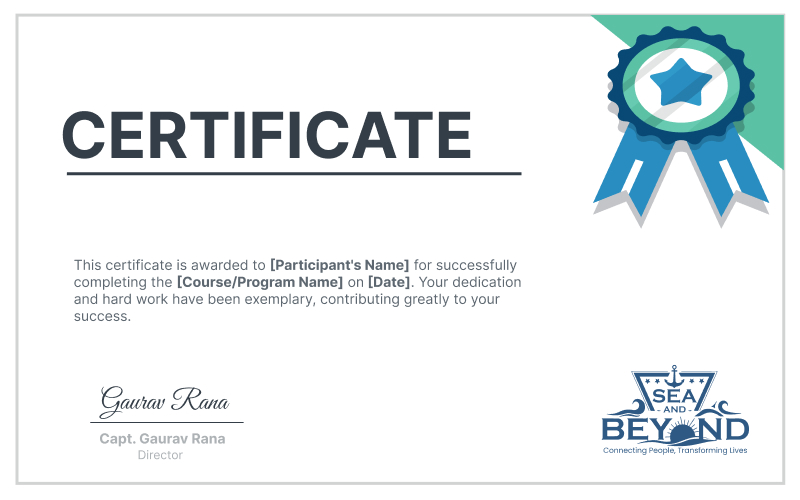
Successful completion of this course will earn you a certificate of completion from Sea and Beyond. This certificate will be emailed to you and you could also share and show it on LinkedIn Please click on the button below to purchase the certificate.