
Abandoned Seafarers: Challenges, Global Practices and a Self-Regulatory Way Forward for India
 Capt. M. M Saggi
26 May 2026
538 view
0
2 Comment
The issue of abandoned seafarers remains one of the most serious humanitarian and regulatory concerns in the global maritime industry.
Every year, hundreds of seafarers across the world are left stranded on vessels without wages, food supplies, insurance support, or repatriation.
While maritime conventions provide certain protections on paper, the operational reality for abandoned crew members is often far more difficult.
For India — one of the world’s largest suppliers of maritime manpower — the growing number of abandonment cases raises an important question:
How can Indian seafarers be better protected without disrupting employment opportunities or overburdening shipowners?
The answer may lie in stronger self-regulation, improved due diligence, and coordinated industry accountability.
Understanding Seafarer Abandonment
Seafarer abandonment usually follows a predictable commercial pattern.
In many cases, aging vessels operating under open registries or weak financial ownership structures are purchased for short-term commercial gains. These ships often begin trading with limited financial resilience and uncertain employment prospects.
When freight markets weaken or vessels face operational issues, the financial model quickly collapses.
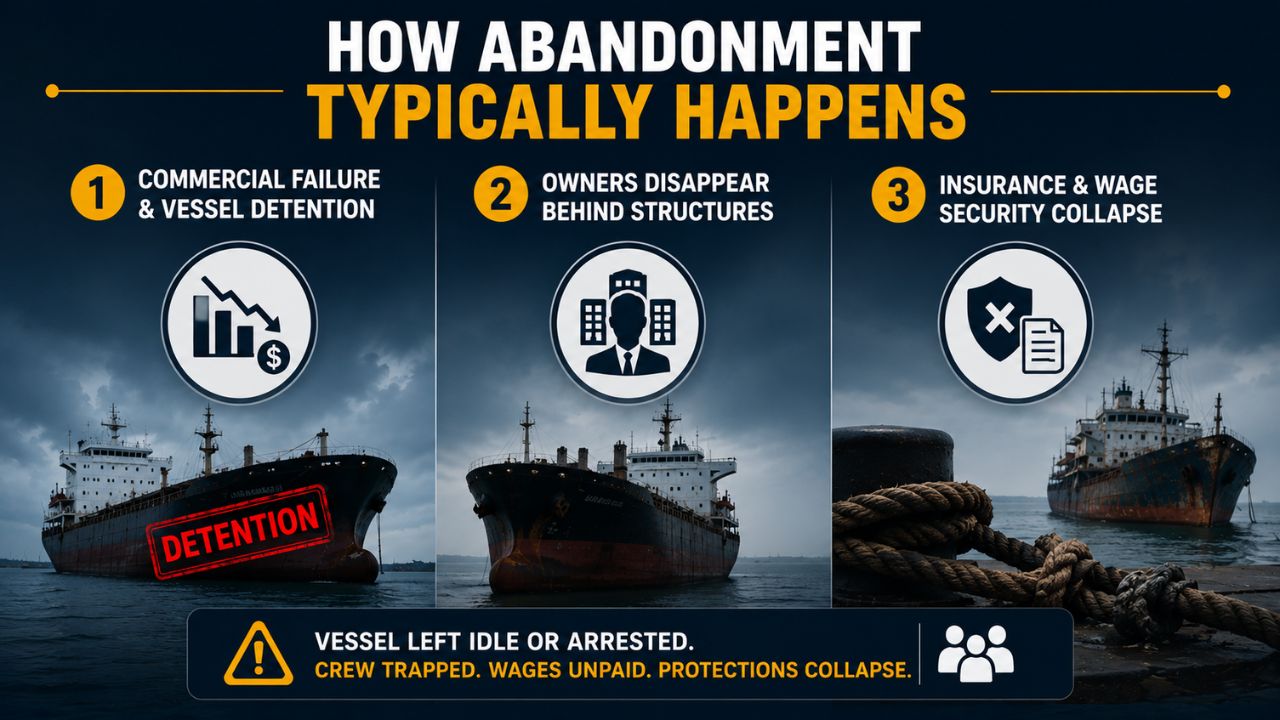
How Abandonment Typically Happens
1. Commercial Failure and Vessel Detention
Many vessels fail to secure sustainable employment or face detention under Port State Control inspections.
Once trading stops:
- Freight earnings disappear immediately
- Operating costs continue rising
- Crew wages remain unpaid
- Port dues and maintenance costs accumulate
The vessel soon becomes financially unviable.
2. Owners Disappear Behind Corporate Structures
At this stage, beneficial owners often disappear behind:
- Single-ship companies
- Layered offshore entities
- Complex ownership structures
The vessel is left idle or arrested while crew members remain trapped onboard.
3. Insurance and Wage Security Collapse
As financial pressure increases:
- Insurance premiums stop being paid
- P&I cover lapses
- Class certificates expire
- Pollution and wreck removal cover becomes invalid
Even wage protection mechanisms under the Maritime Labour Convention (MLC) become difficult to enforce in practice.
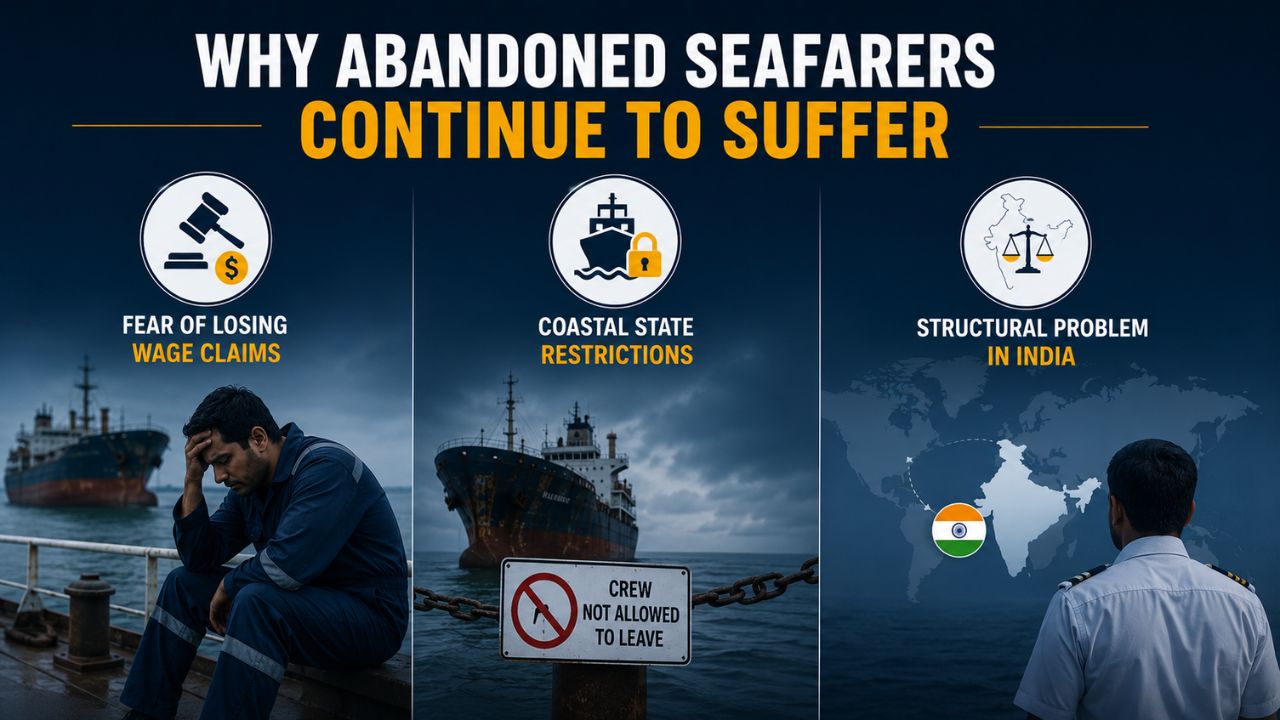
Why Abandoned Seafarers Continue to Suffer
Fear of Losing Wage Claims
Although crew wages enjoy a high maritime lien, enforcement depends on judicial sale of the vessel — a process that can take months or even years.
Most seafarers:
- Cannot afford legal representation
- Fear losing their wage claims if they leave the vessel
- Lack local support systems after repatriation
As a result, many continue staying onboard under extremely difficult conditions.
Coastal State Restrictions
In several cases, coastal states do not allow crew members to leave abandoned ships due to:
- Navigational safety concerns
- Pollution risks
- Security considerations
This effectively turns the crew into captive personnel onboard stranded vessels.
The Structural Problem in India
One of the biggest challenges is the limited control manpower-supplying countries have over shipowners.
India can regulate:
- Recruitment and Placement Service Licence (RPSL) holders
- Manning agencies
- Recruitment procedures
However, wages and operational control remain with shipowners, many of whom are based overseas.
In addition, some seafarers are deployed through:
- Weak intermediaries
- Unregistered agencies
- Informal recruitment channels
making accountability extremely difficult once problems arise.
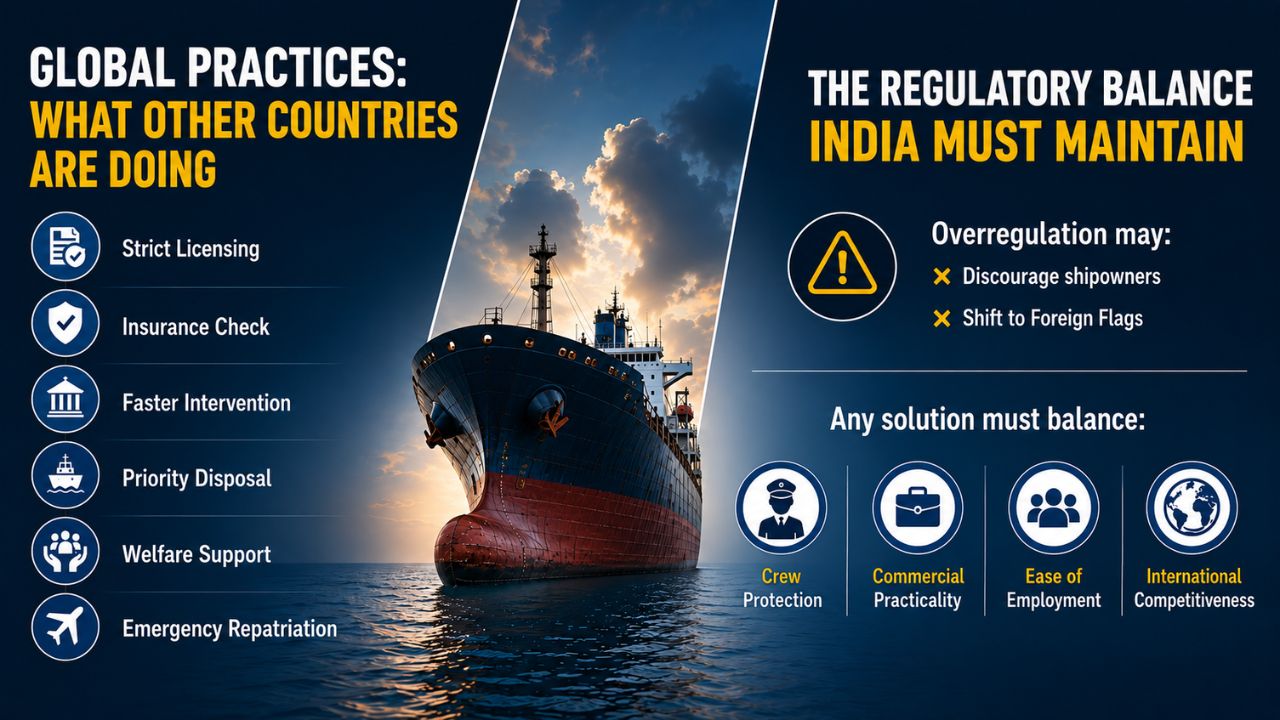
Global Practices: What Other Countries Are Doing
Major maritime manpower suppliers such as:
- Philippines
- China
have adopted stronger systems to reduce abandonment risks.
Common International Practices Include:
- Strict licensing of manning agencies
- Mandatory insurance verification
- Faster government intervention
- Prioritised disposal of abandoned vessels
- Welfare and compensation mechanisms
- Emergency repatriation support
These measures help reduce prolonged abandonment situations and provide quicker humanitarian assistance to affected crews.
The Regulatory Balance India Must Maintain
While stronger regulation is necessary, excessive criminal or financial liability can create unintended consequences.
Overregulation may:
- Discourage foreign shipowners from employing Indian seafarers
- Push Indian shipowners toward foreign flags
- Reduce global competitiveness of Indian maritime manpower
Any solution must therefore balance:
- Crew protection
- Commercial practicality
- Ease of employment
- International competitiveness
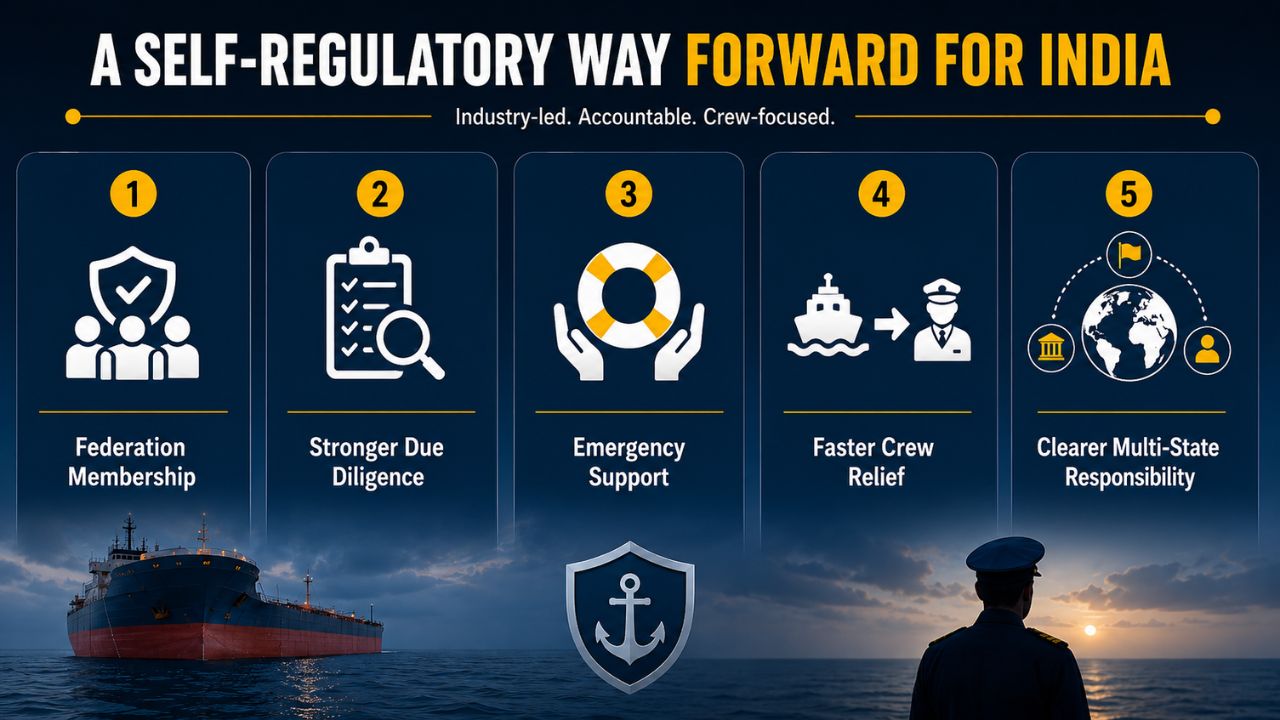
A Self-Regulatory Way Forward for India
One practical solution could be the creation of a stronger self-regulatory framework led by RPSL federations under DG Shipping oversight.
1. Mandatory Federation Membership for RPSLs
DG Shipping could require all RPSLs deploying Indian seafarers to become members of a recognised industry federation or association.
This would create:
- Better accountability
- Centralised oversight
- Uniform operating standards
- Improved monitoring mechanisms
2. Stronger Due Diligence of Shipowners
Federations could conduct enhanced verification of:
- Shipowner financial standing
- Insurance validity
- Operational track record
- Vessel compliance history
before approving crew deployment.
Habitual defaulters could be denied access to Indian seafarers altogether.
3. Emergency Support for Abandoned Crew
If abandonment occurs despite safeguards, the federation could provide immediate support for:
- Food and essential supplies
- Legal assistance
- Temporary welfare support
- Crew repatriation
Funding could come through industry levies linked to federation membership.
4. Faster Crew Relief Through Third-Party Manning
Ports and coastal states could arrange caretaker crews through third-party manning arrangements.
This would allow abandoned seafarers to safely return home while preserving wage claims against the vessel.
Associated costs could later be recovered from judicial sale proceeds.
5. Clearer Multi-State Responsibility
There is also a need to clearly define the responsibilities of:
- Flag states
- Port states
- Seafarer nationality states
to ensure crew wage rights remain protected even after repatriation.
This would remove uncertainty and reduce the fear of leaving the vessel.
The Need for a Practical and Sustainable Framework
The abandonment problem cannot be solved through regulation alone.
It requires:
- Better industry governance
- Faster enforcement systems
- Shared accountability
- Stronger due diligence
- Humanitarian response mechanisms
Most importantly, it requires collaboration between regulators, RPSLs, shipowners, insurers, and maritime welfare organisations.
Conclusion
Seafarer abandonment is not merely a contractual dispute — it is a humanitarian crisis with significant legal, operational, and reputational consequences for the maritime industry.
India, as a major maritime manpower nation, has an opportunity to build a balanced and globally respected framework that protects seafarers while preserving employment competitiveness.
A strong self-regulatory RPSL federation operating under statutory oversight could become a practical and scalable solution for reducing abandonment cases, improving accountability, and strengthening confidence in Indian maritime manpower globally.
The goal should not only be preventing abandonment — but ensuring that no Indian seafarer is left without protection, dignity, or support at sea.



Capt. M. M Saggi
One of the most respected and revered name in the maritime industry who has an holistic overview of how overall shipping functions at the world level as well as within India. Master Mariner (F.G), Extra master and MBA.
Ex-Director at Narottam Morajee Institute of Shipping, Ex-Nautical Advisor to govt. of India, Ex Additional Director General of Shipping, Ex Chief Examiner of mates,masters and extra masters. Ex Country head of casualty investigation. Lead Indian delegation to Maritime Safety Committee of IMO and International Oil Pollution Compensation fund meetings. Ex Trustee Mumbai, JNPT and Kandla Port
Leave a comment
View more
Give your career a boost with S&B professional services.
CV Prep/Evaluation Prep Service
 SeaCommerce
Shop maritime books & essentials
DG Medical Examiners
Find approved doctors near you
Tools & Calculators
Free maritime tools for seafarers
More Jobs
Ship management
Mumbai
Vessel Performance Analyst..
Ship management
Mumbai
Vessel Performance Enginee..
Ship management
Mumbai
Voyage Optimisation Manage..
Interview Prep/Mentoring
Find your polestar with the host of experts available on our platform
Know more

Contact Us