AI Hallucinations in Maritime: Why Chatbots Confidently give Answers Wrong (And How to Prevent It)
 Capt. Vineet Shukla
28 Jan 2026
1643 view
2
0 Comment
When AI Sounds Right but Gets It Wrong: Maritime Hallucinations Explained
Artificial Intelligence is rapidly changing the way professionals work. From writing emails to generating reports and creating training material, AI tools like Large Language Models (LLMs) and chatbots are becoming part of everyday workflows.
But there’s a growing concern that maritime professionals must understand before trusting these tools:
AI can provide incorrect answers with complete confidence.
This isn’t just a minor technical flaw. In an industry like shipping—where safety, compliance, and commercial accuracy matter—this can create real operational and business risk.
In this blog, we’ll explore what AI hallucinations are, why they happen frequently in maritime use cases, and the practical solutions professionals and organizations can adopt to reduce errors.
What Are AI Hallucinations?
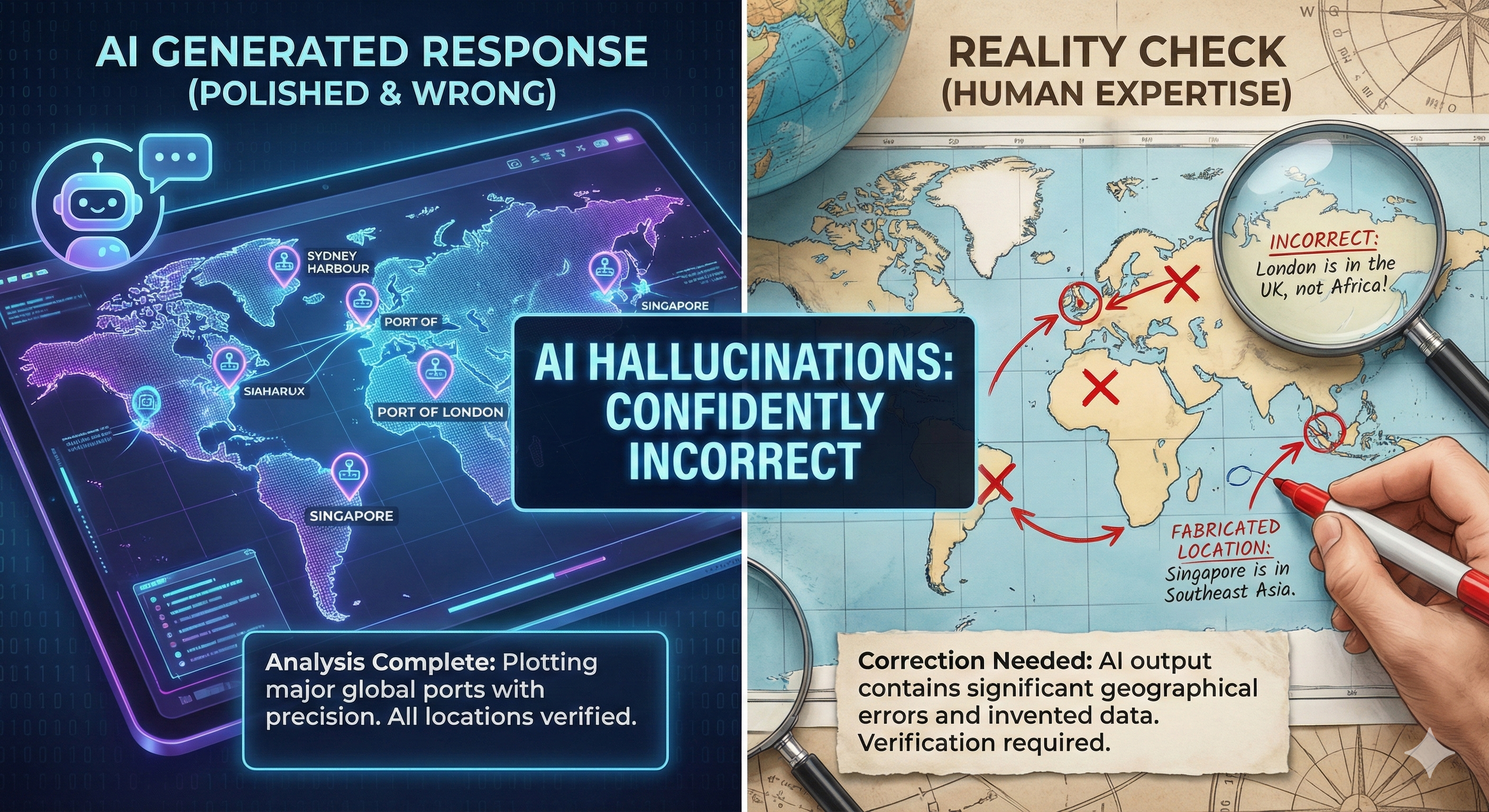
An AI hallucination occurs when a chatbot or LLM generates an answer that looks correct, sounds authoritative, and is presented confidently—but is actually inaccurate, misleading, or completely fabricated.
This could involve:
- wrong facts
- incorrect port locations
- invented regulations
- imaginary statistics
- false shipping industry references
- misinterpretation of technical concepts
The challenge is that hallucinations are often presented in a very polished way. That makes them harder to detect unless the user already knows the subject well.
A Simple Example: When AI Gets Basic Port Mapping Wrong
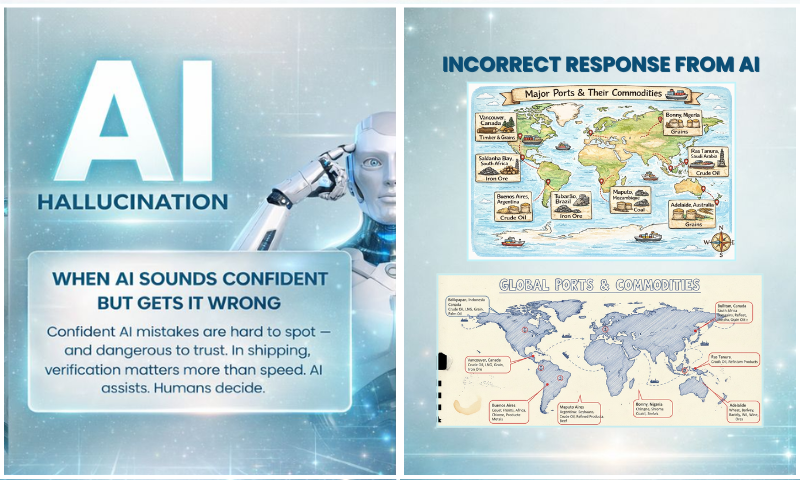
While preparing background material for an AI training session for maritime professionals, I tested a prompt that should be straightforward:
“Plot famous ports on a world map.”
No advanced operations.
No confidential commercial data.
No complex chartering scenarios.
Yet, the response I got was well-formatted and confident—but the output included misplaced ports and incorrect geography.
This is the exact problem:
hallucinations don’t look like mistakes—they look like expertise.
Why Do Chatbots Hallucinate?
Many professionals assume AI works like a search engine or an expert database.
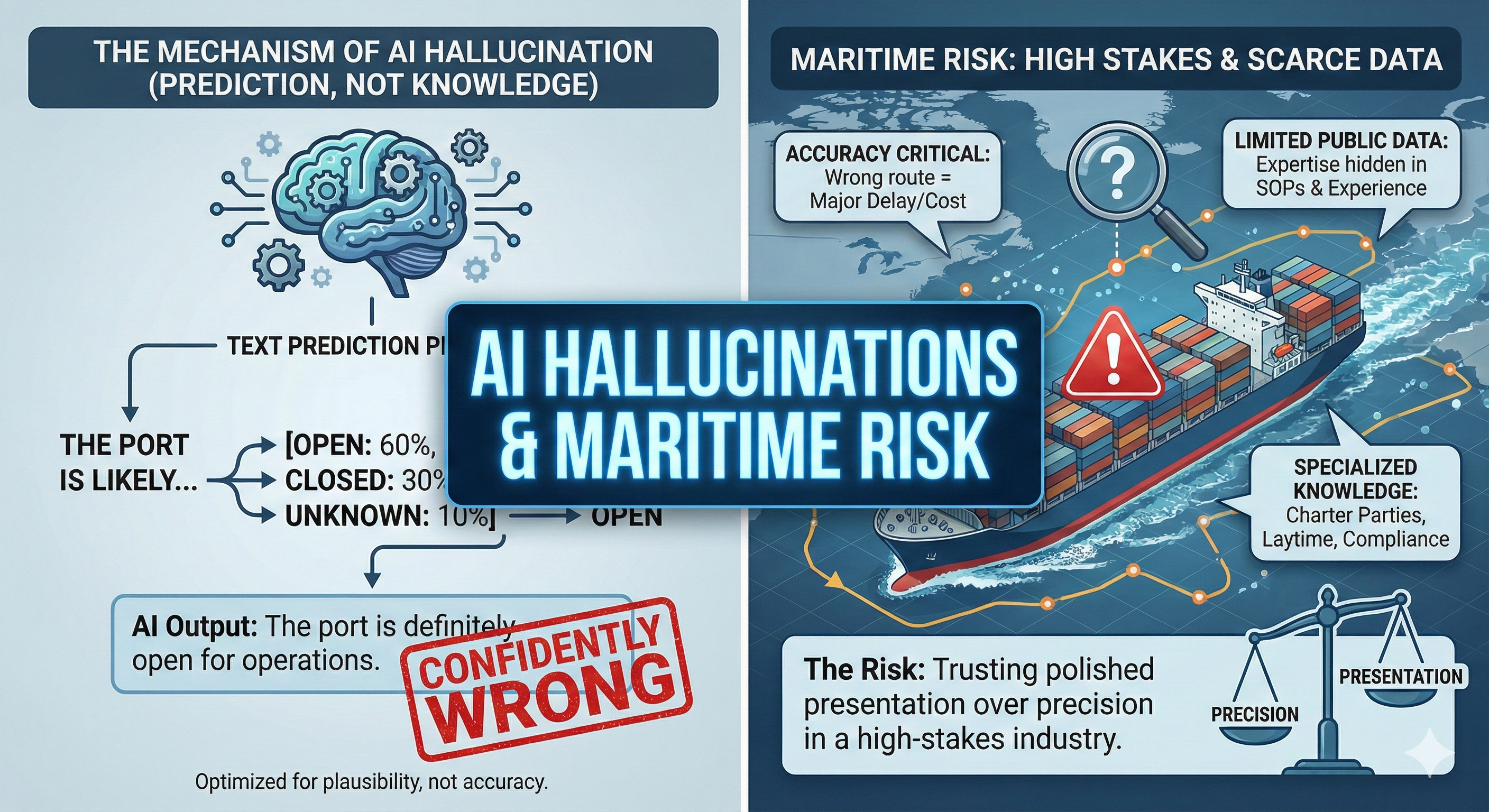
But most LLMs don’t actually “know” facts the way humans do. They generate answers by predicting what text is likely to come next, based on patterns learned during training.
When a model doesn’t have enough data or context, it may still respond with something that sounds plausible, rather than clearly stating uncertainty.
This leads to an important reality:
AI is optimized to produce an answer—not to guarantee the answer is correct.
Why AI Hallucinations Are a Bigger Risk in Maritime
AI hallucinations can happen in any field. But the maritime and shipping industry has unique characteristics that make errors especially risky.
1) Maritime Work Requires High Accuracy
Small mistakes in shipping can lead to bigger consequences, including:
- wrong port capability interpretation
- incorrect routing assumptions
- flawed voyage comparisons
- documentation errors
- compliance mistakes
- poor commercial decisions
In short: “close enough” is rarely good enough in maritime operations.
2) Maritime Knowledge Isn’t Fully Available in Public Data
A lot of maritime expertise lives in:
- internal SOPs and checklists
- company-specific processes
- commercial negotiation strategies
- vessel-specific operational procedures
- non-public incident learnings
- practical judgment gained at sea
Since many LLMs are trained mostly on general internet data, they may lack the depth to answer domain-specific maritime questions reliably.
3) Scarcity of Maritime-Trained AI Models
While there are excellent AI tools today, maritime-focused LLMs are still limited.
This means general-purpose tools may give confident answers on topics like:
- port operations
- laytime logic
- charter party clauses
- tanker operations
- compliance interpretation
…but those answers may not reflect real-world practice.
The Real Problem: AI Sounds Confident Even When It’s Wrong
The biggest risk isn’t that AI makes mistakes.
Humans make mistakes too.
The real risk is that AI can produce a wrong answer with:
perfect language
strong structure
professional tone
high confidence
This can cause users to trust the output without questioning it.
Over time, this creates a dangerous trend:
people start relying on “presentation” more than “precision.”
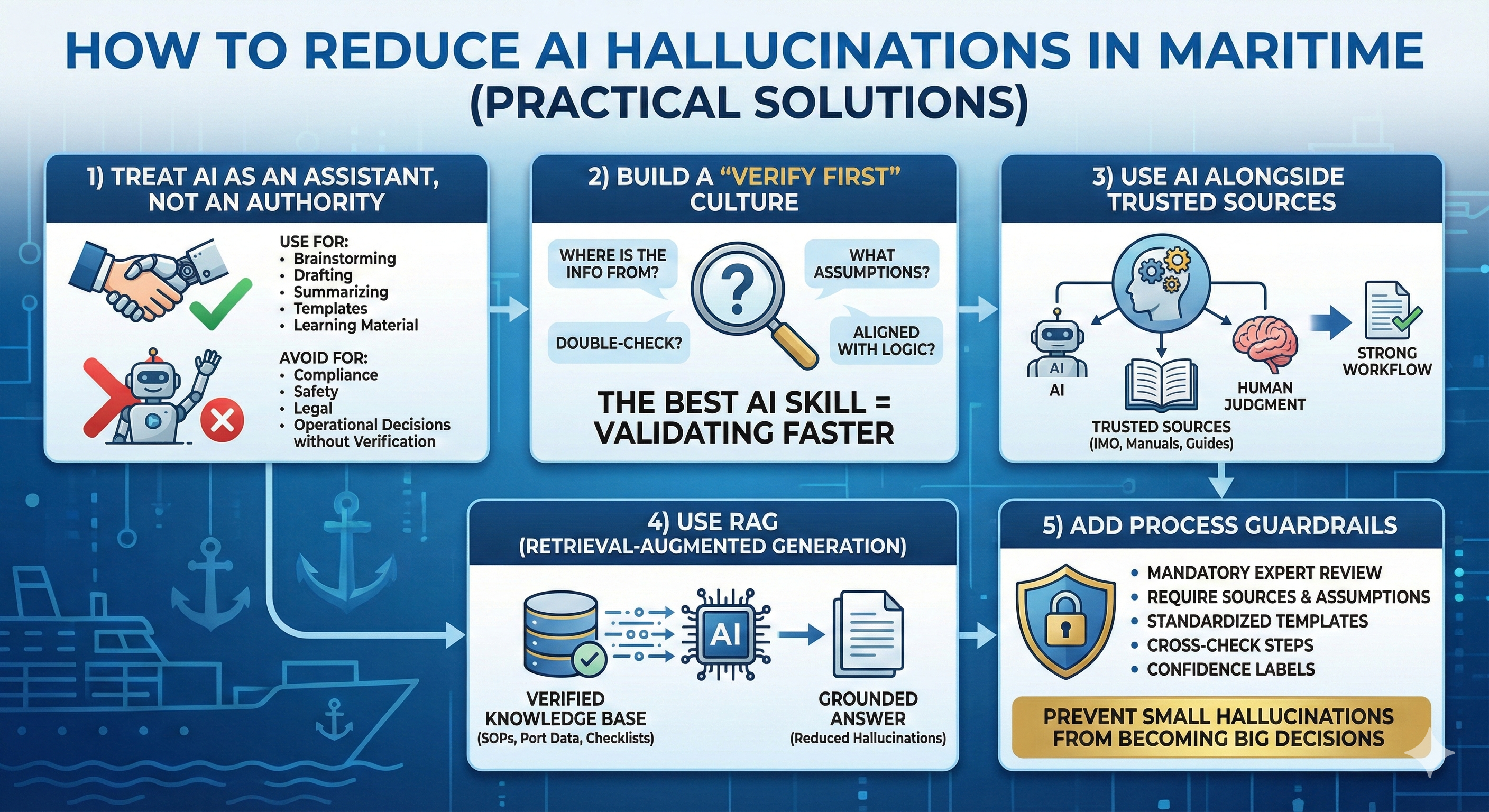
How to Reduce AI Hallucinations in Maritime (Practical Solutions)
The solution isn’t to reject AI.
The solution is to use AI responsibly with a verification mindset.
Here are five practical ways to reduce AI hallucinations in maritime workflows:
1) Treat AI as an Assistant, Not an Authority
Use AI for:
brainstorming
drafting emails and reports
Summarizing notes
building templates
creating learning material
But avoid using AI as a final decision-maker for:
compliance interpretation
safety-critical procedures
legal commitments
routing and operational decisions without verification
2) Build a “Verify First” Culture
Maritime teams should be trained to ask:
- “Where is this information coming from?”
- “What assumptions is the model making?”
- “What would an experienced operator double-check?”
- “Is the answer aligned with industry logic?”
The best AI skill today isn’t prompting better.
It’s validating faster.
3) Use AI Alongside Trusted Sources (Not Instead of Them)
For professional maritime use, AI should be used alongside:
- IMO circulars and regulations
- industry publications
- port authority references
- company manuals
- chartering reference guides
- vessel documents and onboard procedures
A strong workflow is:
AI + trusted sources + human judgment.
4) Use RAG (Retrieval-Augmented Generation) for Maritime Knowledge
A strong technical solution is RAG (Retrieval-Augmented Generation).
Instead of generating answers purely from memory, AI pulls information from a verified knowledge base such as:
- internal SOPs
- vetted maritime reference documents
- port databases
- operational checklists
- company training material
This dramatically reduces hallucinations because the model is grounded in real data.
5) Add Process Guardrails for High-Risk Outputs
For important outputs, add safeguards such as:
- mandatory review by an expert
- prompts requiring sources or assumptions
- standardized templates
- cross-check steps before finalizing documents
- “confidence labels” and uncertainty reporting
These simple controls can prevent small hallucinations from becoming big decisions.
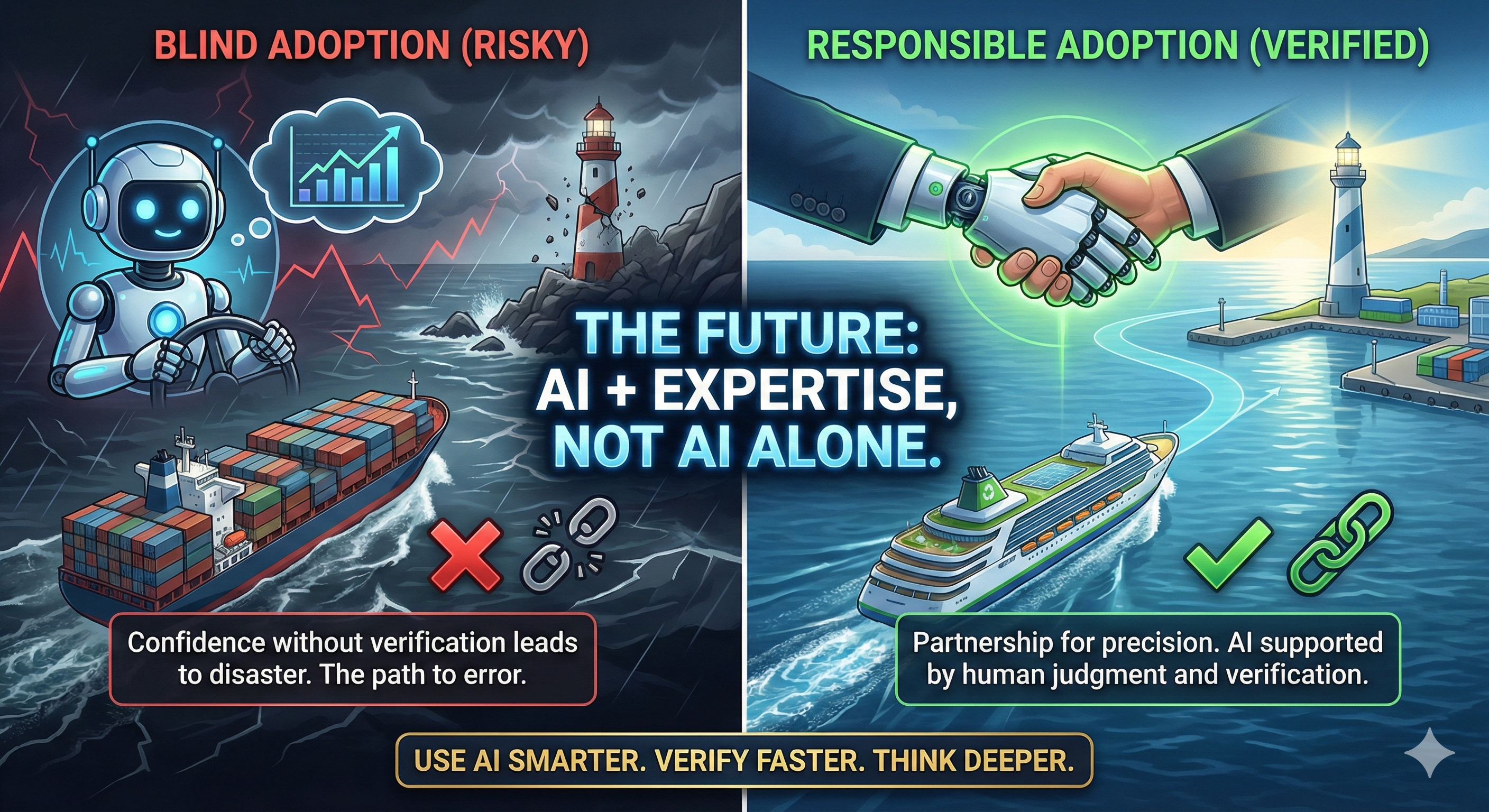
Conclusion: The Future Is AI + Expertise, Not AI Alone
AI will absolutely play a major role in the future of maritime training, operations, and commercial shipping.
But maritime professionals must remember one key truth:
LLMs can produce confident responses even when the answer is wrong.
The way forward is not blind adoption, and not rejection either.
It is responsible adoption, supported by verification frameworks.
Use AI smarter. Verify faster. Think deeper.



Capt. Vineet Shukla
Capt. Vineet Shukla is a maritime expert with over 30 years of experience, primarily on tankers, and a strong background in ship management, maritime education, and ship recycling. A former Master Mariner and DPA/CSO, he now serves as Director–Education at Sea and Beyond, where he mentors seafarers and maritime professionals through career transitions, upskilling, and higher education. With hands-on knowledge of HSEQ, inspections, and regulatory frameworks, Capt. Vineet offers practical, strategic guidance to those navigating the complexities of sea-to-shore careers.
Leave a comment
View more
Give your career a boost with S&B professional services.
CV Prep/Evaluation Prep Service
 SeaCommerce
Shop maritime books & essentials
DG Medical Examiners
Find approved doctors near you
Tools & Calculators
Free maritime tools for seafarers
More Jobs
Ship management
Gujarat
Operations Executive – Tra..
Agency and Logistics
Mumbai
Vessel Performance Analyst..
Sales and Marketing
Mumbai
Manager – Sales (ISO Tank)..
Interview Prep/Mentoring
Find your polestar with the host of experts available on our platform
Know more

Contact Us