
How to Build a Strong Profile Before Your MBA Application
 Akshay Shrivastava
26 May 2026
370 view
0
0 Comment
If you're a working professional — especially someone from a non-traditional background like the merchant navy, thinking about an MBA or MS from a top school, here's something nobody tells you early enough: your GMAT or CAT score and work experience alone won't get you in.
Admissions committees at top schools are evaluating something deeper. They want to know who you are beyond your job title. What drives you? What have you done when nobody was watching? How do you engage with the world outside your professional bubble?
That's where profile building comes in. And the single most important thing to understand about it is this, it cannot be faked, and it cannot be rushed.
Why Does Your Profile Matter So Much?
Top business schools and employers aren't just looking for competent professionals. They're assembling a cohort - a group of people who will learn from each other, challenge each other, and eventually go on to lead teams and organisations.
Your profile tells them three things your resume often doesn't:
Intellectual curiosity - Are you someone who seeks out learning even when it's not required? Do you explore ideas outside your field?
Initiative and ownership - Have you taken on responsibility that nobody assigned to you? Have you built something, led something, or solved a problem because you genuinely cared?
Self-awareness and depth - Can you reflect on your experiences and articulate what they taught you? Do you understand your own motivations?
These aren't abstract qualities. They directly predict how someone will perform in a collaborative classroom, in a case study competition, and later in a leadership role. This is exactly why admissions panels and interviewers probe beyond your professional achievements.
Start Early, Start Genuine
Here's the trap most applicants fall into: they decide to apply for an MBA, then scramble to "build a profile" in the six months before the deadline. They volunteer somewhere for a few weekends, join a club, maybe take a short course — and then try to weave it all into a compelling narrative.
It doesn't work. Interviewers at top schools have seen thousands of applications. They can tell when someone picked up an activity purely to tick a box. The story falls apart the moment they ask a follow-up question: “What specifically did you learn from this? What was difficult? Would you do it again even if it didn't help your application?”
The activities on your profile need to reflect genuine interest and sustained engagement. That doesn't mean you need five years of commitment to everything. But it does mean you should start well before you plan to apply — ideally 18 to 24 months ahead — and choose things that actually matter to you.
If something on your CV exists only because you thought it would look good, drop it. If you can't talk about it with energy and specifics for ten minutes in an interview, it's dead weight.
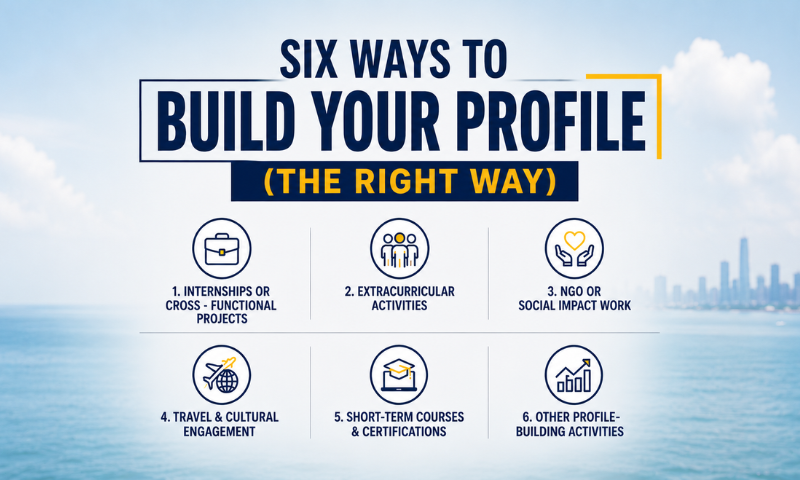
Six Ways to Build Your Profile (The Right Way)
1. Pursue Internships or Cross - Functional Projects
If you're working in a specialised field — say, marine operations or technical fleet management — an internship or project in a different domain shows you're capable of operating beyond your comfort zone. Even a short stint in business development, consulting, or a startup environment demonstrates adaptability and commercial awareness.
For seafarers, this is especially powerful. A shore-side internship in logistics, shipping analytics, or maritime policy during your leave period shows initiative and signals that you're actively building a bridge between your sea experience and a business career. You don't need a Fortune 500 name. What matters is what you did, what you learned, and how you can articulate it.
2. Engage in Extracurricular Activities
This is probably the most misunderstood part of an MBA application. Extracurriculars aren't about collecting memberships. They're about demonstrating leadership, teamwork, and passion outside your day job.
What do extracurriculars reveal about you? They show that you can manage your time across competing priorities. They show you can collaborate with people who don't share your professional background. And if you've taken a leadership role — organising events, running a community group, mentoring juniors — they show you can mobilise people around a goal.
Play a sport competitively. Run a reading group. Organise a local meetup on a topic you care about. Teach something you know well. The specific activity matters far less than the depth of your involvement and what it says about your character.
3. Contribute to NGO or Social Impact Work
Volunteering and nonprofit work carry weight — but only when done with genuine engagement. Admissions committees value social impact because it signals empathy, perspective, and the ability to work in resource-constrained environments.
Pick a cause that connects to something you've experienced or care about. If you're a mariner, that might be ocean conservation, mental health awareness for seafarers, education in coastal communities, or disaster relief coordination. Don't just show up for a photo. Take ownership of a project, track outcomes, and be able to speak about the impact you had, including what didn't work.
4. Travel and Engage with Different Cultures
If you've sailed internationally, you already have an advantage here that most land-based professionals don't. But there's a difference between passing through a port and genuinely engaging with a place.
Travel that strengthens your profile involves curiosity - learning about local industries, understanding how business works differently across regions, picking up a language, or collaborating with people from vastly different backgrounds. It builds cultural intelligence, which is a core competency for any global MBA program.
Document what you learn. Keep notes, write about it, or simply be ready to talk about how a particular experience in West Africa or Southeast Asia shifted your understanding of something.
5. Take Short-Term Bridge Courses and Certifications
A well-chosen short course does two things: it fills a genuine skill gap, and it shows that you're proactive about learning. If you come from a technical or operations-heavy background, a course in finance, data analytics, marketing fundamentals, or leadership can round out your profile significantly.
Platforms like Coursera, edX, and specialised executive education programs from schools like Wharton, MIT, or London Business School offer credible options. For mariners specifically, courses in maritime business management, supply chain analytics, or port operations and policy can bridge the gap between your sea career and a business school classroom.
Don't collect certificates for the sake of it. Pick one or two that genuinely interest you and that you can discuss in depth.
6. Other Profile-Building Activities
There are less obvious ways to build a distinctive profile - writing and publishing articles on industry topics, speaking at conferences or webinars, starting a podcast or community forum, mentoring younger professionals, contributing to open-source projects, or building something entrepreneurial on the side.
What ties all of these together is initiative. Nobody asked you to do it. You saw something worth doing and you did it. That story — the story of someone who acts without being told — is incredibly compelling in both an admissions interview and a corporate hiring conversation.

The Common Thread: Authenticity Survives Cross-Examination
Every element of your profile will be tested — in essays, in interviews, and in group discussions. The question is never just "what did you do?" It's “why did you do it, what did it teach you, and how did it change the way you think?”
If you started volunteering because you genuinely believe in a cause, those answers come naturally. If you did it to fill a gap on your application, you'll hesitate. Experienced interviewers notice.
Build your profile like you're building a life you're proud of — not a checklist you're trying to complete. The MBA application is just one moment where all of that comes together.
Ready to Plan Your Transition?
If you're a mariner thinking about an MBA, MS, or a shift to a shore-side career, the time to start building your profile is now — not when the application opens. At Sea and Beyond, we work with seafarers at every stage of this journey, from career counselling and shore job placements to AI-powered training that helps you build the skills top programs and employers are looking for.



Akshay Shrivastava
Akshay Shrivastav sailed as a Third Officer on oil and chemical tankers before deciding to chart a different course. An IMU Nautical Science graduate and incoming HEC Paris MBA candidate, he writes informational blogs for sailors — breaking down DGS circulars, certification processes, and career transition pathways so merchant navy officers can make well-informed decisions, whether they're sailing or planning the move ashore.
Leave a comment
View more
Give your career a boost with S&B professional services.
CV Prep/Evaluation Prep Service
 SeaCommerce
Shop maritime books & essentials
DG Medical Examiners
Find approved doctors near you
Tools & Calculators
Free maritime tools for seafarers
More Jobs
Marine tech
Mumbai
Project Engineer – Marine ..
Marine tech
Mumbai
Project Engineer – Mechani..
Ship management
Mumbai
Vessel Performance Analyst..
Interview Prep/Mentoring
Find your polestar with the host of experts available on our platform
Know more

Contact Us