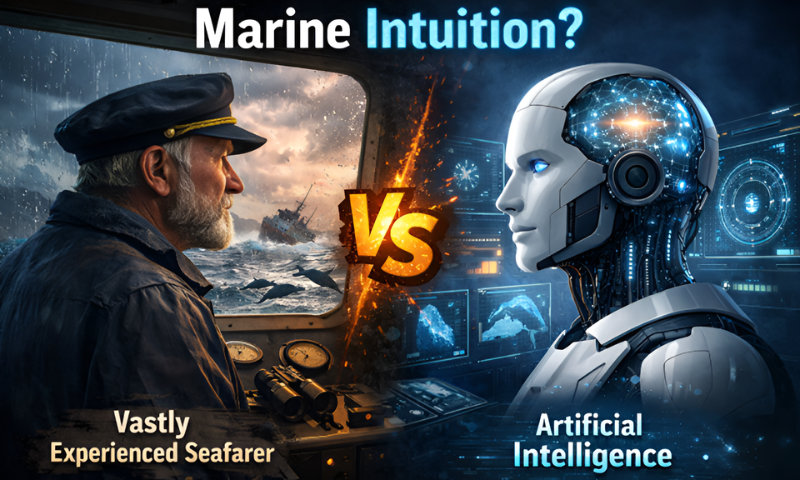
Navigating the Digital Horizon: Why Marine Intuition Cannot Be Replaced by Artificial Intelligence?
 Venkat Krishna Soundarraja
26 Mar 2026
1087 view
0
3 Comment
Abstract:
The rapid integration of Artificial Intelligence (AI) into maritime operations has sparked considerable debate about the future role of experienced seafarers. While AI demonstrably excels at real-time data processing, predictive maintenance, fatigue mitigation through 24/7 monitoring, and early hazard detection, it fundamentally cannot replicate the holistic, multi-sensory intuition forged through decades of seafaring experience. This article critically examines the boundaries of AI capability in the maritime domain, arguing that the "gut feeling" of a veteran mariner — encompassing tacit knowledge of crew dynamics, nuanced physical cues, and ethical crisis judgement — remains irreplaceable in high-stakes, ambiguous, and unprecedented scenarios. Industry data reveals a significant trust paradox: while 82% of maritime professionals acknowledge AI's operational benefits, adoption remains shallow due to human, cultural, and governance barriers rather than technical ones. The article concludes that the optimal maritime future lies not in replacement but in purposeful Human-AI collaboration — a model where AI serves as co-pilot and force multiplier, and where Subject Matter Experts (SMEs) are empowered as co-creators of digital solutions.
Introduction:
Can AI match Marine intuition in comparison to a vastly experienced seafarer & his myriad experiences at sea?
The answer is ‘No’. AI cannot fully match the marine intuition of a vastly experienced seafarer. It excels in data processing but lacks holistic judgement from decades of seafaring experiences, particularly in novel, high-stakes or ambiguous situations.
While AI excels at processing vast datasets for route optimization & detecting objects beyond human visibility, it lacks the ability to sense that something ‘ feels wrong’ or to make complex ethical decisions.
Instead of a replacement, the industry must view AI as a co-captain or force multiplier that complements human experience.
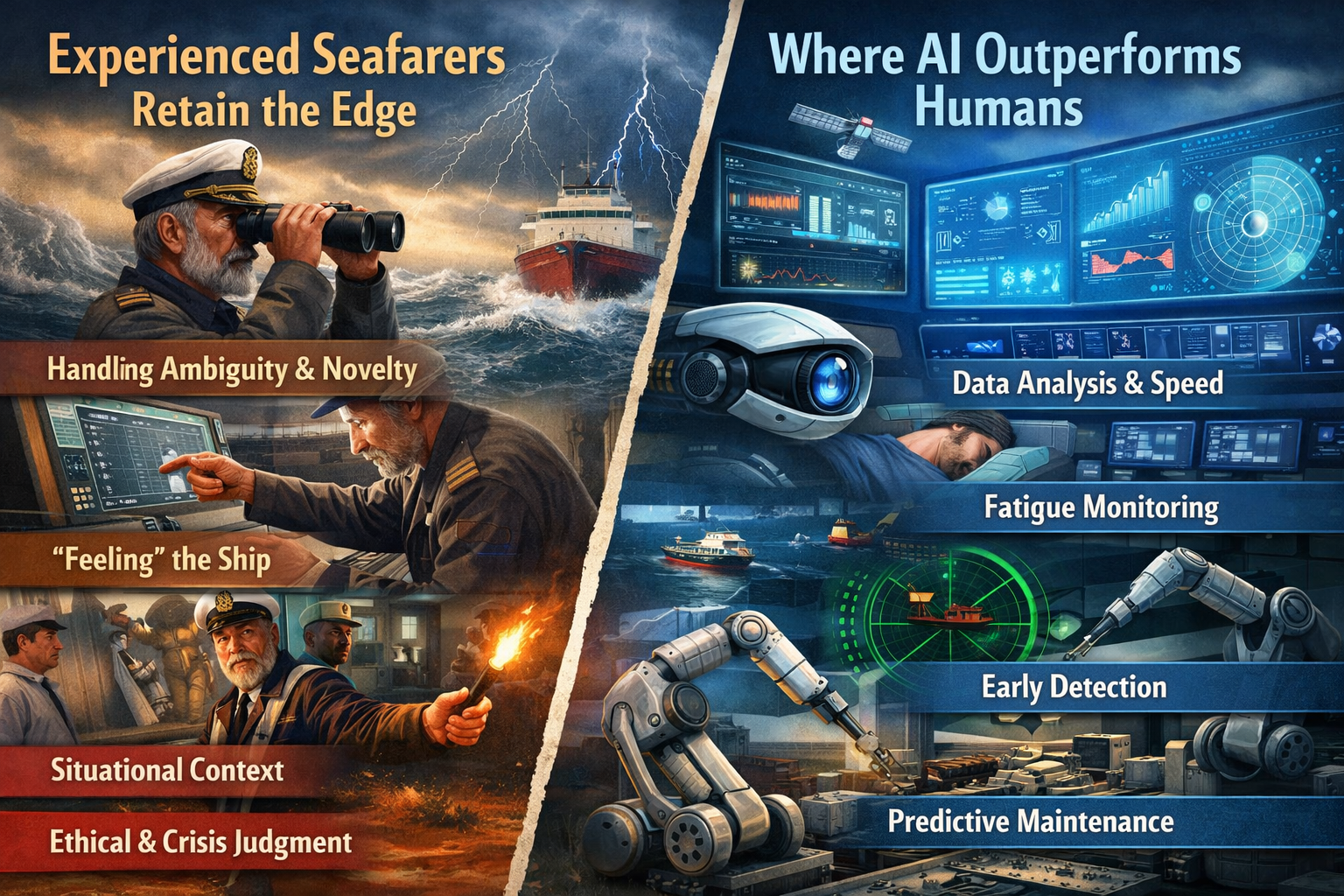
Why experienced seafarers retain the edge?
- Handling ambiguity & novelty: Experienced seafarers (subject matter experts) can adapt to unprecedented situations-such as sudden weather shifts or complex emergency maneuvers-where historical data might not exist.
Moreover, many issues resolved onboard are never documented—neither the root cause nor the solution is recorded.
Without such data, AI systems lack the training context to provide effective recommendations. In these scenarios, the AI can only speculate, which rarely leads to concrete or actionable solutions. - ‘Feeling’ the ship: human intuition often senses through nuanced physical cues (vibration, sound, smell, atmospheric changes etc.) that sensors may not capture or correctly interpret.
- Situational context: A seafarer understands the ‘human element’, including crew exhaustion, the subtle communication of a foreign-language crew or navigating in a way that prioritizes safety over raw efficiency.
- Ethical & Crisis judgement: In situations where human lives are at stake, AI struggles to make ethical choices or handle unexpected threats like piracy or drone warfare.
Where does AI outperform humans?
- Data analysis & speed: AI can analyze massive amounts of data in real-time, including engine performance, weather conditions & navigation data, which is difficult for humans to do constantly.
- Fatigue reduction & monitoring: AI systems can provide 24/7 monitoring, reducing the risk of errors caused by human fatigue or stress.
- Early detection: Certain technologies & systems already developed can detect smaller hazards (buoys, containers, small boats etc.) in low visibility better than human eyes.
- Predictive maintenance: AI can detect when machinery is nearing failure by tracking trends & patterns in sensor data, preventing breakdowns before they occur.
Key limitations of AI at sea:
- Cybersecurity risks: As AI navigation increases, so does the risk of being hacked or having signals spoofed.
- ‘Tail effects’: AI struggles with low probability, high impact ‘black swan’ events not in its training data.
Black swan events are rare unpredictable events that lie outside normal expectations, like COVID-19, geo-political events (Russian-Ukraine war, US, Israel-Iran war etc.) AI predictions collapse because the event is unprecedented. - Data reliability: AI depends on quality data, if sensors are damaged or data is inconsistent, AI driven decisions can be unsafe.
- Black box models: Models (often deep learning systems) whose internal decision-making process is opaque or hard to interpret. We see the inputs and outputs, but the reasoning in between is hidden in layers of complex parameters.
- Interpretability matters: In high-stakes domains (finance, healthcare, maritime safety), we need models that explain themselves, especially when data goes “off script.”
- Human oversight: Black box models can’t be left alone during crisis. Humans must step in with intuition, scenario planning, and domain expertise.
- Regulatory and legal gaps: International maritime law (IMO conventions, SOLAS, COLREGs) hasn’t fully caught up with autonomous AI decision-making. Liability in case of accidents remains unclear — is it the shipowner, the AI vendor, or the crew?
- Crew acceptance and trust: Even if technically sound, AI systems face resistance from seafarers who may distrust opaque algorithms. Human factors — training, confidence, and cultural attitudes — can limit adoption.
- Connectivity dependence: AI systems often rely on satellite links for real-time data. In remote oceans, connectivity can be intermittent, degrading AI’s ability to update or coordinate with shore-based systems.
- Energy and resource constraints: Advanced AI systems require significant computational power, which can strain shipboard energy systems. Maritime environments often prioritize fuel efficiency and safety over heavy computing loads, making deployment tricky.
Summary:
Feature | Veteran seafarer | Maritime-AI |
Data Input | Multi-sensory (smell, touch, sound etc.) | Data-driven (Sensors, telemetry) |
Reasoning, Trust basis | Tacit knowledge & experience, gut feeling. Proven track record & physical understanding of the machinery. | Statistical probability or correlation, requires an explainable AI to be trusted in safety critical roles. |
Crisis response | Intuitive & adaptive | Rules based & Algorithmic |
Reliability | Susceptible to fatigue/stress | Consistent 24/7 monitoring |
Context | Understands the ‘Ship’s Soul’ | Understands the ‘Ship’s Data’ |
Explainability | High: you can walk a junior engineer through your logic & physical ‘why’ or explain to the vessel superintendent how you solved a particular problem? | Low: Deep learning models often provide a result without a human readable ‘audit trail’. |
Error handling | If you make a mistake, you can usually trace the lapse in judgement or the false sensory input. | If the AI ‘hallucinates’ or fails, the root cause is often buried in layers of neural networks. |
Adaptability | You can adapt your model of the ship instantly if a new never before seen refit occurs. | The AI must be ‘retrained’ on new data or it will continue using an outdated ‘black box model’. |
Beyond the hype: What the maritime industry really thinks of AI?
Despite widespread enthusiasm for AI's potential, most maritime companies are stuck in the early stages of AI adoption, unable to scale beyond small experiments.
Research has revealed that a sector that is curious and cautiously optimistic, but still uncertain about how to move from experimentation to meaningful adoption.
82% of professionals believe AI can improve operational efficiency and reduce manual workloads. 81% have already launched pilots or small-scale projects. Yet despite this enthusiasm, adoption remains shallow with only 11% having formal policies to scale.
Just 23% are training staff to build confidence and trust in using AI as part of their daily work.
Maritime, traditionally slow to adopt new technology, is compressing typical 10–15-year adoption cycles into just 2-3 years for AI. What we see emerging is a trust paradox where the benefits and potential of AI are broadly recognized, but that same potential is causing hesitation. The real barriers are not technical. They are human.
Two-thirds of respondents fear overreliance on AI could weaken human oversight. Crucially, 37% have personally witnessed AI failures, yet remain optimistic, suggesting an industry learning from mistakes rather than abandoning AI entirely.
Many are skeptical of vendor promises and overhype.
69% are concerned about poor business outcomes if AI solutions miss critical red flags in contracts or voyage planning, while nearly a quarter express concerns about vendor claims outpacing real-world results. To realize AI’s value at scale, maritime leaders must shift their approach. Adoption is no longer just a technical issue. It is a challenge of governance, culture, and communication. Success will depend on transparent implementation, strong leadership, & tools designed specifically for the realities of maritime operations.
Maritime leaders want to act but often feel uncertain about where to begin or how to scale?
Senior executives and C-Suite leaders, in particular, express a genuine interest in AI, but there remains a significant gap between this enthusiasm and organizational readiness for implementation. The conversation frequently skews towards binary thinking: risk or opportunity, transformation or disruption.
There is a significant disconnect between the development, deployment, and actual use of AI on ships, fueling mistrust. “Salespeople sell a dream... and then time-stressed seafarers are left trying to unbox and make it work.”
What’s holding people back?
Emotional blockers:
Despite widespread optimism, there are signs that maritime stakeholders remain concerned about AI’s growing capabilities.
While many can acknowledge the benefits of new technology, emotional responses can still lead to resistance, particularly when that technology feels unfamiliar, intrusive, or threatening.
People train their AI models but they don’t train their people.
If the crew and the office do not understand the AI outputs, it could lead to misuse, which creates mistrust. We need to first train our people and our minds.
To adopt AI successfully, individuals as well as organizations need a pilot mindset, not just letting tech happen to them, but actively steering its use towards real outcomes.
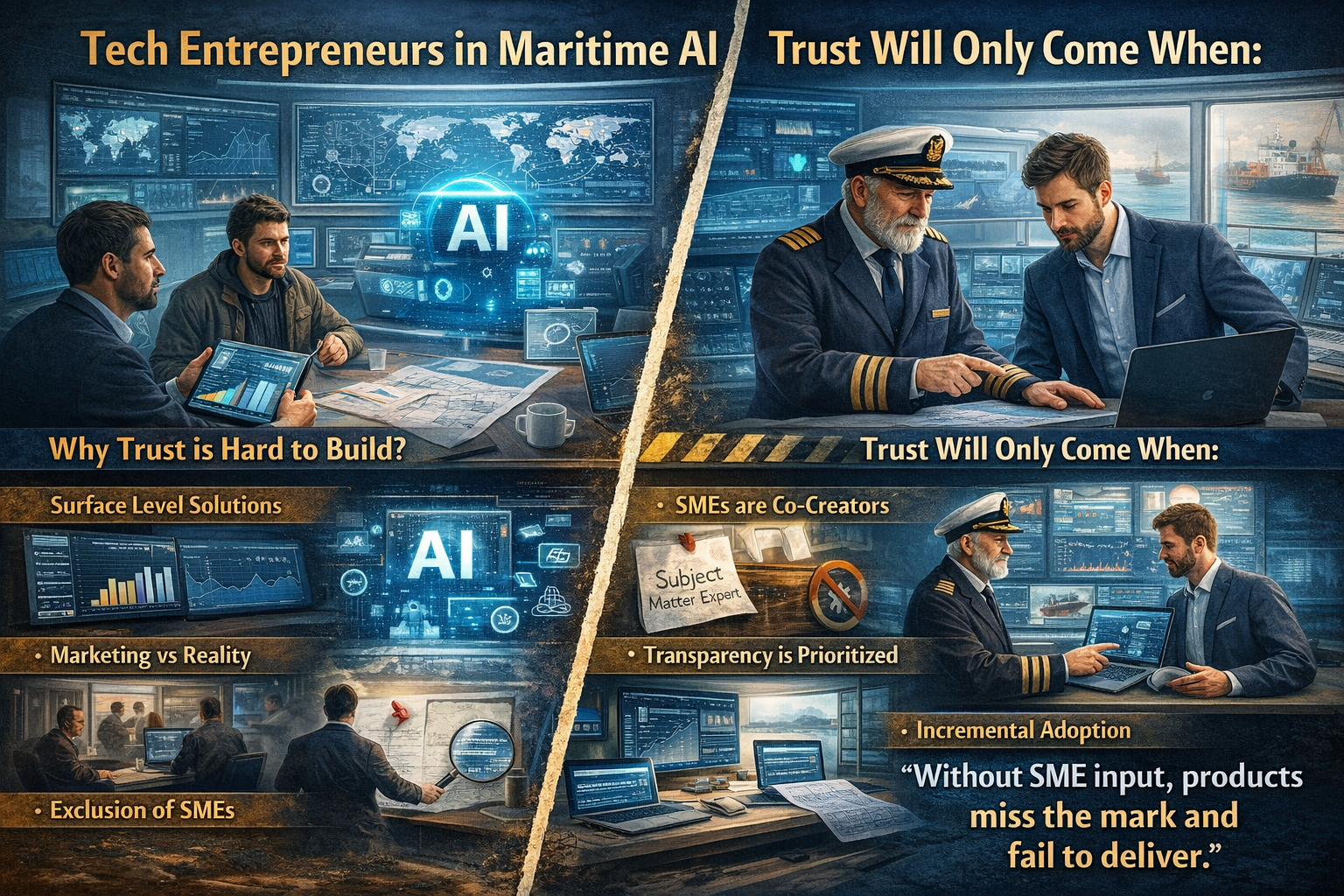
Tech Entrepreneurs in Maritime AI:
Many of the “AI for shipping” ventures are spearheaded by Tech entrepreneurs who recognize the vast potential in digitizing a traditionally conservative industry. Their enthusiasm has brought fresh ideas, investment, and momentum into maritime digitalization.
At the same time, these initiatives often originate outside the lived experience of seafaring, operations management, or regulatory compliance. While this outsider perspective can spark innovation, it also highlights the importance of securing counsel from subject matter experts (SMEs) within the industry. Collaboration between entrepreneurs and seasoned maritime professionals ensures that digital solutions are not only cutting-edge but also practical, safe, and compliant with international standards.
Why trust is hard to build?
- Surface level solutions: Without seafaring or operational background, products can end up as dashboards or analytics that look slick but don’t solve the gritty, day-to-day problems of shipboard operations, bunkering, or compliance reporting.
- Marketing vs Reality: AI gets positioned as a buzzword to attract investors, but mariners and operators quickly spot when tools don’t align with real workflows.
- Exclusion of SMEs (Subject matter experts): Subject matter experts (Chief engineers, Masters, Fleet managers) are rarely embedded in design teams. Their tacit knowledge—like how checklists are actually used onboard or how dual-fuel reporting is structured—is hard to replicate without them.
Trust will only come when:
- SMEs are co-creators:
Mariners need to be part of product design, not just end-users. - Transparency is prioritized:
AI outputs must be explainable, not black-box predictions. - Incremental adoption:
Tools that solve one pain point well (e.g. emissions reporting) will gain traction faster than ‘all-in-one’ platforms. Many marine startups overextend themselves by trying to tackle too many areas at once, diluting their expertise & struggling to establish credibility.
“Without SME input, products miss the mark and fail to deliver”.
The Gray Area:
- SME depth vs. Tech breadth:
Mariners know the nuances of ballast water management, dual-fuel operations, or port compliance—but they may not know how to structure that knowledge into a database schema or machine learning model. - Tech outsiders with jargon:
Non-mariners often learn a handful of shipping terms and assume they’ve grasped the ecosystem. They can pitch confidently to investors, but their solutions lack the tacit knowledge that comes only from lived operations.
Why this matters?
SMEs may dismiss digitalization as “gimmicky,” while tech founders dismiss mariners as “too traditional.” Both sides underestimate the other’s domain.
Without bridging this gap, AI in marine risks becoming:
- Shallow digitization:
Fancy dashboards that don’t integrate with shipboard workflows. - Distrusted tools:
Mariners won’t adopt systems that feel imposed by outsiders. - Missed opportunities:
Real value—like reproducible emissions reporting, predictive maintenance, or voyage optimization—remains underdeveloped, models remain poorly conceived.
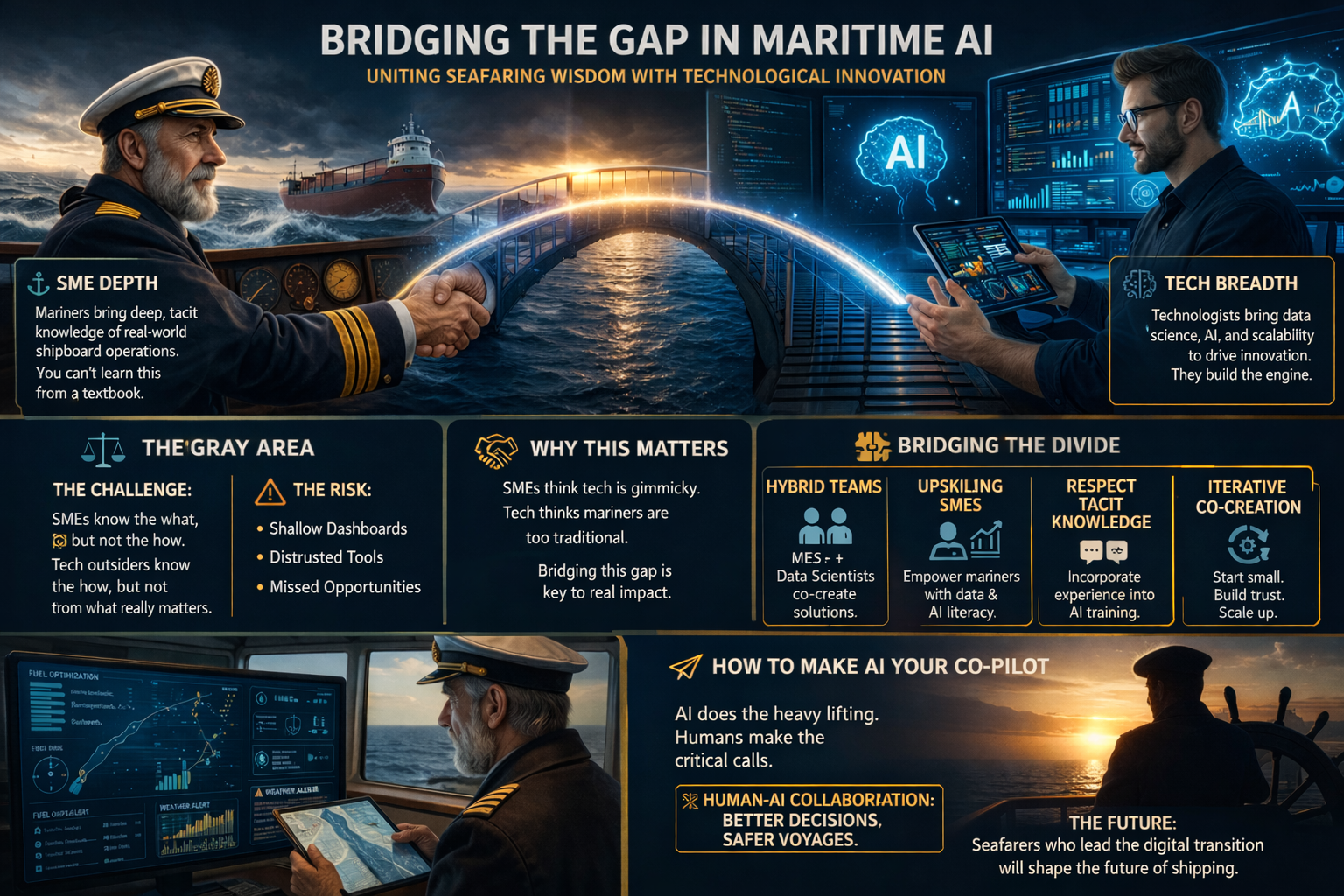
Bridging the divide:
- Hybrid teams:
Pair SMEs with data scientists in product design. The SME defines the problem; the technologist translates it into algorithms. - Upskilling SMEs:
Even basic literacy in data structures, coding logic, or AI workflows empowers mariners to challenge and refine tech solutions. - Respect for tacit knowledge:
AI models should be trained not just on sensor data but on SME annotations— for example, ‘This vibration pattern is normal in heavy seas’ or ’Slight temperature spikes in exhaust gas are typical when switching fuel grades’. - Iterative co-creation:
Start small (e.g., automating one compliance report) and expand trust gradually. Avoid overloading yourself by trying to tackle too much at once; in other words, don’t bite off more than you can chew.
How to make AI your Co-pilot?
While handing over complete control to AI feels unacceptable, risky, and untrustworthy, it is entirely feasible to use AI as a co‑pilot—leveraging its strengths while keeping critical decision‑making firmly in human hands.
Human-AI collaboration: AI handles tedious monitoring or heavy data analysis & the human makes the informed judgement calls with a full understanding of context & consequence.
Imagine a seasoned Chief Engineer, Master, or veteran seafarer—someone with years of hard‑earned experience—transitioning into a technological role. Such a leader could chart an effective roadmap for marine digitalization, bridging tradition with innovation, and inspiring fellow seafarers to embrace the future with confidence.
The outcomes of such a transition are:
- Technological proficiency: SMEs achieve digital fluency, enabling them to interpret code and architect specialized marine applications. SMEs stop being passive recipients of tech and become active shapers.
- The Domain-Tech knowledge: By bridging the gap between operational expertise and technology, SMEs ensure developers deliver outcomes aligned with real-world data and user needs.
- User-centric design: They drive the creation of high-impact applications that solve genuine maritime challenges, fostering user trust through thoughtful design.
- Growth & Authority: Through continuous learning, SMEs transition into lucrative consultancy and advisory roles within the marine and energy sectors.
- Thought leadership: They translate research into practical implementation while contributing original insights via industry white papers and blogs.
- Mentorship: They empower the broader maritime community by guiding fellow seafarers and strengthening the professional fraternity.
Requisites: A Professional Growth mindset
- Openness to change and professional evolution.
- Dedication to constant learning and staying tech-informed.
- Active reading & writing to improve technical literacy.
- Immediate application of new skills to prevent stagnation.
- Peer networking for collaborative growth.
- Project documentation and progress tracking.
- Resilience and a commitment to mentoring others.
Conclusion:
AI is a powerful tool, not a replacement for the seasoned mariner. The maritime industry stands at a critical inflection point. The technology to augment human capability is available; the challenge lies in deploying it wisely, transparently, and collaboratively.
AI's capacity for data analysis, continuous monitoring, and pattern recognition is genuinely transformative — but it operates within the boundaries of its training data and algorithmic logic. It cannot sense the "soul" of a ship. It cannot read a crew's silent exhaustion, improvise in a truly unprecedented crisis, or bear moral accountability for a life-or-death decision. These remain the sovereign domain of human expertise.
The maritime industry's trust paradox — recognizing AI's potential while hesitating to commit — is not a failure of imagination but a reflection of hard-earned operational wisdom. The industry is right to be cautious. Premature or uncritical AI adoption in safety-critical environments carries real and serious consequences. The solution is not to slow digitalization but to deepen it through meaningful SME participation, transparent system design, and a governance culture that keeps humans firmly in the decision-making loop.
Ultimately, the most productive and safest maritime future is one in which the veteran mariner and the AI system are genuine co-pilots. The mariner brings irreplaceable intuition, ethical judgement, and contextual wisdom; the AI brings tireless vigilance, computational precision, and predictive insight. Together, they are far more capable than either alone. The imperative for the maritime industry is not to choose between human and artificial intelligence, but to invest purposefully in the partnerships, training, and governance frameworks that make their collaboration both effective and trustworthy. “AI won’t take your job—people who master AI will”.


Venkat Krishna Soundarraja
Mr. S. Venkat Krishna is the Chief Data Officer at Volteo Maritime, with a background as a Marine Engineer. He brings over 28 years of sailing experience, including 15 years as a Chief Engineer in the tanker industry. A Fellow of the Institution of Marine Engineers (India), he specializes in condition monitoring, data analytics, and reliability engineering. His expertise spans crude oil, product, and chemical tankers, as well as bulk carriers and container vessels.
In his current role, he focuses on ensuring data quality, driving the adoption of AI and machine learning, and enabling data-driven decision-making to enhance organizational performance. Proficient in Python, R, and Power BI, he plays a key role in transforming data into a strategic asset.
Mr. Krishna is also a visiting faculty member, technical mentor, and published researcher, with a strong passion for innovation, education, and emerging technologies. Outside of work, he enjoys singing and artistic sketching—blending creativity with technical precision.
Leave a comment
View more
Give your career a boost with S&B professional services.
CV Prep/Evaluation Prep Service
 SeaCommerce
Shop maritime books & essentials
DG Medical Examiners
Find approved doctors near you
Tools & Calculators
Free maritime tools for seafarers
More Jobs
Marine tech
Mumbai
Project Engineer – Marine ..
Marine tech
Mumbai
Project Engineer – Mechani..
Ship management
Mumbai
Vessel Performance Analyst..
Interview Prep/Mentoring
Find your polestar with the host of experts available on our platform
Know more

Contact Us