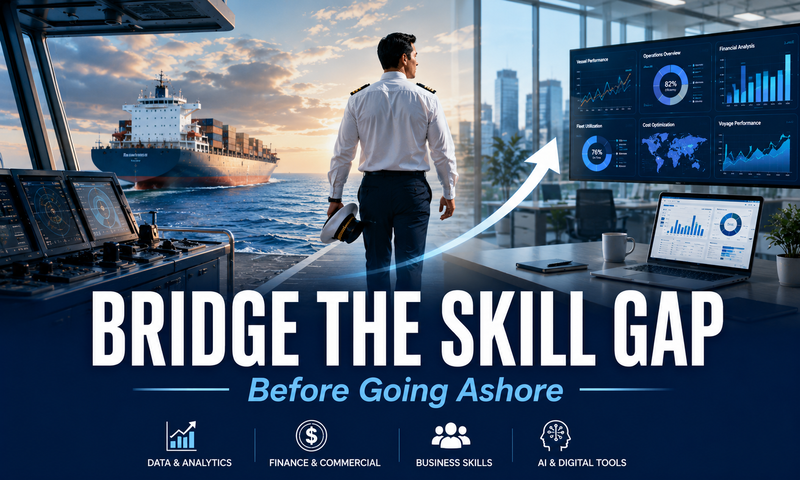
Short Courses to Bridge the Skill Gap Before Going Ashore
 Akshay Shrivastava
01 Jun 2026
467 view
0
0 Comment
Here's something nobody tells you when you're still sailing: the biggest obstacle to getting a good shore job isn't your experience. It's the gap between what you know and what a shore employer assumes you know.
You've managed a bridge team in 40-knot winds. You've handled cargo operations worth millions. You've led safety drills, maintained compliance across flag states, and made split-second decisions that most office professionals will never face.
But when you look at the job description for shore jobs, It'll mention Excel models, data dashboards, financial analysis, or "digital transformation strategy." Terms many seafarers don’t even bother to learn about.
The good news? The gap is narrower than you think. And it can be closed with the right short courses (many of them free) taken strategically before or during your transition.
This post is a practical guide to doing exactly that.
First, a Mindset Shift: You Don't Need to Learn Everything
The biggest mistake seafarers make when preparing for shore roles is trying to become completely different professional. You're not starting from zero. You're adding a layer, a translation layer, that helps shore employers see your existing skills in their language.
That means you don't need a full-time MBA to get started (though it's great if you're planning one down the road). What you need are targeted, short-duration courses that fill specific gaps in tech fluency, commercial knowledge, or business communication.
Think of it like this: you already have the engine. These courses are the shore-side navigation charts.
Here's what to focus on, broken into three skill clusters.
Cluster 1: Tech & Data - Because Every Shore Job Now Runs on Dashboards
This is the single biggest gap most transitioning seafarers face. Shore roles - whether in ship management, operations, chartering, or even crewing - now involve data. Dashboards. Reports. Analytics. If you can open Power BI or build a pivot table without breaking a sweat, you're already ahead of half the applicants.
Free courses to start with:
- Microsoft Power BI - Get Started (Microsoft Learn) - Build interactive dashboards and reports without writing code. This is the most immediately useful skill for any operations or management role ashore.
- SQL for Data Science (Coursera) - If the shore role involves any kind of database or reporting system, knowing basic SQL puts you in a different league.
- Data Analytics Basics for Everyone (edX) - A gentle, non-technical starting point if you've never worked with data tools before. No prerequisites, no jargon.
- AI for Everyone (Coursera / DeepLearning.AI) - Not a coding course. This is a primer on what AI can and can't do, and why every shipping company is suddenly talking about it. Great for interview conversations.
Go Deeper with Sea and Beyond:
- Maritime Focused Power BI Course - This isn't a generic Power BI tutorial. It uses real maritime datasets - vessel performance, voyage data, port statistics - so what you learn maps directly to the work you'll be doing ashore. Includes DAX, data modelling, and even a ChatGPT integration bonus module.
- Maritime Focused Excel Course - Twelve hours of hands-on Excel training built for maritime professionals. From formulas and pivot tables to advanced data analysis. If you can only take one course before your first shore interview, make it this one.
- AI Tools & LLMs for Maritime Professionals - Practical introduction to AI tools and Large Language Models with a shipping-specific lens. Covers prompt writing, data privacy, and ethical AI use - the kind of applied knowledge that makes you useful from day one.
Cluster 2: Finance & Commercial - Speaking the Language of the Business side
If you're aiming for chartering, ship broking, P&I, marine insurance, or any commercial shipping role, you need to understand how money moves through the industry. You've seen it from the operational side - cargo loaded, vessel sailed, port cleared. Now you need to see the same voyage from the fixture, the freight invoice, the laytime calculation, and the insurance claim.
Free courses to start with:
- Financial Accounting and Analysis (IIM Bangalore) - Learn to read and analyse financial statements with confidence. A foundational skill for any commercial role.
- Intro to Banking & Financial Markets (IIM Bangalore) - Useful context if you're heading into ship finance, trade finance, or any role that touches banking relationships.
- Strategic Management (Coursera) - Corporate strategy tools and case-based learning. Good preparation for interviews where they'll ask you about market trends and competitive positioning.
- Finance Courses Free Library (Corporate Finance Institute) - A solid collection covering financial modelling, accounting, and capital markets. Pick what's relevant to the role you're targeting.
Go Deeper with Sea and Beyond:
- Applied Commercial Shipping for Professionals - A 36-hour intensive that covers chartering, freight markets, bills of lading, laytime/demurrage, ship S&P, and marine insurance. You role-play from owner, charterer, and broker perspectives - exactly the kind of applied learning that generic business courses can't offer.
- Tanker Chartering - Oil trade geography, Worldscale structure, voyage estimation, and the full fixture lifecycle. If tankers are your target market, this is the course.
- Marine Insurance - Policies, P&I, hull and machinery, claims procedures, general average, and risk management. If you're looking at P&I clubs, underwriting, or claims roles, start here.
Cluster 3: Business Skills & Professional Development - The Stuff That Gets You Hired
Technical knowledge gets your CV shortlisted. But the interview, the first 90 days, and the long-term career trajectory - those depend on softer skills that seafarers often underestimate. Communication for corporate settings. Project management frameworks. Understanding how organisations are structured and why.
Free courses to start with:
- Effective Business Communication (IIM Bangalore) - Clear, professional communication for corporate contexts. This isn't about grammar - it's about structuring emails, presentations, and reports the way shore professionals expect.
- Google Project Management Certificate (Coursera / Google) - Covers traditional and agile project management. Recognised by employers, and the agile methodology section is particularly relevant for maritime tech and operations roles.
- Operation Management (IIM Bangalore) - Process design, efficiency, and operations strategy. You already think in these terms on a vessel - this course gives you the corporate vocabulary.
- Fundamentals of Digital Marketing (Google Skillshop) - Even if you're not going into marketing, understanding digital marketing basics helps in business development, client management, and commercial roles.
Go Deeper with Sea and Beyond:
- Product and Commercial Strategy - How maritime professionals can think like product managers. If you're joining a maritime tech company or a commercial desk, this bridges the gap between operational thinking and strategic decision-making.
- Stakeholder & Change Management Strategies - Managing stakeholders and leading change in maritime organisations. Also includes career pathway guidance for digital maritime roles - useful if you're targeting the intersection of shipping and technology.
- Plan Your Transition Ashore - A structured framework specifically for seafarers preparing to move to shore employment. Covers positioning, planning, and practical execution. This isn't a business skills course - it's a career transition course built by people who've actually made the move.
The transition from sea to shore is one of the most significant career shifts a maritime professional will make. But it doesn't have to be a leap in the dark. With the right courses - taken in the right order, at the right time - you can walk into that first shore interview knowing you've already closed the gap.
You just have to start.



Akshay Shrivastava
Akshay Shrivastav sailed as a Third Officer on oil and chemical tankers before deciding to chart a different course. An IMU Nautical Science graduate and incoming HEC Paris MBA candidate, he writes informational blogs for sailors — breaking down DGS circulars, certification processes, and career transition pathways so merchant navy officers can make well-informed decisions, whether they're sailing or planning the move ashore.
Leave a comment
View more
Give your career a boost with S&B professional services.
CV Prep/Evaluation Prep Service
 SeaCommerce
Shop maritime books & essentials
DG Medical Examiners
Find approved doctors near you
Tools & Calculators
Free maritime tools for seafarers
More Jobs
Ship management
Mumbai
Vessel Performance Analyst..
Ship management
Mumbai
Vessel Performance Enginee..
Ship management
Mumbai
Voyage Optimisation Manage..
Interview Prep/Mentoring
Find your polestar with the host of experts available on our platform
Know more

Contact Us