
Beyond the Gangway: How Seafarers Can Become SIRE-Accredited Inspectors
 Akshay Shrivastava
08 Apr 2026
4317 view
0
5 Comment
If you've spent years at sea on tankers, you already know the drill — a SIRE inspection can make or break a vessel's commercial viability. But have you ever considered being the one holding the clipboard? Here's everything you need to know about becoming a SIRE-accredited inspector.
What Exactly is SIRE Inspector Accreditation?
The Ship Inspection Report Programme (SIRE), managed by the Oil Companies International Marine Forum (OCIMF), is the global gold standard for tanker vetting. Every oil major, charterer, and terminal operator relies on SIRE reports to assess whether a vessel is safe, well-maintained, and commercially viable.
A SIRE Inspector is the professional who goes aboard, inspects the vessel from bridge to engine room, and compiles the report that goes into the SIRE database. Getting accredited means you have been trained and assessed by OCIMF to carry out these inspections on behalf of an OCIMF member company — also known as a Submitting Company.
This isn't a role you apply for directly with OCIMF. A Submitting Company must nominate you. That distinction is important, but don’t worry yet, we'll get into what it means for your strategy later.
Key Fact: OCIMF organises and manages the accreditation programme, but every new applicant must be nominated by a SIRE Submitting Company. You cannot self-apply. The nominating company is responsible for verifying all your qualifications and experience before forwarding your application to OCIMF.
Two Categories — Which One is Right for You?
SIRE inspectors fall into two main categories, and the one that fits you depends on the type of vessels you've sailed on and the kind of inspections you'd be conducting.
Category 1 — Ocean-Going Tankers
This is the main category most deep-sea officers will aim for. Cat-1 inspectors carry out inspections on oil tankers, chemical tankers, and gas carriers — the big iron. If you've been sailing as a senior officer on ocean-going tankers, this is your track.
Category 3 — Barges & Inland Vessels
Cat-3 covers barge inspections across specific regions: North America, South & Central America, and Europe. The certification and experience requirements here are different — geared toward barge officers, barge masters, and professionals with extensive day-to-day barge operations experience.
For most active seafarers reading this from a deep-sea tanker background, Category 1 is your target. The rest of this guide focuses primarily on Cat-1, with a brief section on Cat-3 at the end.
Category 1: The Full Roadmap
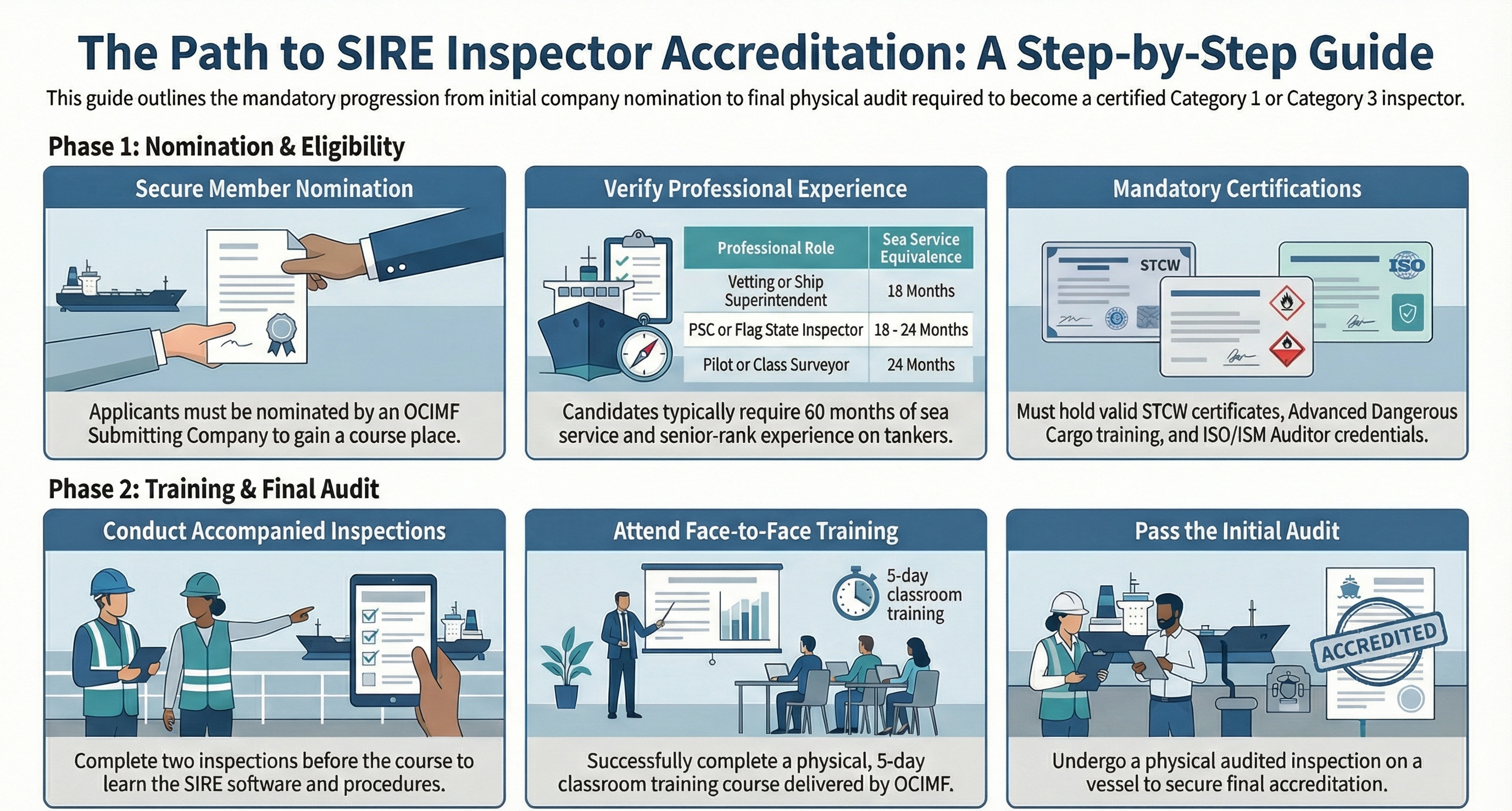
Let's break down the entire journey from deciding "I want to do this" to getting your accreditation. There are six distinct stages.
Step 1: Meet the Eligibility Criteria
Before anything else, confirm you meet the minimum requirements. This is the non-negotiable foundation.
Certification — you must hold:
- A valid Certificate of Competency (STCW II/1, II/2, III/1, or III/2) either as Deck officer or an Engine officer from a recognised flag state
- Advanced dangerous cargo training certificates for the vessel types you want to inspect (oil, chemical, or gas tankers)
- A valid ISO/ISM Auditor Course completion certificate
Sea Service — you must have:
- At least 60 months of overall sea service on ocean-going vessels above 3,000 GT (or engines above 3,000 kW for engineer officers)
- At least 18 months of senior rank sea service (Master, Chief Officer, Chief Engineer, or 1st/2nd Engineer) specifically on oil, chemical, or gas tankers
Important notes on sea service calculation:
- Experience on FSO/FPSO or other floating storage vessels counts at 50% of actual time for overall sea service
- FSO/FPSO experience does NOT count toward the 18-month senior rank requirement
- Up to 6 months of the senior rank requirement can be substituted using the equivalence table (see below)
Step 2: Secure a Nomination from a Submitting Company
This is arguably the hardest part. You need an OCIMF member company that submits SIRE reports to nominate you. These are typically major oil companies, large tanker operators, and prominent charterers.
Who Can Nominate You?
Only OCIMF member companies that are registered as SIRE Submitting Companies can nominate you for accreditation. The full list runs to over 100 organisations globally, but here are the names seafarers will recognise: Shell, BP, Chevron, TotalEnergies, ExxonMobil (via IMT), Equinor, Aramco, QatarEnergy, Petrobras, Marathon Petroleum, Phillips 66, Valero, Cargill Ocean Transportation, and MISC Maritime Services — among others. For Indian officers, Reliance Industries Limited is the only Indian company on the OCIMF member list. That said, many international majors run their vetting and marine assurance operations out of Singapore, Dubai, and London, and actively engage experienced tanker officers from India. Companies like Marathon Petroleum have publicly stated that they employ both in-house and third-party SIRE-accredited inspectors worldwide — so opportunities exist beyond direct employment. The complete list of OCIMF members is available at ocimf.org/about-ocimf/members.
Start building relationships with the vetting or marine assurance departments of these organisations. Many won't nominate external candidates unless they see a strong professional profile and genuine commitment.
The nominating company must be satisfied that you possess the required qualifications, knowledge, experience, and physical fitness — and that you are an individual of integrity who can represent the best interests of the SIRE Programme.
Step 3: Complete Pre-Course Accompanied Inspections
Once nominated, you must complete at least two accompanied inspections before attending the training course. These are conducted alongside an existing accredited inspector.
If you don't hold a Dangerous Cargo Endorsement (DCE) as per STCW, you'll need at least two additional accompanied inspections on each vessel type you're seeking accreditation for.
The purpose of these accompanied inspections is to introduce you to the practical aspects of the SIRE inspection system, the actual conduct of an inspection, and the SIRE editor software.
Step 4: Attend the SIRE New Inspector Training Course
The course is delivered face-to-face over five days. It covers the SIRE 2.0 methodology, inspection techniques, and report writing standards.
Your nominating company submits your application through the SIRE electronic registration portal. Applications should be submitted at the earliest opportunity to allow sufficient time for logistics — venue setup, visa applications, accommodation, and travel.
OCIMF reviews courses up to three months before start dates to determine whether they will proceed.
Step 5: Complete Post-Course Accompanied Inspections
After successfully completing the training course, you must undertake two more accompanied inspections. These can be completed on any vessel type for which accreditation is being sought.
Think of this as your supervised practice period before going solo.
Step 6: Pass the Initial Audited Inspection
The final gate. You must successfully undergo an initial audited inspection during a physical SIRE Cat-1 inspection. An OCIMF assessor evaluates your inspection technique, report quality, and overall competence.
Pass this, and you're accredited. Congratulations!!
The Equivalence Table — Important for Career Changers
If you've moved ashore and are working in certain maritime roles, some of that shore-side experience can count toward the 18-month senior rank requirement. Up to 6 months of the senior rank sea service can be substituted using the table below.
Note: The 60-month overall sea service requirement cannot be substituted — that needs to be actual time served at sea.
| Shore-Side Role | Equivalent Credit |
|---|---|
| Vetting Superintendent (Submitting Company only) | 18 months |
| Ship Superintendent (Oil/Chemical/Gas tankers only) | 18 months |
| PSC Inspector | 18 months |
| Flag State Inspector | 24 months |
| Pilotage | 24 months |
| Mooring / Loading Master | 24 months |
| Terminal Operator | 24 months |
| Class Surveyor | 24 months |
Special Pathway — Less Than 60 Months Sea Service: If you have less than 60 months of total sea service, you can still qualify — but only if you are currently employed in the marine assurance department of the nominating Submitting Company. You'll need a structured, documented training programme administered by that company covering ethics, code of conduct, and shipboard operations for the vessel types you'd inspect. The 18-month senior rank requirement still applies.
Additional Requirements You Shouldn't Overlook
ECDIS Training
All Cat-1 inspectors must complete a one-day ECDIS training course for inspectors. If you haven't done this yet, OCIMF will allocate you to a course. As of 2026, no new ECDIS courses are currently scheduled — keep an eye on OCIMF updates.
Refresher Courses
Accreditation isn't a one-and-done deal. Cat-1 inspectors are allocated refresher courses by OCIMF, delivered via online platforms in 2026. Cat-3 refresher courses will be face-to-face. Multiple refresher sessions are scheduled throughout 2026 across Asia, the USA, Europe, and the Middle East.
Ongoing Performance Reviews
OCIMF has suspended the traditional renewal audit (where you'd be assessed during a physical inspection) for existing Cat-1 inspectors. Instead, an alternative performance review process is in place — OCIMF continuously reviews inspector performance and prioritises reviews by original accreditation expiry date. Your reports are being evaluated, so stay sharp.
A Quick Note on Category 3
If your background is in barge operations rather than deep-sea tankers, Cat-3 could be your entry point. The requirements are less stringent on sea time — you need at least two years served on the vessel types you'd inspect — but you'll still need appropriate certification (barge master licence, Second Engineer COC, or extensive barge operations experience), advanced training for the vessel type, and strong English proficiency in both written and spoken form.
Regional knowledge and familiarity with local regulations are also essential, as Cat-3 programmes are region-specific. The nominating Submitting Company must assess and verify your knowledge before passing your application to OCIMF.
Practical Tips for Seafarers Planning This Move
Start your documentation early. Gather your COCs, advanced dangerous cargo certificates, and ISM auditor certification well before you approach a Submitting Company. Missing even one certitificate can delay your nomination by months.
Get your ISO/ISM Auditor course done while still sailing. Many officers neglect this, but it's a mandatory requirement. Do it during leave — it typically takes 3–5 days and is offered by most major classification societies.
Network strategically. The nomination requirement means your path to accreditation runs through a Submitting Company. Attend maritime conferences, engage on LinkedIn, and let vetting superintendents know you're interested. Some companies actively seek experienced officers for their inspector panels.
Keep your sea service records meticulous. Every month counts. Make sure your Continuous Discharge Certificate (CDC) and sea service letters are accurate and show rigour, especially for the 18-month senior rank requirement on tankers. Time on FSO/FPSO vessels counts at only 50% for overall sea service and doesn't count at all for the senior rank requirement.
Think long-term. SIRE accreditation isn't just a career step — it positions you at the intersection of safety, compliance, and commercial operations. It opens doors to vetting superintendent roles, marine consultancy, and senior positions with oil majors and P&I clubs.
Ready to Make the Move?
For queries on SIRE Cat-1 or Cat-3 courses, reach out to OCIMF directly:
- SIRE courses: sireaccredit@ocimf.org
- Official page: https://www.ocimf.org/sire-inspector-accreditation
And if you're looking for guidance on planning your maritime career transition, we're here to help.



Akshay Shrivastava
Akshay Shrivastav sailed as a Third Officer on oil and chemical tankers before deciding to chart a different course. An IMU Nautical Science graduate and incoming HEC Paris MBA candidate, he writes informational blogs for sailors — breaking down DGS circulars, certification processes, and career transition pathways so merchant navy officers can make well-informed decisions, whether they're sailing or planning the move ashore.
Leave a comment
View more
Give your career a boost with S&B professional services.
CV Prep/Evaluation Prep Service
 SeaCommerce
Shop maritime books & essentials
DG Medical Examiners
Find approved doctors near you
Tools & Calculators
Free maritime tools for seafarers
More Jobs
Misc
Mumbai
Front Desk Executive – Mum..
Sales and Marketing
Mumbai
Sales Manager
Ship management
Khapoli
Computer Science Faculty –..
Interview Prep/Mentoring
Find your polestar with the host of experts available on our platform
Know more