
Standard Deviation vs Standard Error: Why It Matters!
 Venkat Krishna Soundarraja
11 Jul 2025
7027 view
0
4 Comment
In the world of data-driven decision-making, understanding the difference between standard deviation (SD) and standard error (SE) is not just academic—it's essential.
Misinterpreting these metrics can lead to flawed conclusions, missed opportunities, or costly missteps.
SD, SE, and Confidence Intervals: What They Tell You?
Standard Deviation (SD): Describes Spread. SD tells you how spread out your data is. It’s used to understand individual variability in your dataset. But SD alone doesn’t tell you how precise your estimate of the mean is.
Standard Error (SE): Describes Precision. SE tells you how precise your sample mean is as an estimate of the population mean. It’s the key ingredient in building confidence intervals.
Confidence Interval Formula:
For a 95% confidence interval around the sample mean:
CI = 
 = sample mean,
  = critical value (e.g. 1.96 for 95% CL)
σ = population standard deviation, n = sample size
Understanding SD and SE:
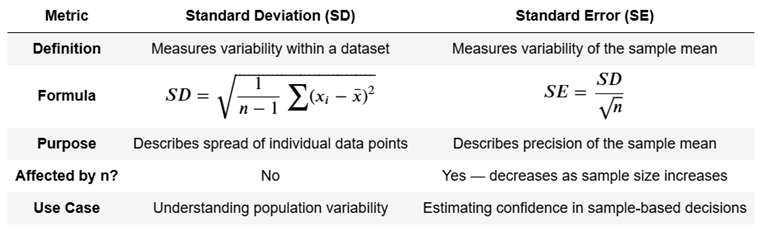
*n is no. of samples.
Why it matters for business?
Risk Assessment:
- Standard Deviation (SD): helps quantify volatility—be it in customer behavior, sales, or operational metrics.
- Standard Error (SE): helps assess how reliable your sample-based estimates are, which is crucial for forecasting and budgeting.
Decision Confidence:
- A small SE: implies high confidence in your sample mean, guiding pricing, inventory, or marketing strategies.
- A large SE: suggests more uncertainty—decisions made here carry higher risk.
Central Limit Theorem: The Central Limit Theorem (CLT) states that the sampling distribution of the mean of any independent, random variable will be normal or nearly normal, if the sample size is large enough.
Key Concepts:
- Population Distribution: The original distribution of data (can be any shape).
- Sampling Distribution: The distribution of sample means from repeated sampling.
- As sample size increases, the sampling distribution becomes more normal.
Visualizing the concepts:
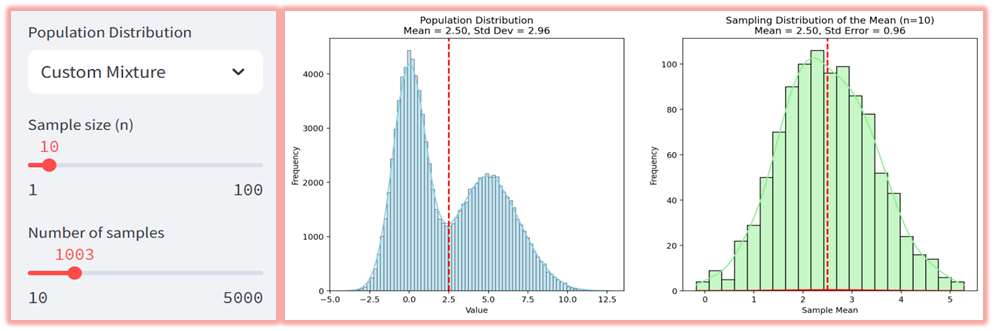
Scenario 1: Sampling from a custom mixture of distribution with 1003 samples, each with 10 observations.
What's happening here?
- Population: We started with a custom mixture distribution (left plot) with mean μ = 2.50 and standard deviation σ = 2.96.
- Sampling: We took 1003 samples, each with 10 observations, and calculated their means.
- Results: The distribution of these sample means (right plot) has:
- Mean = 2.50 (same as μ)
- Standard Error = 0.96 (close to σ/√n = 0.94)
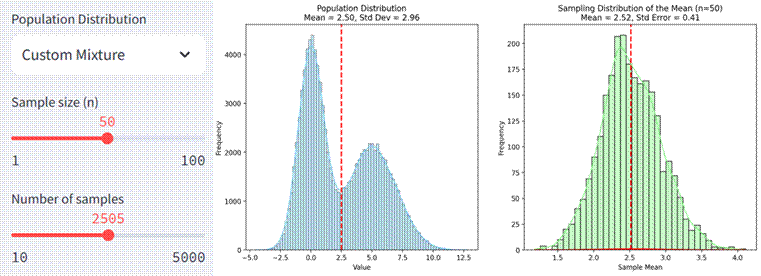
Scenario 2: Sampling from a custom mixture of distribution with 2505 samples, each with 50 observations.
What's happening here?
- Population: We started with a custom mixture distribution (left plot) with mean μ = 2.50 and standard deviation σ = 2.96.
- Sampling: We took 2505 samples, each with 50 observations, and calculated their means.
- Results: The distribution of these sample means (right plot) has:
- Mean = 2.52 (very close to μ)
- Standard Error = 0.41 (close to σ/√n = 0.42)
Scenario 3: Sampling from a custom mixture of distribution with 5000 samples, each with 100 observations.
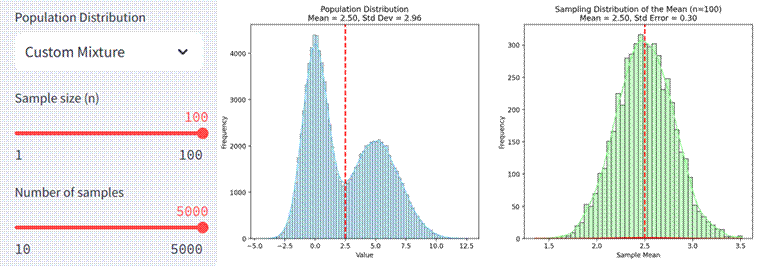
What's happening here?
- Population: We started with a custom mixture distribution (left plot) with mean μ = 2.50 and standard deviation σ = 2.96.
- Sampling: We took 5000 samples, each with 100 observations, and calculated their means.
- Results: The distribution of these sample means (right plot) has:
- Mean = 2.50 (same as μ)
- Standard Error = 0.30 (close to σ/√n = 0.30)
As sample size increases, the standard error decreases, providing a more precise estimate of the population mean.
CLT Observations:
- The sampling distribution is approximately normal even though the population is custom mixture.
- The sampling distribution is approximately normal even though population distribution would be Uniform, Exponential, Binomial, Poisson, or any other distribution.
- As sample size (n) increases, the standard error decreases (σ/√n).
- The mean of the sampling distribution equals the population mean.
- This holds true regardless of the population distribution shape, as n becomes large(typically n ≥ 30).
Key Takeaways:
- The CLT explains why many statistical procedures assume normality.
- It allows us to make inferences about population parameters using sample statistics.
- The approximation improves with larger sample sizes.
- The population distribution shape becomes less important as n increases.
Sample Size and Hypothesis Testing:
The Null Hypothesis Dilemma
- Small sample size → Large SE → Wide confidence intervals → May fail to reject the null hypothesis even if an effect exists (Type II error).
- Large sample size → Small SE → Narrow confidence intervals → May reject the null hypothesis even for trivial effects (risk of overinterpreting significance).
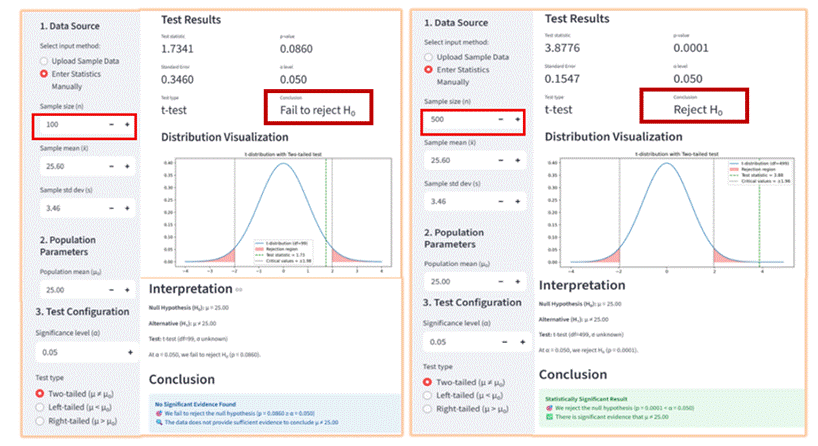
Use Case: Testing operational fuel consumptions against a hypothesized mean of fuel consumption, population standard deviation is unknown in this case. A t-test is performed.
A low sample size of 100 concludes with ‘Fail to reject Null hypothesis’, while increasing sample size to 500 for similar set of mean and standard deviation value concludes with ‘Rejecting the Null hypothesis’. Exactly opposite results.
The decision confidence is low for small samples; risk of Type II error is high. (Type II error means ‘failing to reject the Null hypothesis’, even though it is false, in short it is ‘false negative’).
Example: You’re testing to see if something has an effect.
The test says: “Nope, no effect.” But in reality: There actually is an effect. So, the test missed it—that’s a false negative.
Note: Type I error is ‘false positive’. Type II error is ‘false negative”.
Reducing Type II Error:
- Increase sample size (reduces standard error).
- Use more sensitive tests.
- Accept a slightly higher Type I error rate (α) to gain power.
APPLICATIONS:
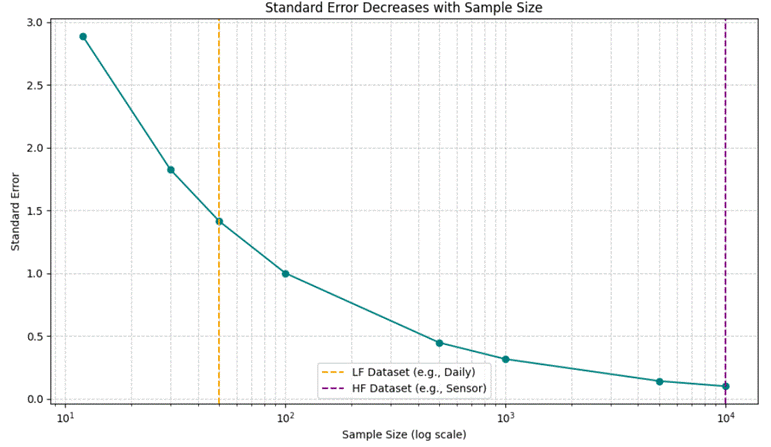
Comparing HF vs LF datasets: The above-mentioned tests can be used to show a powerful comparison between low-frequency (LF) and high-frequency (HF) datasets which illustrates how standard error and sample size interact.
This contrast is especially relevant in fields like finance, operations & sensor analytics (Marine, Oil &Gas).
LF datasets often lead to larger SE, making it harder to detect statistically significant effects. This can result in missed opportunities or conservative decisions.
HF datasets reduce SE, increasing the likelihood of rejecting the null hypothesis—but this also raises the risk of detecting trivial or spurious effects.
Final Thoughts:
In the realm of data-driven decisions, knowing the difference between standard deviation and standard error isn't just statistical trivia—it's strategic insight.
SD tells you how wild the world is; SE tells you how sure you are about your view of it.
As you navigate business challenges—whether forecasting demand, optimizing operations, or validating hypotheses—remember: “precision matters”.
A small standard error can give you the confidence to act boldly, while a large one should prompt caution and curiosity.
So next time you're handed a dataset, ask yourself not just “What’s the average?” but “How sure are we about that average?”
That one question could be the difference between a smart bet and a blind leap. ⚓


Venkat Krishna Soundarraja
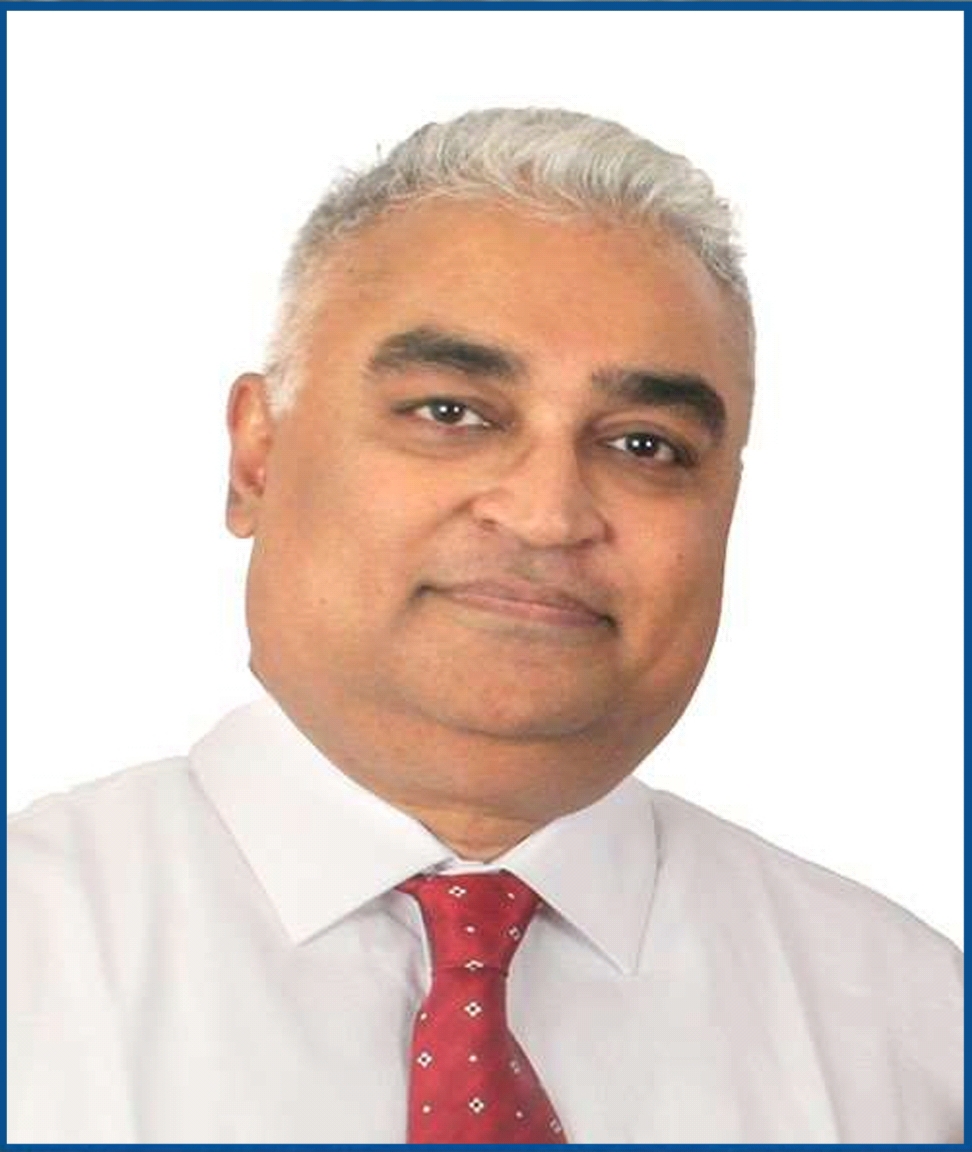
Mr. S. Venkat Krishna is the Chief Data Officer at Volteo Maritime, with a background as a Marine Engineer. He brings over 28 years of sailing experience, including 15 years as a Chief Engineer in the tanker industry. A Fellow of the Institution of Marine Engineers (India), he specializes in condition monitoring, data analytics, and reliability engineering. His expertise spans crude oil, product, and chemical tankers, as well as bulk carriers and container vessels.
In his current role, he focuses on ensuring data quality, driving the adoption of AI and machine learning, and enabling data-driven decision-making to enhance organizational performance. Proficient in Python, R, and Power BI, he plays a key role in transforming data into a strategic asset.
Mr. Krishna is also a visiting faculty member, technical mentor, and published researcher, with a strong passion for innovation, education, and emerging technologies. Outside of work, he enjoys singing and artistic sketching—blending creativity with technical precision.
Leave a comment
View more
Give your career a boost with S&B professional services.
CV Prep/Evaluation Prep Service
 SeaCommerce
Shop maritime books & essentials
DG Medical Examiners
Find approved doctors near you
Tools & Calculators
Free maritime tools for seafarers
More Jobs
Ship management
Ahmedabad
Project Engineer | Civil ..
Ship management
Chennai
Electrical Superintendent ..
Ship management
Chennai
Head of Reporting – Vessel..
Interview Prep/Mentoring
Find your polestar with the host of experts available on our platform
Know more

Contact Us