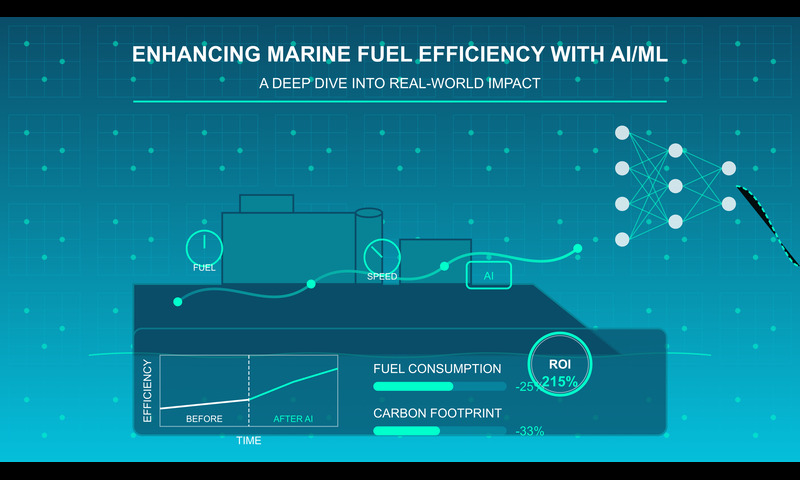
Enhancing Marine Fuel Efficiency with AI/ML: A Deep Dive into Real-World Impact
 Sea and Beyond
08 May 2025
4814 view
0
2 Comment
In today’s rapidly evolving maritime landscape, two challenges dominate operational strategy: rising fuel costs and tightening environmental regulations. Traditional methods—centered around historical data, static route planning, and manual reporting—are no longer sufficient to keep fleets efficient and compliant.
What’s emerging in their place is a powerful combination of Artificial Intelligence (AI) and Machine Learning (ML) —technologies that are transforming raw maritime data into real-time, actionable insights.
This article dives into a real-world case study on AI-powered voyage optimization and fuel efficiency in shipping—a key trend that's increasingly discussed in industry knowledge-sharing sessions: a collaboration between a Ship Owning Company, and a marine tech innovator. Their partnership offers key insights into how AI/ML can deliver measurable improvements in fuel efficiency, operational reliability, and sustainability in shipping.
The Challenge: Operational Inefficiencies in a Complex Environment

A Ship Owning Company faced a familiar set of operational pain points:
- Fuel Costs: Representing up to 60% of total operating expenses
- Compliance Pressure: Navigating the IMO’s 2020 sulfur cap and broader decarbonization mandates
- Voyage Disruptions: Weather, currents, and port delays often derailed fuel planning
- Manual Reporting: Noon reports, a staple of vessel communication, were time-lagged and prone to error
A particularly telling incident involved Ship Owning Company’s LNG carrier. During a voyage from Australia to Japan, the vessel encountered typhoon conditions in the South China Sea. With no predictive tools in place, the crew was forced into reactive rerouting—increasing fuel consumption by 12%.
Later simulations showed that if predictive analytics had been deployed, The owning company could have avoided 8% of that excess fuel use.
The Solution: Integrating AI/ML into Vessel Operations
In response, Owning Company partnered with A Marine Tech Company to deploy an AI-powered maritime decision support system for real-time voyage planning and emissions reduction. The system's architecture combined:
Data Integration
- High-frequency IoT sensors capturing variables like:
- Shaft RPM
- Engine load
- Vessel draft
- Real-time weather and sea state
- Shaft RPM
- Manual data sources like noon reports were digitized and aligned with sensor data
Predictive Modeling
- Multiple Linear Regression to model correlations between speed, weather, draft, and fuel use
- Reinforcement Learning (RL) to simulate dynamic “what-if” route planning, enabling decisions that evolve in real time
Real-Time Insights
- A dashboard provided shoreside and onboard teams with:
- Predicted vs actual fuel consumption
- Suggested speed and route adjustments
- Deviation alerts in case of emerging inefficiencies
- Predicted vs actual fuel consumption
Tangible Results: From Data to Dollars

The integration of this AI/ML system led to clear, quantifiable gains:
- 14% fleet-wide fuel savings, contributing to significant CO2 emission reductions in compliance with IMO decarbonization targets
- 18,000 tons of CO₂ saved annually
- During a 2022 voyage of the ship, the new system enabled proactive rerouting around a storm:
- $50,000 saved in fuel
- 3-day delay avoided
- $50,000 saved in fuel
These gains weren’t theoretical—they were captured through continuous benchmarking against vessel sea trial baselines, identifying underperformance due to issues like hull fouling or propeller degradation.
Human & Machine Collaboration: A Critical Factor
One key insight from the Owner & Marine Tech partnership was the value of Human-AI collaboration in maritime operations:
- The Marine Tech Company onboarded former seafarers to help interpret operational nuances
- Crew training was prioritized to foster trust in AI recommendations
- Data quality was ensured through automated sensor calibration, addressing a common challenge in ML deployment
This combination of domain knowledge and algorithmic intelligence created a feedback loop that improved both the model and the crew’s confidence in it.
Why This Matters: A Broader Shift in Maritime Thinking
This case study represents the shift toward smart shipping and AI-based fleet management systems that are redefining maritime operations —it represents a paradigm shift in how decisions are made at sea.
Rather than relying on fixed routes or delayed reports, vessels can now adapt to live conditions using AI-enhanced tools. This is no longer a vision for the future—it’s happening today, and it’s scalable across fleets.
As more shipping companies integrate machine learning into their operations, we’re seeing the emergence of:
- Data-Driven Voyage Optimization
- Predictive Maintenance
- Automated Benchmarking Against Historical Performance
- Real-Time ESG Reporting and Compliance Forecasting
Explore the Broader Digitalization of Shipping
This case study contributes to the growing momentum around digital transformation in shipping, especially in areas like ship fuel optimization, voyage performance analytics, and real-time vessel monitoring systems.
As the maritime industry evolves, topics like predictive routing, data-enabled decarbonization, and fleet-wide AI integration are gaining traction globally. Across the sector, professionals are engaging in specialized sessions, collaborative forums, and technical discussions to better understand how digital tools are redefining efficiency, safety, and sustainability at sea.
Final Thought: Data is the Fuel—AI is the Engine
As more shipping companies turn to predictive systems, there’s also a growing interest among maritime professionals in understanding shore-based opportunities related to AI, data science, and digital fleet operations
Whether you're at the helm of a fleet or building maritime software, the opportunity is clear: smart use of data leads to smarter shipping. Many professionals exploring these technologies for the first time benefit from mentorship and peer-led learning—especially when navigating career transitions from sea to shore.



Sea and Beyond
At Sea and Beyond we strive for authenticity and honesty in our work. Our mission is to help “You take a well informed decision” and we try and support you through our various services like
- Mentoring
- Skill enhancement/Education
- Job Opportunities and
- Your branding (CV and LinkedIn preparation)
We have a team of writers who conduct thorough research to ensure the accuracy of the content and for the clarity in communication. We will be happy to support you wherever required
Leave a comment
View more
Give your career a boost with S&B professional services.
CV Prep/Evaluation Prep Service
 SeaCommerce
Shop maritime books & essentials
DG Medical Examiners
Find approved doctors near you
Tools & Calculators
Free maritime tools for seafarers
More Jobs
Ship management
Gujarat
Operations Executive – Tra..
Agency and Logistics
Mumbai
Vessel Performance Analyst..
Sales and Marketing
Mumbai
Manager – Sales (ISO Tank)..
Interview Prep/Mentoring
Find your polestar with the host of experts available on our platform
Know more

Contact Us