
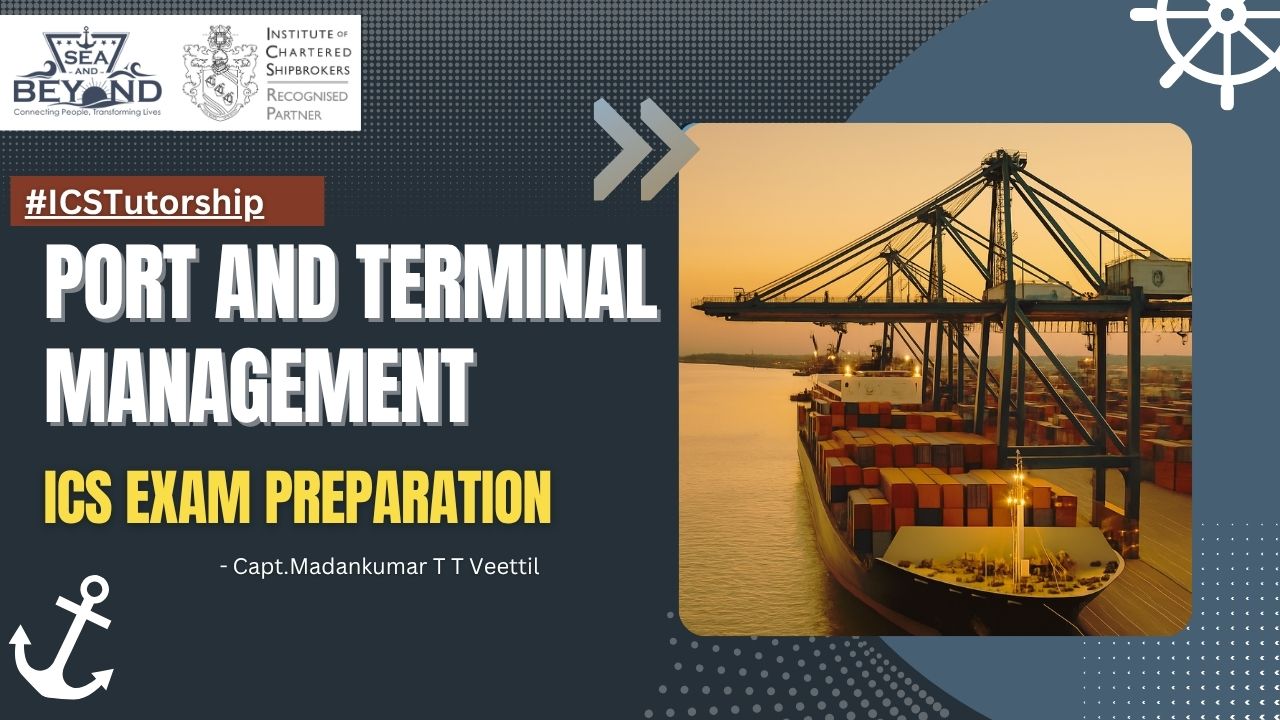
Port and Terminal Management
ICS Tutorship
09:00:00

Capt. Madankumar T T Veettil
Free Lessons
Sea and Beyond, in collaboration with Capt. Madan Kumar, offers a comprehensive video-based course designed for students preparing for the Institute of Chartered Shipbrokers (ICS) Port and Terminal Management examination.
This engaging programme, with a total duration of approximately 10 hours, combines theoretical understanding, practical application, and exam-focused guidance to help students develop a strong grasp of port operations and terminal management. The course is structured into chapters, each explaining key concepts, followed by Q&A sessions based on recent ICS examination papers, enabling students to approach different question formats with confidence.
Course Structure and Chapter Overview
Chapter 1: Role and Development of Ports
This chapter introduces the role of ports in global trade, focusing on their economic significance, operational efficiency, and integration into global supply chains. Topics include the cost of congestion, port-related industries, and the impact of globalization on port development.
It also examines the evolution and redevelopment of ports, including strategic location, specialized commodity ports, classifications, and operational types such as artificial harbours and non-tidal river ports, along with the challenges and opportunities faced by modern ports.
Chapter 2: Cargoes and Ships
This Chapter explores the relationship between cargo types and ship design, covering unitized cargo, dry bulk, and liquid bulk cargoes. It explains how ship design is influenced by trade routes, tonnage, and cargo characteristics, providing a foundation in maritime logistics.
The chapter continues with an overview of specialized vessels, including crude oil, product, chemical, LNG, LPG, dry bulk, and container ships, introducing key concepts such as TEUs (Twenty-foot Equivalent Units) and tanker design considerations.
Chapter 3: Port Management and Governance
This chapter covers the core functions of port management, including organizational structures, marine operations, cargo operations, and safety and security procedures. It introduces statutory bodies responsible for port regulation and governance.
It further examines immigration control, port health authorities, support services, and value-added port services, highlighting their impact on overall port performance. The chapter also explains key performance indicators (KPIs) such as vessel turnaround time, cargo throughput, and handling speed, along with optimization strategies and capital investment planning.
Chapter 4: Port Finance and Investment
This Chapter introduces port finance, covering financial statements, depreciation, and accounting controls used in port operations. It explains financial performance analysis through gearing, liquidity, and profitability ratios.
It also explores economic and financial evaluation of port investments, including cost-benefit analysis, Net Present Value (NPV), and Internal Rate of Return (IRR). Funding models such as PPP, leasing, and concessions, along with risk management strategies, are discussed in line with ICS exam requirements.
Chapter 5: Legal Framework in Port Management
This chapter addresses the legal aspects of port and terminal management, including international conventions, jurisdiction, and environmental regulations such as MARPOL and SOLAS.
It also covers port planning regulations, employment laws, and port security measures under the ISPS Code, providing essential legal context for ICS Port and Terminal Management examinations.
Chapter 6: Port Competition and Strategy
This Chapter analyzes port competition using economic frameworks, including perfect and imperfect competition, SWOT analysis, and competitive strategies such as cost leadership.
It examines inter-port and intra-port competition, key market drivers, and strategic responses that influence port performance and long-term sustainability.
Chapter 7: Port Marketing
This chapter introduces port marketing strategies, focusing on attracting port users through product, price, and place-based promotion. It covers marketing tools such as websites, advertising, port fairs, and data-driven stakeholder engagement.
Chapter 8: Port Planning and Operations
This Chapter focuses on operational and strategic port planning, including berth planning, yard planning, and intermodal system design. It explains performance monitoring, resource allocation, traffic forecasting, and congestion management to optimize port capacity.
Chapter 9: Port Equipment and Terminal Operations
This chapter details port equipment and terminal layouts, covering general-purpose terminals, container terminals, and ship-to-shore equipment such as harbour cranes and forklifts.
It continues with RoRo terminals, pallet systems, dry bulk terminals, and tanker terminal equipment, while addressing future challenges in terminal operations and infrastructure development.
Chapter 10: Port Ownership Models
This Chapter examines port ownership and governance models, comparing public, private, and hybrid structures such as BOT and BOOT. Case studies and discussions on port privatization highlight its benefits and challenges.
ICS Exam Preparation – Q&A Sessions
The course includes two dedicated Q&A sessions, analyzing May 2024 and November 2024 ICS examination papers. These sessions guide students on answer structuring, time management, and handling various ICS question formats effectively.
Why This Course Works for ICS Students
This course provides a structured learning path, progressing from fundamental concepts to advanced port management topics, with exam-focused Q&A sessions ensuring strong ICS exam readiness.
Capt. Madankumar T T Veettil
More than 25 years of multi-faceted experience working with reputed market leaders where, carried out functions as diverse as Vessel Operations, Port Operations, Supply Chain Management, Strategy Planning, Overseas Agency Development.
Gained valuable working experience in Vessel and terminal Operations, CFS / ICD Operations in the decade long work experience in Middle eastern ports.
Handled various cargoes including Grain, Steel, Bagged cargoes, Project cargo and Heavy lifts.
Rich sailing experience of Fifteen years. Started the Sea career with Scindia Steam Navigation Company Ltd. Sailed on various type of vessel's ranging from Panamax bulk carriers, multipurpose vessels and Cellular container vessels on ascending ranks.Command experience as Master of ocean-going vessels.
Holder of Membership in the Institute of Chartered Shipbrokers for 15+ years,Promoted and confered Fellowship by the Institute in April 2025.
Expertise covers managing comprehensive Port Operations, defining Optimal Logistics Solutions for projects with large volumes, ICD/CFS Operations and Operational Excellence.
Academically being a holder of Post graduate diploma in supply chain Management, Have completed executive program on Advance Strategic project management from Reputed B school of IIM- Calcutta.
Currently engaged as Permanent faculty in Indian Maritime University - Navi Mumbai,Teaching Nautical science and MBA subjects.
Rating:
Price:
₹ 14999
Language:
English
Length:
09:00:00
Intended for:
Professionals preparing for ICS Examination
Reference:
Topics:
11 Sections . 19 lectures . 8h 50m total length
22 min
1.1 Chapter 1 | Port & their functions, Supply Chain approach
Port & their functions, Key requirements for ports, Impact of ports on economic development, Port efficiency, cost of congestion at port, Port related industries, Effect of globalization, Supply chain approach
25 min
1.2 Chapter 1 | Port location and Development, classification
Port location and Development, Evolution of ports, Modern port development, Redevelopment, Challenges & opportunities, Specialized commodity ports, Port classification, Artificial Harbours, Non tidal river ports, Various operational port types

28 min
1.3 Chapter 1 | Intermodalism, EDI, Port ownership models
Intermodalism, Container terminals, EDI in international trade, Port ownership models, PPP- Public private partnership, effective port management, key port activities, terminal operations
26 min
2.1 Chapter 2 | Cargoes and Ships, Categorisation, Ship designs
Cargoes and Ships,Categorisation, Ship designs- Consideration based on trade, tonnage, route & cargo requirements/capabilities. Characteristics of Cargo, Unitised cargo, Bulk Cargo like Grain, Ore etc.
Liquid bulk cargo
22 min
2.2 Chapter 2 | Crude oil tankers, Operational designs, Vessels
Ship types-Continued, Crude oil tankers, Operational designs of tankers, Product tankers, LR1, LR2, MR tankers, Chemical tankers, LNG & LPG tankers, Dry Bulk cargo vessels, Container vessels, TEU’s
34 min
3.1 Chapter 3 | Port management, Port functions
Port management, Rationale of port business, Port functions, Port Organisation structure, Port Marine operations, Cargo operations at Port, Port safety management, Port security management, statutory controlling bodies
20 min
3.2 Chapter 3 | Statutory bodies, Port health authority
Statutory bodies-Continued, Immigration control, Port health authority,
Other port interests, Support business, Value added services, Port performance
20 min
3.3 Chapter 3 | Port performance measurement, Global trades
Port performance measurement, Optimisations, Capital investment intensity, Contribution to Global trades, KPIs for ports, Vessel Turnaround time, cargo Volume handled, Speed of cargo handling, cargo Safety, Container terminal performance
20 min
4.1 Chapter 4 | Port finance, Income statement, Balance Sheets
Introduction to Port finance, Income statement, Financial Statements, Balance sheets, cash flows, Depreciation, Accounting controls, Financial Performance, Financial ratios, Gearing ratios, Liquidity Ratios, Profitability ratio, Profit margins, ROCE, ROI, Return on Assets(ROA)
30 min
4.2 Chapter 4 | Port Investment, Cost revenue/ Cost benefit analysis
Financial and economic appraisal of port investments, Cost revenue/ Cost benefit analysis, Cash flows, Discount rates, Payback, NPV (Net present value), IRR, Economic appraisal, Port Impact studies,
Funding and financing port projects, Private investments, PPP model, leasing, Concession arrangements, Risk and risk management of investments in port, Cost risks, Revenue Risk, Country risk, Financial Analysis, Conclusion
40 min
5.1 Chapter 5 | Legal Issues and Jurisdiction, MARPOL
Legal issues concerning Port management, Jurisdiction & International conventions, Flag, Port and coastal state,Aspects of Port planning, Public vs privatized planning approach, Inquiry process, Port employment law, Health & Safety at work act 1974, Environmental Protection, MARPOL, Ballast water management, London Dumping convention, SOLAS, EU and National Env protection legislation, Place of refuge, Marine safety, Dangerous substances, Port security, ISPS code
25 min
6.1 Chapter 6 | Economic Concepts and SWOT Analysis
Economic concepts of Port competition, Perfect & Imperfect competition, structural analysis of industries, Increased competition factors, Port competitive factors, Inter-Intra port competition, aggregate competition, Decisive factors, SWOT analysis, strengths and weaknesses, Opportunity and threats, Generic competitive strategies, cost leadership, Focus on Improvement
30 min
7.1 Chapter 7 | Introduction to Port Marketing
Introduction to Port Marketing, Data required on existing and potential port users, regulatory framework, Port marketing Tools, Product & Price Marketing, Promotion of Port based on Place, Port promotion strategy, Promotion tools, website, advertising, Direct mailing, Port fairs and open days/exhibitions, Summary
20 min
8.1 Chapter 8 | Operational Planning and Strategic Planning
Operational Planning and strategic planning, Various levels of planning, elements of operational planning, Berth planning, Loading/Unloading planning, Yard planning, Intermodal system planning, Performance monitoring, resource allocation, Queuing theory-Berth assignment & port capacity, Port congestion, Annual storage and throughput of a port, Strategic port planning, Traffic forecasting
33 min
9.1 Chapter 9 | Port Terminal Arrangements, Ship to Shore
Port equipment and terminal arrangements, General purpose terminal, Ship to shore interchange equipment, Harbour cranes, Fork lift trucks, stevedoring equipment, Cargo shore storage, Unitised cargo terminals, Container terminals, gantry/cranes, details of yard equipment
33 min
9.2 Chapter 9 | Port Equipments, RoRo Terminals, Pallet Systems
Port equipment continued, RoRo terminals details, Pallet systems and equipment, Dry bulk cargo terminals, Shiploaders and unloaders, tanker terminal equipment and pipelines, Future challenges
40 min
10.1 Chapter 10 | Port Ownership and Privatisation
Port Ownership, Public and Private ownership, port deregulation, port privatisation, case studies and reviews, arguments For/against port privatisation, partial privatisation, BOT/BOOT models (Build,operate transfer)
35 min
11.1 Q&A | May 2024 question paper
Discussion based on May 2024 question paper, explaining how to answer various sorts of questions.
27 min
11.2 Q&A | Nov 2024 question paper
Discussion based on Nov 2024 question paper, explaining how to answer various sorts of questions.
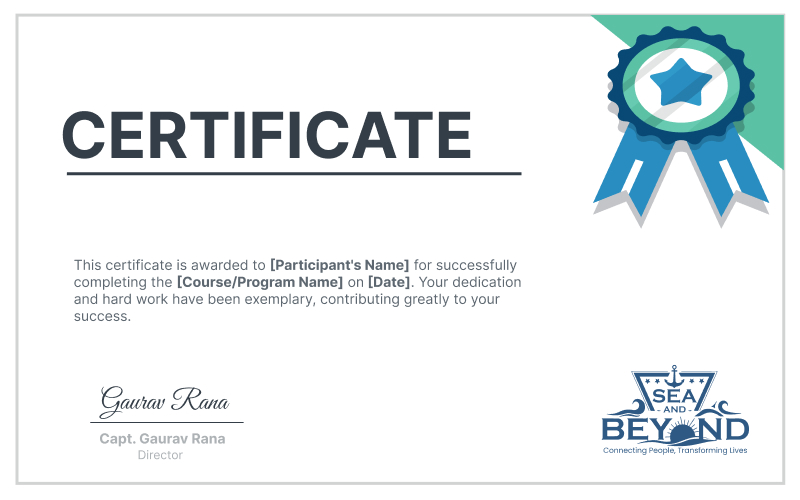
Successful completion of this course will earn you a certificate of completion from Sea and Beyond. This certificate will be emailed to you and you could also share and show it on LinkedIn Please click on the button below to purchase the certificate.
Similar Courses






Reviews...
Yang Yue On Mar 12th 2026
A well-presented and info....
Asif Karim Path... On Mar 18th 2026
vey nice, very helpfull....