
Extreme War Risk Insurance in Shipping: What Owners, Charterers, Shippers, and Consignees Need to Know
 Capt. M. M Saggi
30 Jul 2026
358 view
0
0 Comment
Global geopolitical tensions can significantly impact maritime trade, shipping operations, and marine insurance markets. While standard marine insurance policies are designed to address routine operational risks, extreme war situations introduce a level of uncertainty and exposure that can challenge even the most robust insurance frameworks.
For shipowners, charterers, shippers, and cargo consignees, understanding how war risk insurance works and what happens when coverage becomes limited or unavailable is critical for effective risk management and business continuity.
Understanding Extreme War Risk Insurance
War risk insurance is a specialized form of marine insurance that provides protection against losses arising from war-related events, including armed conflict, terrorism, hostile acts, piracy in designated regions and other politically motivated incidents that fall outside standard marine insurance coverage.
However, during periods of extreme conflict, insurers may reassess their exposure and take steps to limit or withdraw coverage altogether.
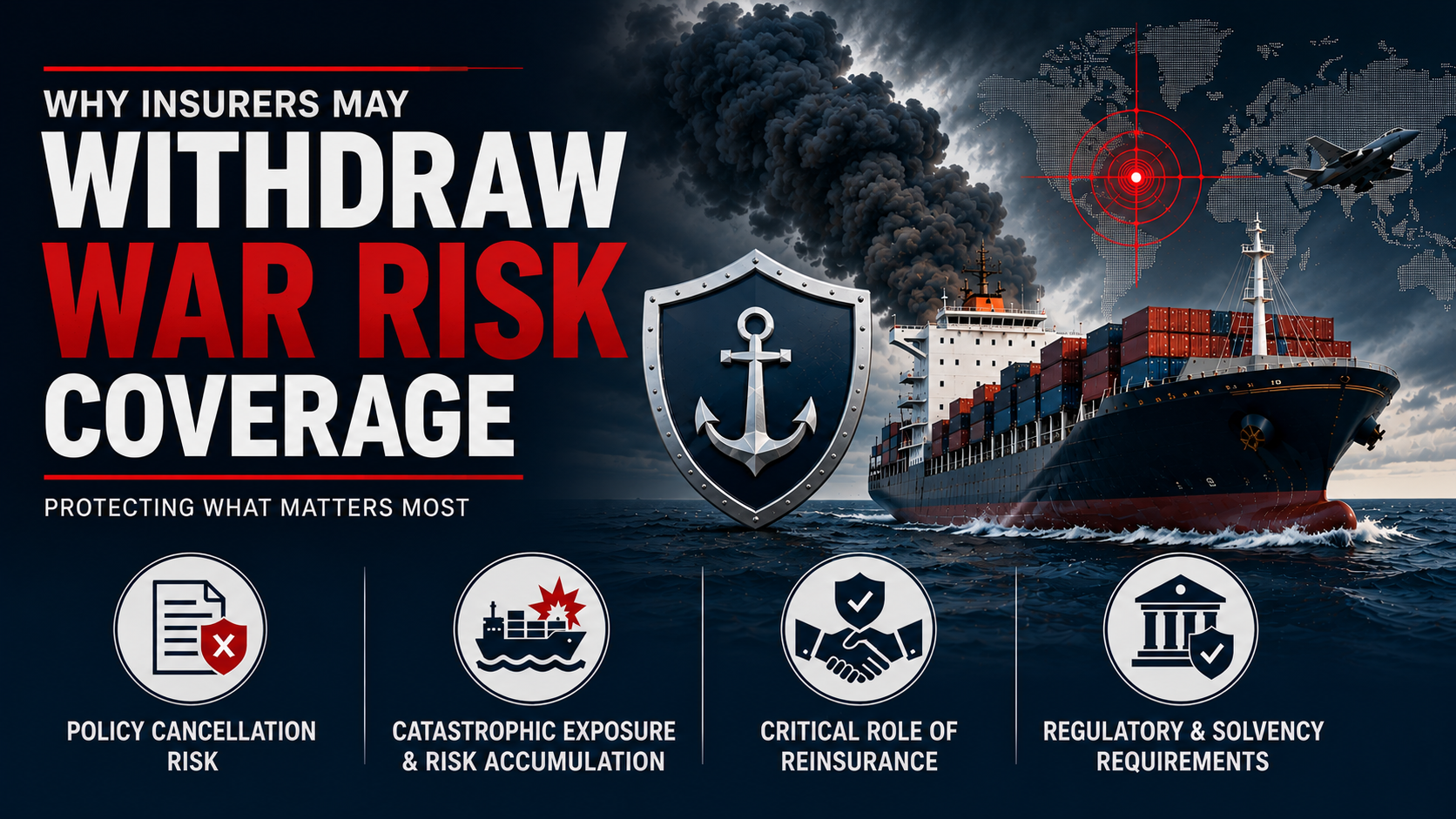
Why Insurers May Withdraw War Risk Coverage
1. Extreme War Risk Can Trigger Policy Cancellation
Most Hull War and Protection & Indemnity (P&I) War Risk covers contain provisions allowing insurers to cancel or amend coverage with short notice under extraordinary circumstances.
When a conflict escalates to a level where risks become widespread, unpredictable, and potentially catastrophic, insurers may determine that the exposure can no longer be accurately assessed or priced. In such cases, coverage may be withdrawn to protect the financial stability of the insurance market.
2. Catastrophic Exposure and Risk Accumulation
One of the biggest concerns for insurers is the accumulation of losses.
A major conflict can result in multiple vessels being damaged, detained, destroyed, or rendered inoperable within the same geographic region. Such simultaneous losses can create claims far exceeding the capacity of commercial insurers and reinsurers.
As a result, insurers closely monitor exposure concentrations in high-risk areas and may restrict coverage when accumulation risks become excessive.
3. The Critical Role of Reinsurance
Marine insurers do not retain all risks on their own balance sheets. Instead, they transfer a significant portion of their exposure to reinsurers.
In India, war risk insurance capacity is supported by the General Insurance Corporation of India (GIC Re) as well as major international reinsurance markets, including Lloyd's of London.
When global reinsurers reduce or withdraw support for war-related exposures, primary insurers may be unable to continue providing coverage because the underlying risk transfer mechanism no longer exists.
4. Regulatory and Solvency Requirements in India
Indian insurers operate under the regulatory framework established by the Insurance Regulatory and Development Authority of India (IRDAI).
These regulations require insurers to maintain prescribed solvency margins and adequate capital reserves. Without sufficient reinsurance protection, insurers cannot assume unlimited war-related liabilities without potentially breaching regulatory requirements.
This regulatory discipline helps maintain the long-term stability of the insurance sector but can also result in reduced underwriting capacity during periods of extreme conflict.
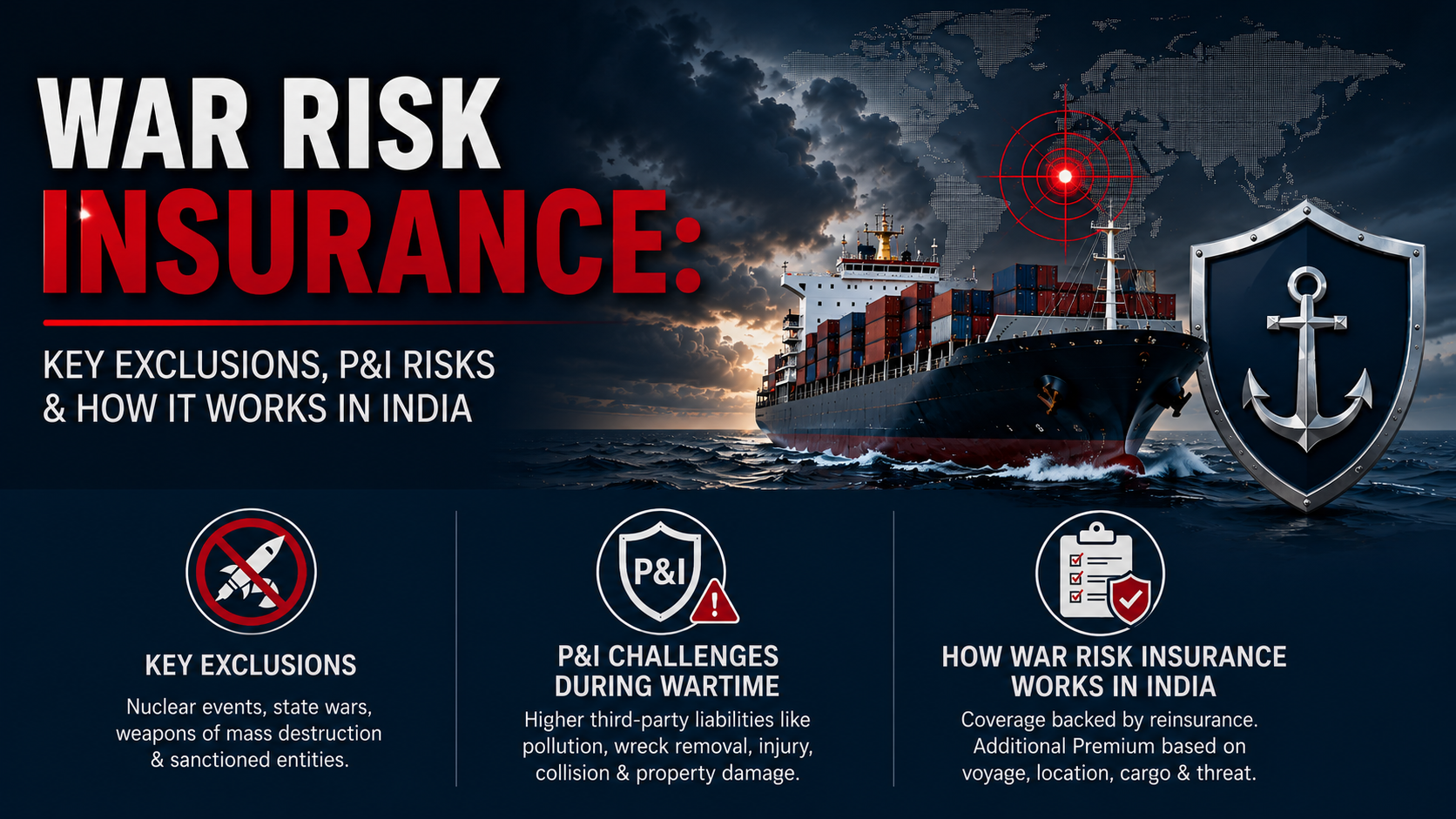
Key Exclusions in War Risk Insurance Policies
5. Nuclear Events, State Wars, and Sanctions Restrictions
Although war risk policies provide broader protection than standard marine insurance, they are not unlimited.
Common exclusions may include:
- Nuclear incidents and radioactive contamination.
- Certain large-scale state-to-state military conflicts.
- Use of prohibited or unconventional weapons.
- Losses involving sanctioned countries, entities, or individuals.
In some cases, international sanctions regulations may legally prohibit insurers from paying claims, even if coverage would otherwise apply.
The P&I Challenge During Wartime
6. Third-Party Liability Risks Increase Significantly
War-related incidents can generate substantial third-party liabilities, including:
- Oil pollution and environmental damage.
- Wreck removal costs.
- Collision liabilities.
- Crew injury, disability, or death claims.
- Property damage claims.
Protection & Indemnity (P&I) Clubs and insurers may therefore impose limits, additional premiums, or restrictions on war-related extensions to safeguard the financial stability of their mutual insurance pools.
How War Risk Insurance Typically Works in India
7. Current Market Structure
Under normal operating conditions, Indian marine insurers offer Hull War Risk and Cargo War Risk extensions, supported by domestic and international reinsurance arrangements.
When vessels trade into designated high-risk areas, insurers typically charge an Additional Premium (AP) based on:
- Voyage duration
- Geographic location
- Nature of cargo
- Vessel type and age
- Current threat assessment.
These premiums are usually assessed on a voyage-by-voyage basis and can change rapidly depending on geopolitical developments.
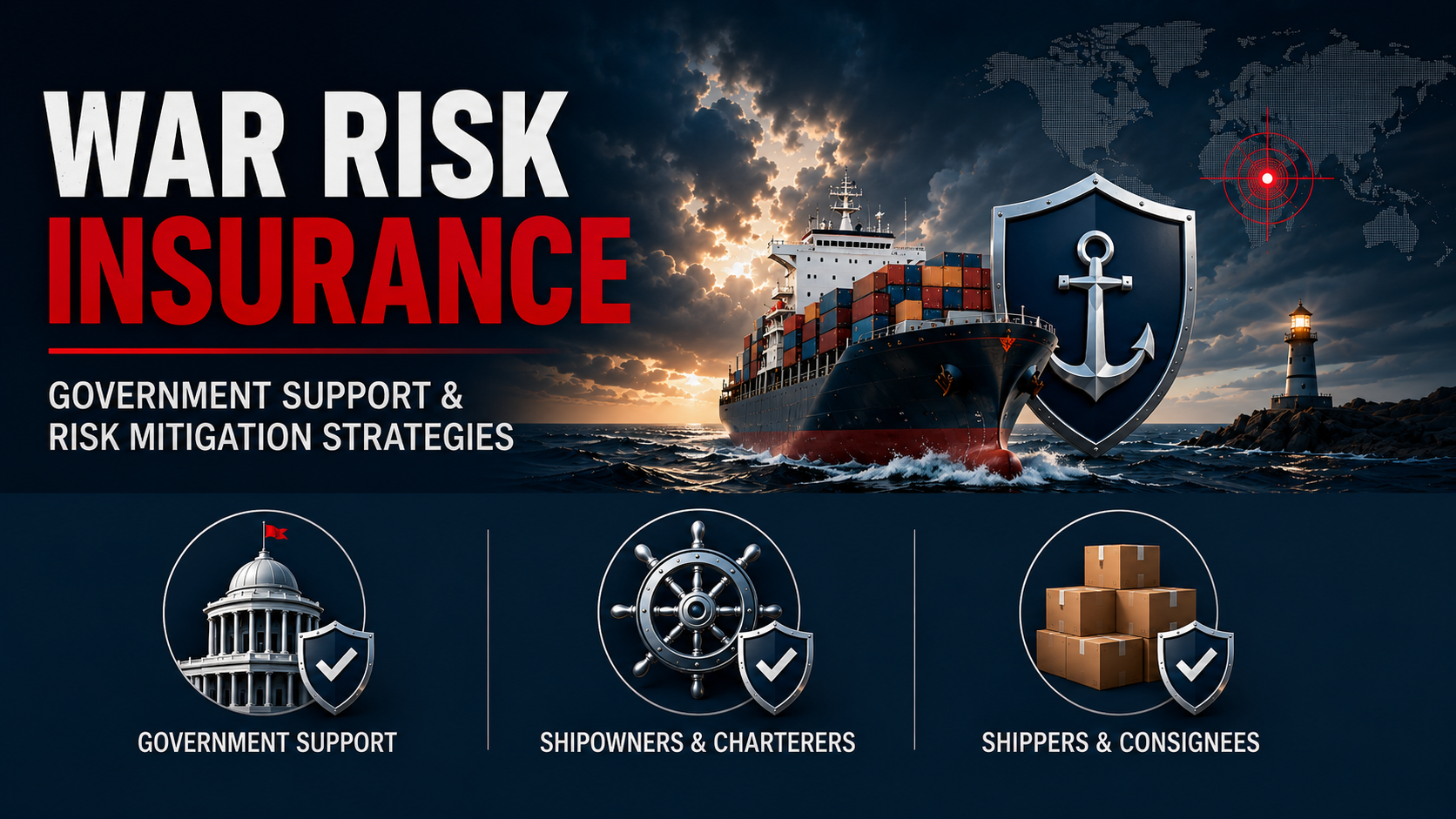
Can Governments Step In?
8. Potential Government Support Mechanisms
In circumstances where maritime trade is critical to national interests such as energy security, essential imports, or strategic shipping operations governments may consider intervention measures.
Possible support mechanisms can include:
- Sovereign guarantees
- Government-backed insurance schemes
- Temporary risk-sharing arrangements
- Emergency support for strategic shipping routes.
Such measures are intended to ensure continuity of trade when commercial insurance capacity becomes severely constrained.
Options Available to Shipowners and Charterers
9. Managing Uninsured War Risk Exposure
When war risk coverage becomes limited or expensive, shipowners and charterers may consider several risk mitigation strategies:
Obtain Additional War Risk Coverage
Purchase voyage-specific war risk insurance or stand-alone policies where available.
Negotiate Additional Premium Arrangements
Allocate war risk premiums contractually between owners and charterers.
Reroute Vessels
Avoid high-risk trading areas where practical.
Invoke Contractual War Clauses
Utilize provisions such as CONWARTIME and VOYWAR clauses that allow parties to refuse unsafe voyages or ports.
Suspend Operations if Necessary
Where adequate insurance cannot be secured, parties may choose to suspend performance to avoid potentially catastrophic uninsured liabilities.
Options Available to Shippers and Consignees
10. Protecting Cargo Interests During Conflict
Cargo owners and receivers also have several options for managing war-related risks:
Purchase Separate Cargo War Risk Insurance
Secure dedicated coverage to protect cargo while in transit through affected regions.
Review Trade Terms
Consider using trade terms such as CIF (Cost, Insurance and Freight) or CIP (Carriage and Insurance Paid To) to clarify insurance responsibilities between buyers and sellers.
Explore Government-Backed Programs
For strategic or essential cargoes, government-supported insurance mechanisms may be available during exceptional circumstances.
Prepare for Higher Freight Costs
When risk levels increase, freight rates and insurance premiums generally rise, and cargo interests may need to account for these additional costs.
Conclusion
Extreme war situations create unique challenges for the global shipping industry and the marine insurance market. As geopolitical risks evolve, shipowners, charterers, shippers, and consignees must understand the limitations of war risk coverage, the role of reinsurance, regulatory constraints, and the practical options available when insurance capacity becomes restricted.
A proactive approach to risk assessment, contractual planning, insurance procurement, and voyage management can help maritime stakeholders navigate uncertainty while protecting both commercial interests and operational continuity.



Capt. M. M Saggi
One of the most respected and revered name in the maritime industry who has an holistic overview of how overall shipping functions at the world level as well as within India. Master Mariner (F.G), Extra master and MBA.
Ex-Director at Narottam Morajee Institute of Shipping, Ex-Nautical Advisor to govt. of India, Ex Additional Director General of Shipping, Ex Chief Examiner of mates,masters and extra masters. Ex Country head of casualty investigation. Lead Indian delegation to Maritime Safety Committee of IMO and International Oil Pollution Compensation fund meetings. Ex Trustee Mumbai, JNPT and Kandla Port
Leave a comment
View more
Give your career a boost with S&B professional services.
CV Prep/Evaluation Prep Service
 SeaCommerce
Shop maritime books & essentials
DG Medical Examiners
Find approved doctors near you
Tools & Calculators
Free maritime tools for seafarers
More Jobs
Ship management
Mumbai
Vessel Performance Analyst..
Ship management
Mumbai
Vessel Performance Enginee..
Ship management
Mumbai
Voyage Optimisation Manage..
Interview Prep/Mentoring
Find your polestar with the host of experts available on our platform
Know more

Contact Us