
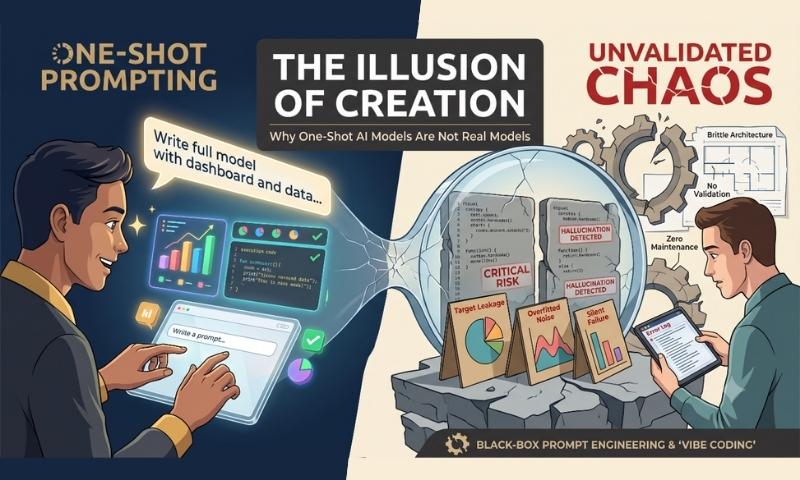
The Illusion of Creation: Why One Shot AI Models Are Not Real Models?
 Venkat Krishna Soundarraja
31 Aug 2026
364 view
0
0 Comment
Abstract:
In the age of generative AI, it has become remarkably easy to produce something that looks like a data science solution. A few lines typed into Claude, ChatGPT, or any modern LLM can instantly yield:
- A “machine learning model”
- A colourful dashboard
- Some synthetic data
- A neat explanation that feels mathematically sound
For someone without coding, statistics, or data science experience, this output can appear magical. It feels like creation. It feels like expertise. It feels like achievement.
But is it?
This article explores a growing phenomenon: non technical users claiming to have “built a model” simply because an AI generated one for them — and why such one shot outputs are dangerous, misleading, and absolutely unfit for production.
Introduction:
We are living through an unprecedented democratization of technological capability. Large Language Models (LLMs) such as Claude, GPT-4, and Gemini have flattened the learning curve for writing software, performing statistical analysis, and generating complex web dashboards.
A domain expert — whether a marine engineer, a financial analyst, a supply chain manager, or a medical professional—can now type a natural language prompt into a chat interface and receive, in return, a complete Python script, a Scikit-Learn machine learning pipeline, an interactive Streamlit dashboard, and a neatly structured synthetic dataset within seconds. The experience is undeniably intoxicating.
Charts flicker to life in vibrant hex codes, interactive sliders update prediction values dynamically, and statistical metrics like R² = 0.96 or high F1-scores flash across the screen.
To a non-coder who possesses deep contextual domain knowledge but lacks formal training in software engineering or statistical data science, it feels like magic. It feels as though a fully operational, industry-grade predictive model has been birthed in a single prompt. But this feeling creates a dangerous cognitive illusion.
Excited by the visual polish and execution of code they cannot read, non-coders frequently claim ownership, declaring that they have "built a model." They package the script and hand it over to software developers to "put into production." This process—and the deep structural flaws inherent within it—raises fundamental questions about engineering ethics, intellectual rigor, and systems failure.
The Ethics of Ownership:
Is it fair to claim authorship of a model generated by a black-box LLM? What term captures this phenomenon? And, most critically: Can these "one-shot" LLM-generated models ever survive deployment into a real-world production environment?
Strictly speaking, no. Prompting an LLM to generate a statistical model is philosophically equivalent to describing a complex physical building to a master architect and taking credit for civil structural engineering. Prompting demonstrates product vision and domain context, but taking credit for model creation without understanding its logic misrepresents authority and creates unaccountable liability.
The Prompt Is Not the Model:
Let’s start with the core truth:
Typing a prompt is not the same as building a model. What is a ‘model’?
A model is not the code. A model is not the chart. A model is not the dashboard.
A model is the logic behind the code, the rigour behind the chart, and the validation behind the dashboard.
Real model creation requires:
- Understanding the business problem
- Knowing the data deeply
- Selecting meaningful features
- Applying statistical reasoning
- Testing assumptions
- Validating performance
- Ensuring reproducibility
- Designing deployment pipelines
- Monitoring drift and failure modes
None of this happens in a one shot AI output.
When a domain expert simply copies the AI generated artefacts and forwards them to a developer who also lacks context, the result is not collaboration — it is ‘cargo cult’ data science.
Cargo Cult Data Science: The Perfect Term:
The term Cargo Cult Data Science comes from historical "cargo cults" that arose in the South Pacific after World War II. Indigenous islanders observed Allied soldiers building airstrips, wearing headphones, and waving batons, after which cargo planes landed with supplies. When the military left, islanders built mock airstrips out of bamboo and wood, copying the outward appearance of the bases in the belief that mimicking the superficial rituals would make the cargo return.
In technology, famous physicist Richard Feynman popularized the concept of "Cargo Cult Science" during a 1974 Caltech commencement address, defining it as practices that follow all the outward forms and ceremonies of scientific research, but lack the underlying rigor and understanding of first principles.
In data science, it describes copying tools, code, and workflows—like running a Random Forest script, tuning hyperparameters, or outputting Plotly charts—without understanding the domain physics, statistical assumptions, or operational constraints.
Thus, cargo cult behaviour is when people imitate the appearance of a complex system without understanding its substance.
In data science, this looks like:
- Using jargon without comprehension
- Skipping data cleaning and jumping straight to model training.
- Trusting charts because they are colourful
- Believing code is correct because it runs
- Assuming AI outputs are inherently valid
- Building high-accuracy models that do not solve the actual real-world problem.
It is a ritualistic mimicry of data science, not the practice of it.
Generative AI has made cargo cult data science easier than ever.
The Anomaly of the "Double-Blind Hand-Off”
The core breakdown in this paradigm occurs during the transition from prototype to software development.
Consider the structural dynamic of the typical hand-off:
The Domain Expert (The Prompter):
Possesses deep operational intuition (e.g., understanding engine torque under varying sea states or clinical workflow nuances) but cannot audit Python syntax, statistical leakage, or memory allocation.
The Software Developer (The Recipient):
Possesses deep knowledge of software architecture, Docker containerization, API endpoints, and CI/CD pipelines, but lacks domain context and advanced statistical training. This creates a Double-Blind Hand-Off Problem.
The domain expert hands over the LLM output under the belief that "the AI wrote the data science, so the statistical logic is sound."
The developer receives the code under the belief that "the domain expert validated the business logic, so the math is sound."
Neither party actually verifies the core statistical engine or feature engineering assumptions.
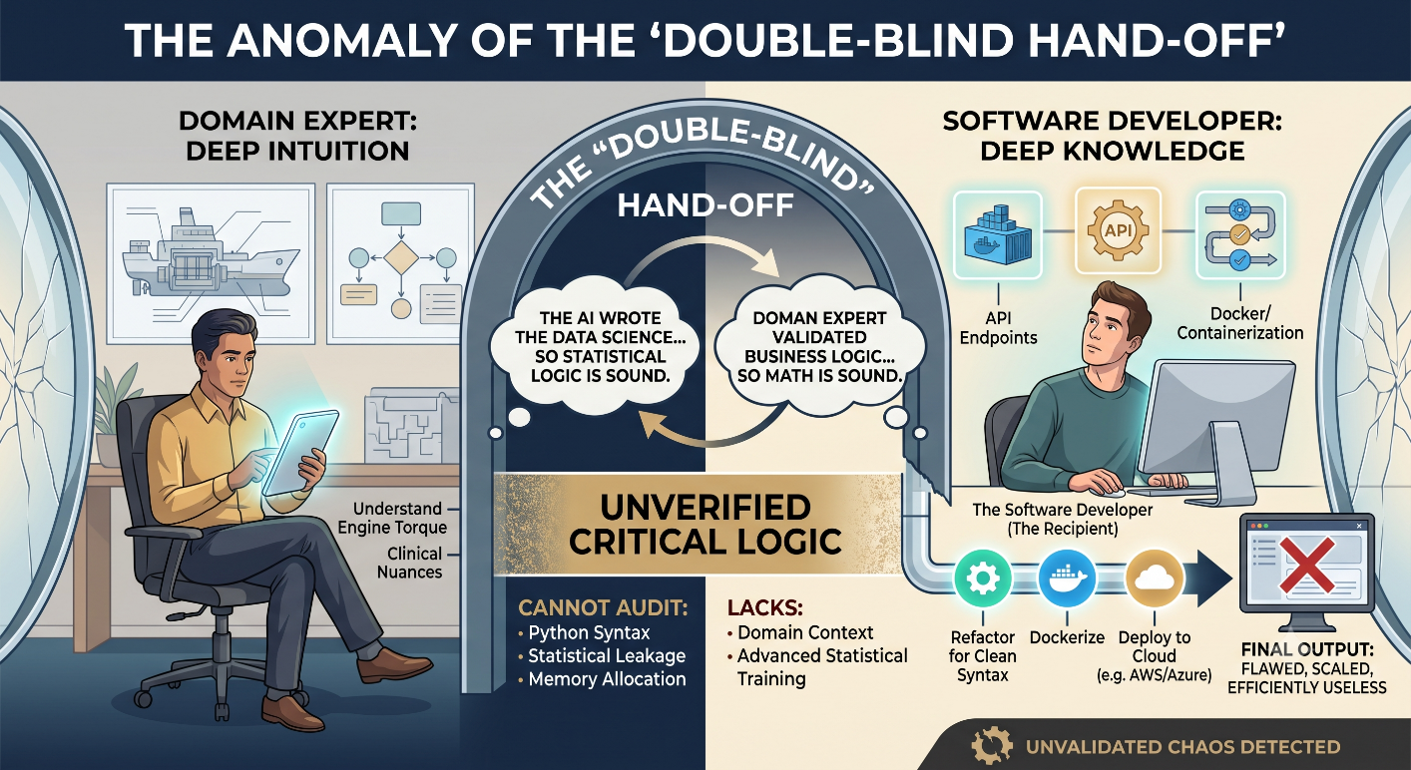
The code is refactored for clean syntax, dockerized, deployed to AWS or Azure, and hooked into live streaming pipelines—delivering flawed outputs at scale with absolute efficiency.
Why One Shot AI Models Cannot Be Productionised?
Can a model generated in a single prompt session by an LLM be directly productionized?
In virtually all non-trivial enterprise use cases, the answer is a resounding NO.
Even if the output looks impressive, even if the dashboard is slick, even if the code executes — these models are fundamentally unsuitable for real world deployment.
1. They are built on hallucinated or synthetic data
LLMs invent data. Models trained on invented data collapse instantly in production.
2. They lack validation
No train/test split. No cross validation. No error analysis. No drift checks.
A model without validation is not a model — it is a guess.
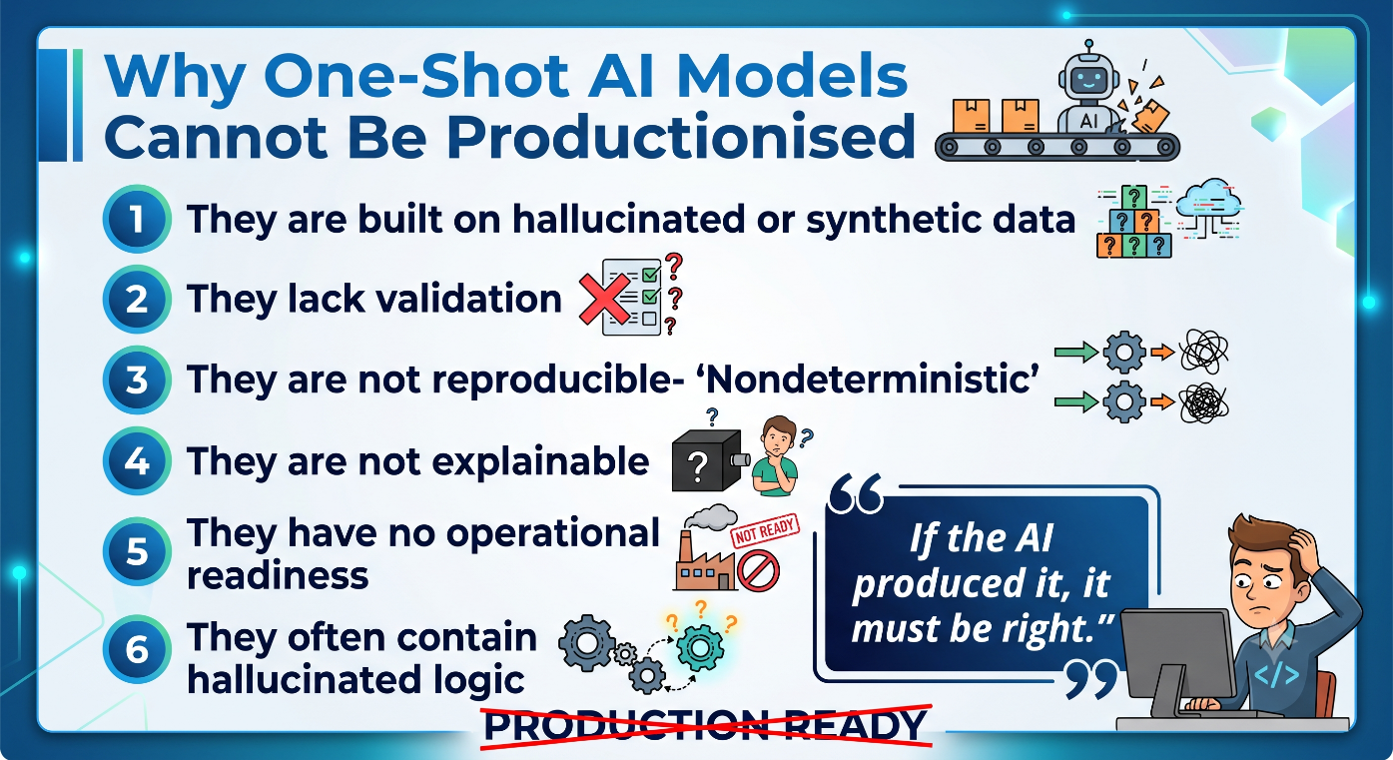
3. They are not reproducible- ‘Nondeterministic’
Run the same prompt again and you get a different model. There is no lineage, no versioning, no audit trail.
4. They are not explainable
The domain expert cannot explain the model. The developer cannot explain the model. The AI cannot explain the model beyond surface level reasoning.
This is a black box inside a black box.
5. They have no operational readiness
Production requires:
- CI/CD – (Continuous Integration/Continuous Development)
- Monitoring
- Retraining pipelines
- Logging
- Error handling
- Governance
One shot models have none of these.
6. They often contain hallucinated logic
LLMs frequently invent:
- Features that don’t exist
- Columns that aren’t in the dataset
- Statistical methods that are misapplied
- Metrics that are meaningless
Deploying such a model is operationally dangerous.
The False Confidence Problem:
The biggest risk is not the model. It is the confidence the user gains from the model.
Non technical users often mistake:
- Appearance for accuracy
- Code for correctness
- Charts for truth
- AI fluency for expertise
This creates a dangerous illusion:
“If the AI produced it, it must be right.”
In safety critical industries — maritime, LNG operations, machinery diagnostics, energy systems — this illusion can cause real harm.
Case Study: Fuel Consumption Modelling in Maritime Operations:
To illustrate the concrete dangers of this workflow, consider a real-world scenario from maritime vessel performance analytics.
A vessel performance superintendent (a former Chief Engineer with deep sea-going experience) wants a model to predict Main Engine Fuel Oil Consumption (FOC in metric tons/day) based on vessel speed through water, sea state, propeller RPM, and weather force.
He prompts an LLM: "Write a complete Python script with a Streamlit UI to predict ship fuel consumption from RPM and draft, build a Random Forest model, and show a sleek dashboard." The LLM generates a 300-line Python script.
It creates synthetic data using a simple Gaussian curve, fits a Random Forest Regressor, builds interactive Plotly graphs with neon blue themes, and outputs an evaluation card showing MAE (Mean Absolute Error) = 0.12 tons.
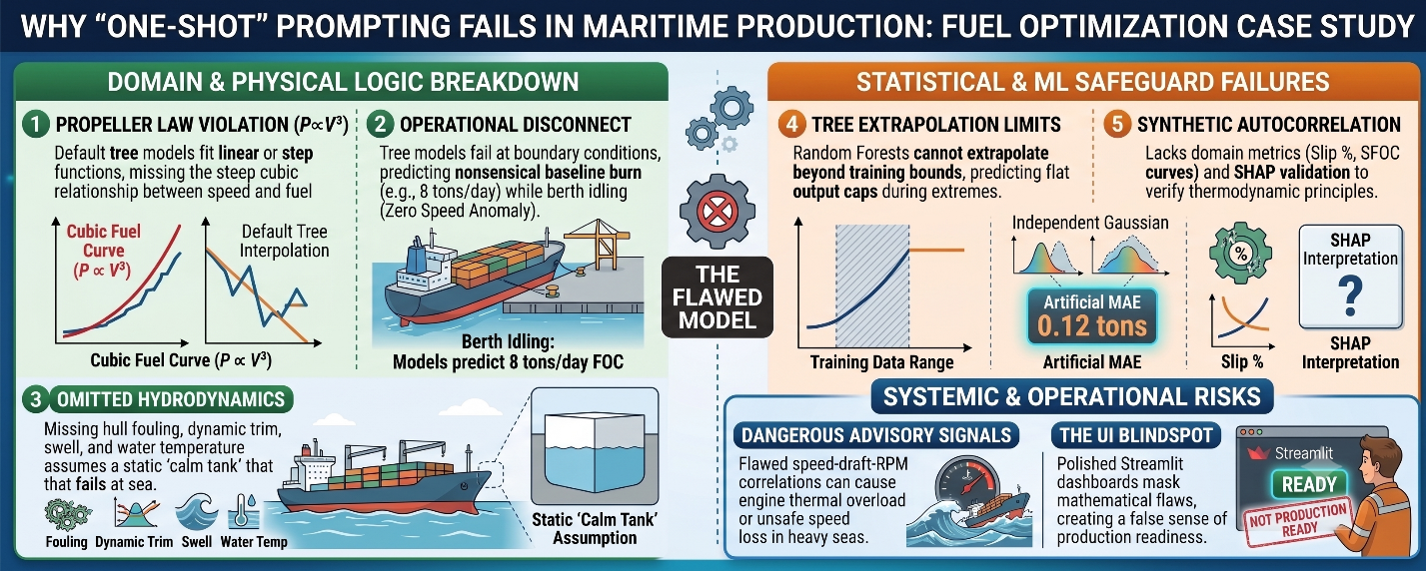
Thrilled, the superintendent shows management: "I built a machine learning model for fleet fuel optimization." He passes the script to an IT developer to push to production.
In production, the automated dashboard recommends engine power adjustments that contradict basic marine engineering logic. Had the developer understood the domain, or had the superintendent understood the machine learning pipeline, this model would never have left the drafting table.
So, What Is Fair to Claim?
A non technical user who prompts an AI can fairly claim:
- They initiated an idea
- They explored a concept
- They generated a prototype
But they cannot claim:
- They built a model
- They engineered a solution
- They created a data science pipeline
- They authored the logic
- They validated the output
The tool did the work. The human did not.
Where AI Fits: Ideation, Not Production
Generative AI is powerful — but its power lies in acceleration, not replacement.
AI can help:
- Brainstorm features
- Sketch prototype dashboards
- Generate starter code
- Create synthetic examples
- Provide conceptual scaffolding
But the real model must be:
- Designed by a data scientist
- Reviewed by a domain expert
- Built on real data
- Validated rigorously
- Deployed by engineers
AI is the spark, not the engine.
The Path Forward: Responsible AI Assisted Modelling
To avoid cargo cult data science, organisations should adopt a simple rule:
AI can generate prototypes. Humans must validate and build the real model.
This ensures:
- Technical correctness
- Domain relevance
- Operational safety
- Ethical deployment
- Long term maintainability
AI is a powerful collaborator — but only when paired with human expertise.
The Proper Architecture: Bridging Domain Expertise & Data Science Rigor
If "one-shot" prompting cannot produce production models, does that mean generative AI has no place in data science? Absolutely not.
LLMs are extraordinarily powerful acceleration tools when embedded into a disciplined, multi-disciplinary workflow.
The solution requires replacing the "Double-Blind Hand-Off" with a Tripartite Engineering Standard:
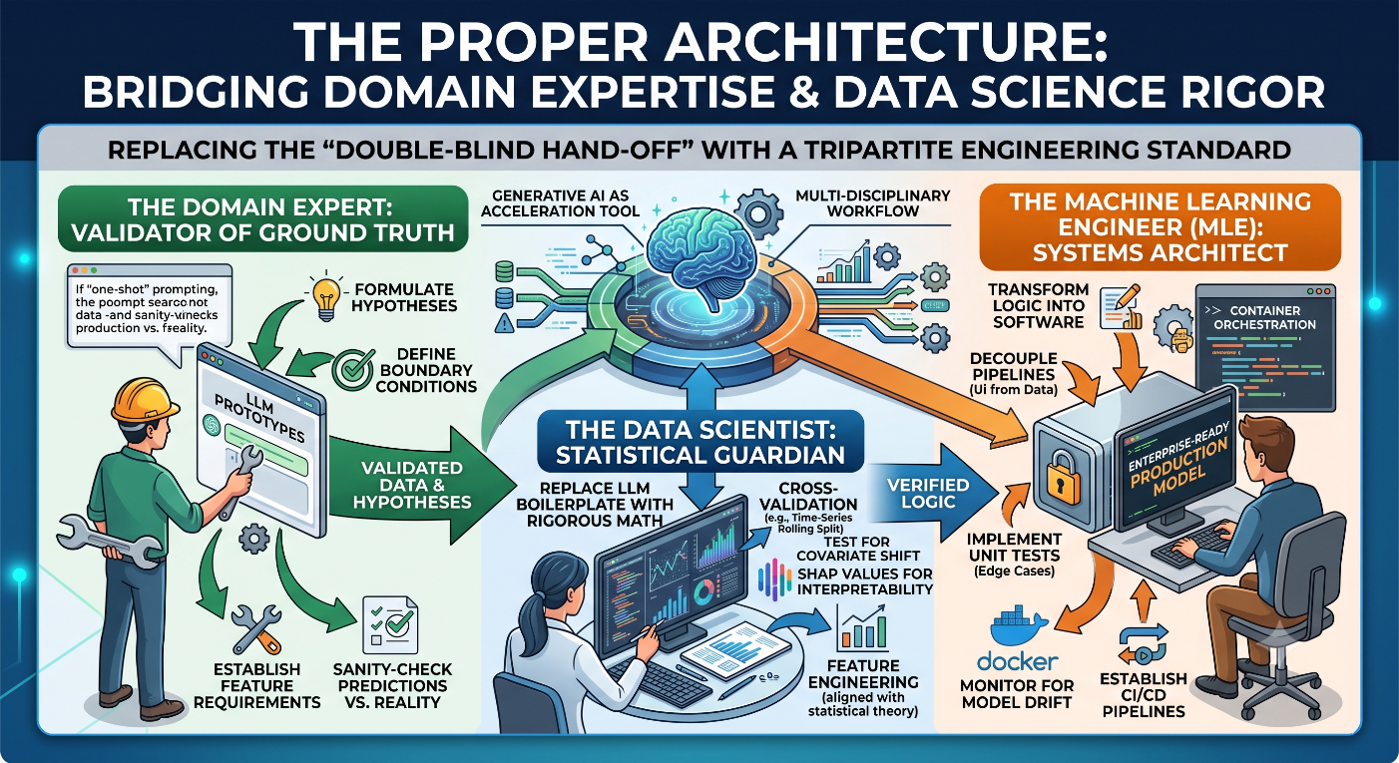
The Domain Expert as the Validator of Ground Truth:
Rather than claiming to "build the model," the domain expert uses LLM prototypes to formulate precise hypotheses, define physical boundary conditions, establish feature requirements, and sanity-check model predictions against operational reality.
The Data Scientist as the Statistical Guardian:
The data scientist audits the underlying mathematics. They replace simplistic LLM boilerplate with rigorous cross-validation strategies (e.g., time-series rolling split), test for covariate shift, implement SHAP (SHapley Additive exPlanations) values for model interpretability, and ensure feature engineering aligns with statistical theory.
The Machine Learning Engineer (MLE) as the Systems Architect:
The MLE transforms verified data science logic into enterprise software. They decouple data pipelines from UI layers, implement unit tests for edge cases, build Docker containers, setup monitoring for model drift, and establish CI/CD pipelines.
Conclusion:
Generative AI has gifted domain experts a superpower: the ability to express complex conceptual ideas in functional code without waiting months for initial prototyping resources. This is a monumentally positive shift for industrial innovation.
However, confusion between prototyping speed and production readiness poses a severe risk to technological integrity.
A polished dashboard generated in five seconds by Claude or GPT-4 is a conversation starter—a wireframe brought to life. It is not an enterprise data science model.
Taking credit for creating a model based solely on prompt execution misrepresents technical competence and creates brittle systems.
Production-grade data science requires rigorous statistical validation, physical domain alignment, and disciplined software engineering.
Until we bridge the gap between prompt aesthetics and engineering rigor, one-shot models must remain where they belong: inside the sandbox of rapid prototyping.
A prompt can generate a concept. But only knowledge can create a model.



Venkat Krishna Soundarraja
Mr. S. Venkat Krishna is the Chief Data Officer at Volteo Maritime, with a background as a Marine Engineer. He brings over 28 years of sailing experience, including 15 years as a Chief Engineer in the tanker industry. A Fellow of the Institution of Marine Engineers (India), he specializes in condition monitoring, data analytics, and reliability engineering. His expertise spans crude oil, product, and chemical tankers, as well as bulk carriers and container vessels.
In his current role, he focuses on ensuring data quality, driving the adoption of AI and machine learning, and enabling data-driven decision-making to enhance organizational performance. Proficient in Python, R, and Power BI, he plays a key role in transforming data into a strategic asset.
Mr. Krishna is also a visiting faculty member, technical mentor, and published researcher, with a strong passion for innovation, education, and emerging technologies. Outside of work, he enjoys singing and artistic sketching—blending creativity with technical precision.
Leave a comment
View more
Give your career a boost with S&B professional services.
CV Prep/Evaluation Prep Service
 SeaCommerce
Shop maritime books & essentials
DG Medical Examiners
Find approved doctors near you
Tools & Calculators
Free maritime tools for seafarers
More Jobs
Sales and Marketing
Mumbai
Sales Manager
Ship management
Khapoli
Computer Science Faculty –..
Agency and Logistics
Gujarat
Electrical Superintendent
Interview Prep/Mentoring
Find your polestar with the host of experts available on our platform
Know more