
Expectations from AI in the Maritime Industry: Aspirations vs Reality! What Do We Really Want AI to Do for Us?
 Venkat Krishna Soundarraja
23 May 2026
1171 view
0
2 Comment
Abstract:
Artificial Intelligence (AI) has rapidly transitioned from a futuristic concept to an operational necessity across industries—and the maritime sector is no exception. A cornerstone of global trade, the maritime industry drives the movement of goods worldwide, it faces immense pressure to improve efficiency, reduce costs, enhance safety, and meet sustainability goals. In this context, AI is seen not just as a tool—but as a transformative force. But a critical question remains:
What does the maritime industry actually expect from AI, why is reality falling short? Most organizations are eager to tap into the potential of AI, yet many lack clarity on the problems they aim to solve. Their entry into the AI space is often driven more by a fear of missing out than by clearly defined business needs.
The market today is crowded with digital players, many of whom are led by technology entrepreneurs rather than domain experts. At the same time, marine data remains highly fragmented, residing in multiple silos and characterized by its complexity. Without a focused approach to applying AI in specific areas, it becomes extremely challenging for organizations to effectively integrate and derive meaningful insights from data spread across disparate systems. Across shipping companies, ports, and shipyards, AI is already embedded in several core operations. Across stakeholders—ship owners, operators, regulators, and engineers—expectations from AI are remarkably consistent viz., fully autonomous operations, end to end decision intelligence, zero downtime and predictive ecosystems, sustainability and compliance, human augmentation (not replacement). The reality gap, where expectation is not met viz., data challenges, fragmented ecosystem, failing to productionize, lack of clear problem statements, skill gaps, infrastructure & legacy systems, regulatory & safety constraints, traditional mindset are some of the constraints the industry is trying to grapple with. To create an impact from pure hype, defining clear use cases, starting with problems not technology, building data foundations, using AI as a decision support system not replacement, investing in skills, inculcating a growth mindset, moving from pilots to small production & deployment could help build trust and confidence in AI systems that can further enhance and optimize various operations.
Introduction:
Artificial Intelligence (AI) is increasingly positioned as a key enabler of digital transformation across the maritime industry, promising advancements in operational efficiency, safety, and sustainability. However, the transition from potential to practical value remains complex. Unlike digitally mature sectors, the marine industry operates within a highly fragmented and heterogeneous environment characterized by legacy systems, siloed data architectures, and diverse stakeholder ecosystems. While there is strong momentum toward AI adoption, a significant portion of this interest is driven by external pressures and emerging industry trends rather than clearly articulated problem statements or measurable objectives. Consequently, organizations often encounter difficulties in translating AI initiatives into scalable, production-grade solutions. This article examines the expectations surrounding AI in the maritime domain, juxtaposes them against current operational realities, and analyzes the structural, technical, and organizational barriers that continue to constrain its effective deployment.
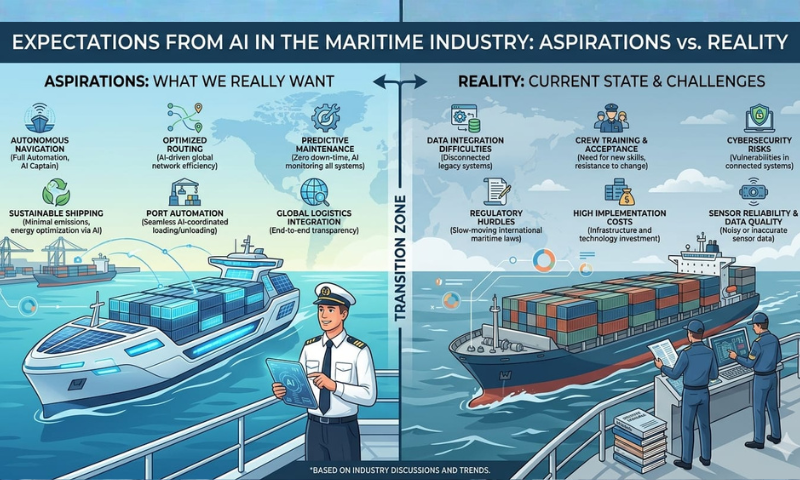
Expectations from AI: What do we really want AI to do for us? (A Marine industry perspective)
The maritime industry stands as a cornerstone of global trade, connecting economies and enabling the seamless flow of goods across continents. Yet, for an industry so fundamental to global commerce, transformation has traditionally been slow, shaped by legacy systems, complex regulations, and high-stakes operations. Today, that is changing.
Artificial Intelligence (AI) has entered the conversation—not as a distant innovation, but as a strategic priority. From ship owners to port operators, everyone is asking the same question: What do we really want AI to do for us?
What does industry expect from AI?
Across the maritime ecosystem, expectations from AI are both ambitious and remarkably consistent.
At its core, the industry is not just looking for automation, it is looking for intelligence.
Operators want AI to act as a co-pilot, capable of:
- Predicting risks before they occur
- Suggesting optimal decisions in real time
- Making sense of vast, fragmented datasets
There is also an expectation that AI will enhance safety—arguably the most critical aspect of maritime operations. Whether it’s collision avoidance, hazard detection, or operational decision support, AI is expected to reduce uncertainty in environments where mistakes are costly.
Then comes efficiency. With fuel costs, operational margins, and environmental pressures constantly rising, AI is seen as a lever to:
- Optimize routes
- Reduce fuel consumption
- Minimize downtime
- Improve fleet performance
And finally, there is sustainability. With tightening regulations and growing environmental scrutiny, AI is expected to help organizations meet compliance requirements while reducing emissions.
In essence, the industry is looking at AI as a solution that can think, predict, optimize, and guide.
The Reality: Where do we stand today?
Despite these expectations, the reality on the ground tells a slightly different story.
AI adoption in the maritime industry is growing—but mostly in small, fragmented steps.
Many organizations are experimenting with:
- Pilot projects
- Limited use cases
- Proof-of-concept initiatives
But very few have successfully scaled AI into core operations.
Instead of transformation, what we see is incremental improvement.
AI is often used to:
- Automate repetitive workflows
- Support contract analysis
- Provide basic predictive insights
While these applications deliver value, they fall short of the larger vision. The gap between what AI could do and what it is doing today remains significant.
And perhaps most telling is this:
Most professionals do not yet trust AI to make decisions independently.
They want AI to assist—not replace them.
The Gap: Why AI Isn’t Delivering at Scale?
1. The Data Problem
Enterprises are accumulating more data & deploying more powerful data platforms than before. Yet the ability to activate that data, to put it to work across decisions & applications, is not keeping pace. The result: teams spend more time finding and validating data than using it & nearly half of them say they cannot fully trust the data they use for business decisions. The data is not clean or trustworthy for AI operations.
AI is only as good as the data it relies on.
The challenge isn’t capability but it’s activation: making it trustworthy enough to act upon, discoverable enough to find quickly & contextual enough to use confidently at the moment decisions need to made.
In maritime, data is often:
- Fragmented across systems
- Poorly structured
- Inconsistence between stakeholders
Without clean, integrated, and standardized data, even the most advanced AI systems struggle to deliver reliable results.
AI can’t reason from data that humans themselves can’t rely upon.

What are the struggles when trying to make enterprise AI ready?
- Data is not clean or trustworthy
- Not understandable or misses context
- Unable to trigger real operational decisions or build feedback loops between AI models & live data, keeping AI insights disconnected from action
- Data in silos or in fragments across various systems
- Slow or Broken pipelines
Together these signals suggest that most organizations are stuck in ‘an analysis’ only AI phase where insights exist, but execution, learning & continuous improvement remain structurally out of reach.
Cost of bad data: Which business KPI’s are affected the most?
- Productivity loss
- Increased costs
- Strategic missteps
- Revenue loss
- Customer churn
- Compliance risk
What are the most recurring challenges?
- Fragmented tools making stitching data slow, manual & error prone
- Poor access, trust & understanding due to data in silos & permissions
- Untrustworthy data due to quality concerns
- Not understandable due to missing definitions, context & shared meaning
- IT dependency & delayed data

Where can better data deliver greatest impact?
- Speed of decision making
- Confidence in decisions
- Revenue growth
- Profitability margin
- Operational efficiency
- Strategy & planning
- Customer experience
- Ability to experiment & innovate
- Cross team collaboration
2. Legacy Systems and Infrastructure
Ships and ports are not built like modern digital enterprises.
Many still operate on:
- Outdated hardware
- Non-integrated software systems
- Limited connectivity
Bringing AI into such environments is not plug-and-play—it requires significant transformation at the foundational level.
3. Lack of Standardization
The maritime ecosystem involves multiple stakeholders—shipping companies, ports, regulators, logistics providers—each operating differently.
The absence of common data standards makes it difficult to scale AI solutions across the value chain.
AI thrives on integration.
The maritime industry, however, is still highly fragmented.
While technical frameworks like ISO 19847/19848 and JSMEA provide a solid foundation for sensor-level parameters, the maritime ecosystem remains commercially fragmented. The challenge is no longer just defining the data but achieving universal adoption across legacy fleets and disparate stakeholders to truly scale AI.
4. Skill Gaps and Workforce Readiness
One of the most critical—and often underestimated—barriers is the human factor.
The industry is undergoing a shift:
- From manual operations to digital workflows
- From experience-based decisions to data-driven insights
But the workforce is still catching up.
There is a growing gap between:
- Traditional maritime skills
- Emerging digital and analytical capabilities
This is not about a shortage of people—it’s about a shortage of preparedness.
5. Organizational Mindset and Resistance to Change
Maritime is a high-risk industry by nature.
Decisions are often conservative, shaped by:
- Safety concerns
- Regulatory pressures
- Established ways of working
Introducing AI challenges this mindset.
Even when technology exists, adoption is slowed down by:
- Resistance to change
- Lack of digital leadership
- Uncertainty about ROI
6. The Problem Statement Gap
Perhaps the most overlooked issue is this:
Many organizations don’t clearly define the problem they want AI to solve.
Instead, they:
- Start with technology
- Experiment without a clear objective
- Expect transformation without redesigning processes
This leads to:
- Failed pilots
- Poor outcomes
- Frustration with AI initiatives
7. Actual use of AI
Frequency of adoption remains low. AI in analytics is present, but shallow.
Most teams are experimenting at the surface layer rather than “embedding” AI deeply into how data actually flows and decisions get made.
AI usage is stuck at the surface.
Nearly three-quarters of people use AI for natural language querying, making AI primarily an interface improvement. Usage drops off towards more structurally transformative capabilities like automated insights, predictive analysis, recommendations & forecasting.
Only 30% use AI for automated data prep cleaning, the very layer that would make all other outputs more trustworthy. In short, AI helps teams ask better questions, but it hasn’t yet been trusted to fix the data, close the loop or drive decisions.
8. Day to Day reality of data consumers
Despite widespread adoption of dashboards, the reporting environment remains deeply fragmented. Dashboards coexist with manual reports, spreadsheets creating multiple parallel paths to same metrics.
Most of them still rely on manual reports or excel reports, introducing delays, versioning risks & human dependency into leadership-facing KPIs. Some of them bypass governed layers entirely to access source systems directly.
One in five organizations lack a consistent reporting method altogether. This implies reporting layers built on fragmented systems, where high BI (business intelligence) adoption has not translated into convergence, hence trust in accuracy, consistency & ownership of metrics remains fragile.
When working with data platforms what are some of the major challenges?
- Cannot tell who owns the data
- Too many tables not many documents (or provide Too much information & clutter)
- Often built on unreliable or stale data
- Spend too much time chasing permissions
- No easy way to trace data lineage
- Unclear about costs or billing for queries
- UX is built for engineers not for business users (not user friendly)

Which of these platform promises do you think are the most hyped?
The most overhyped promises in popular data platforms are the ones that collapse human, organizational, & semantic complexity into a ‘marketing slogan’. Respondents are most skeptical of claims that suggest anyone can do everything, instantly without trade-offs.
Some of the ‘overhyped’ marketing slogans organizations view with caution are:
- Anyone can build / consume data products
- Instantly query-able at any scale
- Autonomous data management
- Built in governance in one click
- Single source of truth
- Real time insights effortlessly
- Data engineering + ML in one platform
- No/Low code for everyone
- One stop data cloud
The Shift Needed: From Hype to Execution
If the industry is to unlock the real value of AI, it must rethink its approach.
The transition required is not just technological, it is strategic.
- From adopting tools → to building AI-driven strategies
- From isolated experiments → to scalable solutions
- From data silos → to integrated data ecosystems
- From automation → to intelligent augmentation

Most importantly, industry must invest in people:
- Upskilling workforce
- Building digital confidence
- Encouraging collaboration between domain experts and technologists
To remain relevant, AI products require constant refinement driven by boots-on-the-ground insights. Closing the feedback loop with operators and fleet managers ensures the product evolves alongside user’s needs. Neglecting this input turns sophisticated technology into a 'useless' tool that misses the mark on every practical application.
The Future: A More Realistic View of AI
The future of AI in maritime is often imagined as fully autonomous ships and completely automated operations.
But that vision, while exciting, is not immediate.
A more realistic future looks like:
• AI assisting human decision-making
• Predictive systems preventing failures before they occur
• Connected ecosystems providing end-to-end visibility
• Human expertise augmented by intelligent systems
In the future, AI will not be a replacement, it will act as a force multiplier.
Conclusion: Are We Ready to meet our expectations?
The maritime industry does not lack ambition when it comes to AI.
It lacks alignment.
Alignment between:
• Expectations and execution
• Technology and infrastructure
• Innovation and workforce readiness
The real question is no longer: “What can AI do for us?”
But rather: “Are we ready to use AI effectively?”
Because in the end, the success of AI will not be defined by its capabilities—but by how well we integrate it into the way we think, work, and decide.



Venkat Krishna Soundarraja
Mr. S. Venkat Krishna is the Chief Data Officer at Volteo Maritime, with a background as a Marine Engineer. He brings over 28 years of sailing experience, including 15 years as a Chief Engineer in the tanker industry. A Fellow of the Institution of Marine Engineers (India), he specializes in condition monitoring, data analytics, and reliability engineering. His expertise spans crude oil, product, and chemical tankers, as well as bulk carriers and container vessels.
In his current role, he focuses on ensuring data quality, driving the adoption of AI and machine learning, and enabling data-driven decision-making to enhance organizational performance. Proficient in Python, R, and Power BI, he plays a key role in transforming data into a strategic asset.
Mr. Krishna is also a visiting faculty member, technical mentor, and published researcher, with a strong passion for innovation, education, and emerging technologies. Outside of work, he enjoys singing and artistic sketching—blending creativity with technical precision.
Leave a comment
View more
Give your career a boost with S&B professional services.
CV Prep/Evaluation Prep Service
 SeaCommerce
Shop maritime books & essentials
DG Medical Examiners
Find approved doctors near you
Tools & Calculators
Free maritime tools for seafarers
More Jobs
Ship management
Dubai
Engineer Surveyor – Marine
Ship management
Chennai
Buyer – Marine Procurement
Ship management
Dubai
Procurement Executive
Interview Prep/Mentoring
Find your polestar with the host of experts available on our platform
Know more