
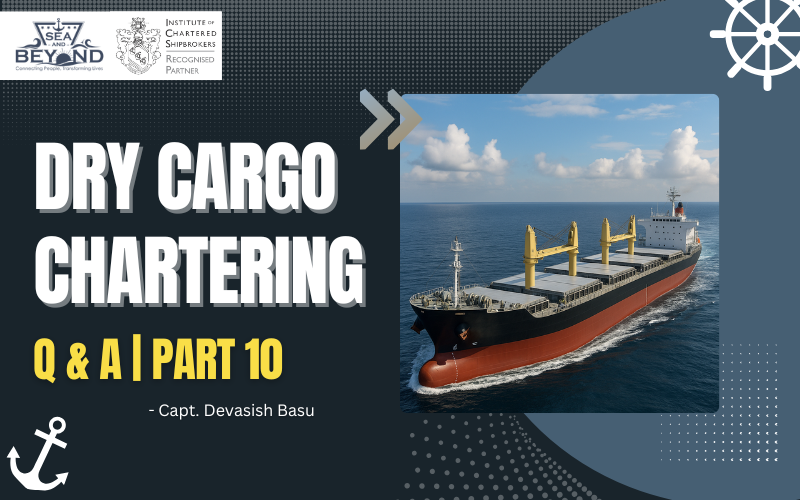
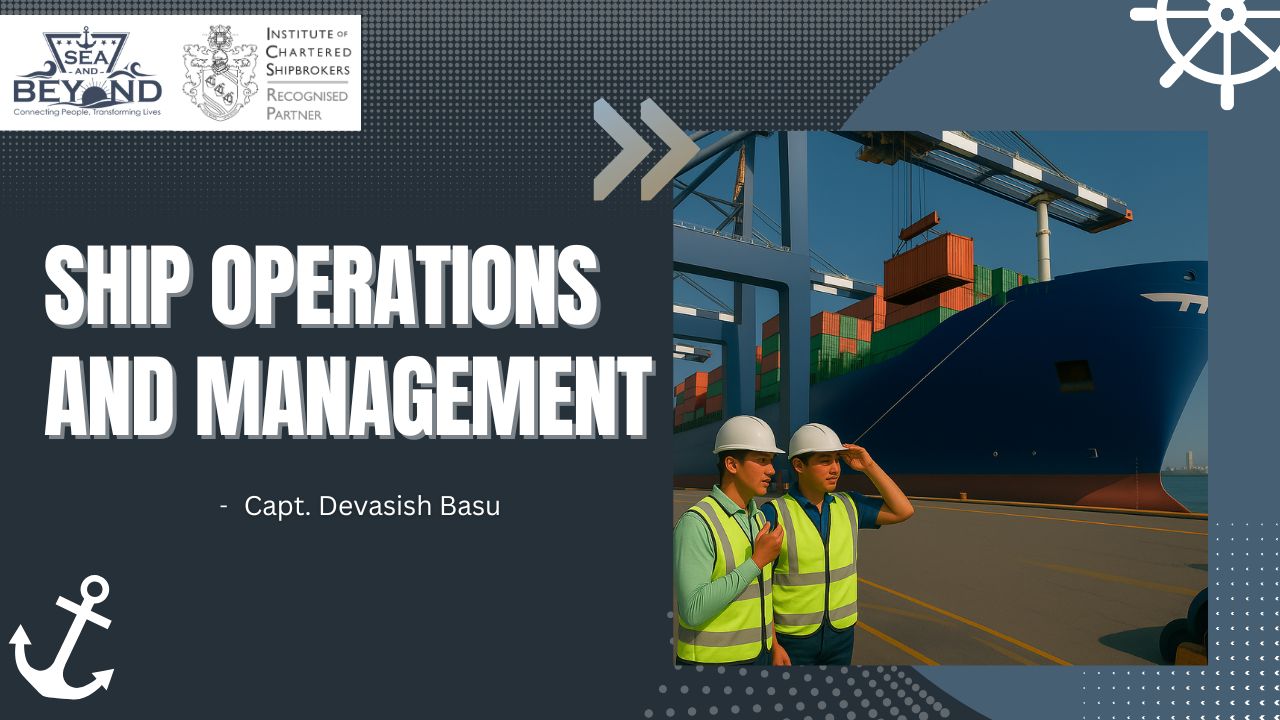
The Dry Cargo Chartering Tutorship by Sea and Beyond, conducted by Capt. Devasish Basu, is a structured video-based learning programme designed to help maritime professionals build a strong understanding of dry cargo chartering and commercial shipping practices.
This ship chartering course is ideal for aspiring shipbrokers, seafarers transitioning ashore, and maritime professionals who want a clear and practical understanding of dry cargo shipping and chartering concepts used in the global shipping industry.
Delivered through 10 comprehensive recorded video chapters, this commercial shipping course simplifies complex commercial concepts using practical explanations, real-market insights, and structured learning modules.
Course Structure and Syllabus Coverage
Dry Cargo Ships and Trade Fundamentals
The course begins with an introduction to various cargo ship types, including dry bulk carriers, container vessels, Ro-Ro ships, and specialised vessels.
Students learn about ship design, onboard equipment, and cargo-handling systems, creating a strong foundation for understanding dry cargo operations.
Tonnage, Certification, and Trading Areas
The programme explores cargo vessel tonnage and certification, including different capacity measurements and stowage factors.
It also examines global trading areas and operational limitations that influence dry cargo trades across different regions.
Freight Markets and Commercial Practices
In-depth modules explain how the freight market operates, including the Baltic Dry Index (BDI), a key indicator in the dry cargo chartering market.
Students gain a practical understanding of:
- Freight market dynamics
- Chartering negotiations
- Commercial offer structures
- Freight calculations
- Forward Freight Agreements (FFA) used in dry cargo trading
Charter Parties, Brokerage, and Laytime
Key chapters cover different types of charter parties, along with brokerage practices and commission structures involved in fixing vessels.
The programme also explains laytime calculations, including:
- Commencement and cessation of laytime
- Demurrage and despatch
- Voyage-related operational scenarios
Voyage Estimation and Shipping Documentation
Later chapters focus on voyage estimation calculations, revenue evaluation, and charter party application in cargo trades.
Students also learn about essential shipping documentation including:
- Bills of Lading
- Mate’s Receipts
- Different types of Bills of Lading used in commercial shipping
Claims, Disputes, and Professional Liability
The final modules explore claims management and dispute resolution, including:
- Cargo damage claims
- Role of P&I Clubs
- Arbitration procedures in chartering disputes
- Professional liability considerations in shipping transactions
Who This Course Is For
- Aspiring shipbrokers and chartering professionals
- Seafarers planning a transition to shore-based roles
- Maritime professionals seeking practical chartering knowledge
- Anyone interested in understanding commercial shipping operations
- Anyone looking for a dry cargo chartering course or shipbroking training in commercial shipping
Learning Outcomes
By the end of this programme, participants will:
- Develop a strong conceptual and practical understanding of Dry Cargo Chartering
- Gain confidence in freight market and charter party concepts
- Understand voyage estimation, documentation, and commercial negotiations
- Build the knowledge required to pursue professional opportunities in shipbroking and chartering

Sea and Beyond
At Sea and Beyond we strive for authenticity and honesty in our work. Our mission is to help “You take a well informed decision” and we try and support you through our various services like
- Mentoring
- Skill enhancement/Education
- Job Opportunities and
- Your branding (CV and LinkedIn preparation)
We have a team of writers who conduct thorough research to ensure the accuracy of the content and for the clarity in communication. We will be happy to support you wherever required
Rating:
Price:
₹ 14999
Language:
English
Length:
16:01:00
Intended for:
Reference:
Topics:
11 Sections . 36 lectures . 16h 1m total length
20 min
1.1 Chapter 1 | Introduction to Dry Cargo Chartering
Introduction to Dry Cargo Chartering, Dry cargo key trade routes, Bulk and Dry cargo ship types
20 min
1.2 Chapter 1 | Dry cargo Trade - Iron Ore, Coal, Grain
Dry cargo Trade- Iron Ore, Coal, Grain, Agri products, Fertilizers and Minerals, Forest Products

34 min
1.3 Chapter 1 | Geography's role, Global trade chokepoints
Geography's role in shipping, Global trade chokepoints, Drafts, Load lines and tidal effect, Trading restrictions
34 min
1.4 Chapter 1 | Dry Cargo Types, Cargo Distribution
Dry cargo ship types, Propulsion, Vessel design, Cargo spaces, Crane/gear, Cargo distribution
40 min
2.1 Chapter 2 | Ship Fittings, Container Ships, RoRo Ships
Ship fittings, Container ships, RoRo ships, Semi submersible, Heavy Lift, Reefer ships
23 min
3.1 Chapter 3 | Grain & Bale Capacity, Stowage factor
Grain & Bale Capacity, Stowage factor, Tonnage and Loadline certification
19 min
3.2 Chapter 3 | Suez & Panama canal certification, Dimensions
Suez & Panama canal certification, Vessel GA/ Capacity Plans, Dimensions, Stowage calculations
35 min
3.3 Chapter 3 | Cargo handling, Dangerous cargoes
Cargo handling, Dangerous cargoes, IMDG classes, Vessel certification and classification societies
22 min
4.1 Chapter 4 | Freight market, Baltic exchange & dry index
Freight market and market practice, Baltic exchange, Baltic dry index, Key features, Routes and Calculations, FFA trading
30 min
4.2 Chapter 4 | FFA continued, Role of charterers/ Ship owner
FFA continued, Role of charterers/ Ship owner, Operators, Vessel registry, Role of ship brokers
47 min
4.3 Chapter 4 | INCOTERMS, Trading, Letter of Credit (LC)
INCOTERMS, Trading, Letter of Credit (LC), Market negotiations, Methods of ship employment, Various types of charter parties
11 min
5.1 Chapter 5 | Charter Parties, Standard CP wordings
Understanding Charter parties, Standard CP wordings, FONASBA form
17 min
5.2 Chapter 5 | CP for specific trades, NYPE forms, CP clauses
CP for specific trades (Grain, Iron ore,Coal) NYPE forms for time charters, CP Clauses
27 min
35 min
6.1 Chapter 6 | Freight Calculation, Deadfreight, Taxes
Freight, Freight calculation in Voyage and time charter, Deadfreight, Taxes, Commission and brokerage, Off hire
23 min
7.1 Chapter 7 | Voyage estimation, Revenue, Voyage costs
Voyage estimation, Revenue, Voyage costs, Offering and countering, Working examples
30 min
7.2 Chapter 7 | Time charter Voyage estimate, TCE calculation
Time charter Voyage estimate, TCE calculation, Voyage planning, Cargo intake planning, Worked examples
34 min
8.1 Chapter 8 | Laytime, Statement of Facts, SOF remarks
Laytime, Calculations for laytime, Statement of Facts, SOF remarks, Hatch calculation of Laytime, Indefinite laytime, Commencement
24 min
8.2 Chapter 8 | Laytime Interruptions, Breakdown calculations
Laytime Interruptions, Bad weather, Breakdown calculations, Despatch/Demurrage, Cessation of Laytime, Averaging Laytime
28 min
9.1 Chapter 9 | Mate’s Receipt, Bills of Lading
Mate’s Receipt, Bills of Lading, B/L as Document of title, B/L as evidence of contract, B/L at Load port
25 min
9.2 Chapter 9 | Contents of B/L, Release of B/L, Remarks on B/L
Contents of B/L, Release of B/L, Remarks on B/L, Quantity and condition clauses, Other clauses
34 min
9.3 Chapter 9 | B/L at Discharge port, LOI, Cargo Claims
B/L at Discharge port, Delivery of cargo, Bank Guarantee, LOI, Types of Bills of Lading, B/L in Time Charter, Cargo Claims, Cargo Damage, Clause paramount
22 min
9.4 Chapter 9 | Hague Visby rules, Carriage of goods by Sea Act
Hague & Hague Visby rules, Carriage of goods by Sea Act (COGSA), Limits and Liability, Rights and Immunities, Hamburg Rules
11 min
33 min
10.1 Chapter 10 | Disputes & professional Indemnity, English law
Disputes and professional Indemnity, English law, Arbitration platforms, Steps in arbitration, P&I Clubs, Charterer’s P&I
36 min
10.2 Chapter 10 | P&I- Agents and Brokers, Professional survival
P&I- Agents and Brokers, Unknown Charterers and Owners, Professional survival, Office Organization, Putting Knowledge into effect
27 min
11.1 Q & A | Draft a firm offer for Time charter trip
Drafting a firm offer for Time charter trip on behalf of Owner-explained in detail, explain BOD/BOR
19 min
11.2 Q & A | Functions of Bills of Loadings
Functions of Bills of Loadings, Draft a message as a broker to owners asking master to sign the B/L prior completion of loading, Advise the owners about the consequences, Also recommend actions for owner in this case.
25 min
11.3 Q & A | Handysize bulk carrier, State the vessel specifications
Draw and label a handysize bulk carrier, State the vessel specifications, Describe one main trade route of such vessel, Load and Disch ports, Hazards of such trade, limitations involved
33 min
11.4 Q & A | Trade route, Special pattern, Hazards & care
Describe trade route, Special pattern, Hazards and care in such trade, Cargo care required, loading method, Stowage requirements, And discharging processes for these commodities, 1. Iron Ore, 2. Forest Products
15 min
11.5 Q & A | Cape size bulk carrier, principle specifications
Draw and label a cape size bulk carrier, With principle specifications, Specify one main trade route for such a vessel, load and discharge port, How the cargo is loaded and discharged, Cargo hazards and weather conditions expected in the route
35 min
11.6 Q & A | Shipowners broker, 10 year old Panamax vessels
Write a report as a shipowners broker, Interested in buying a series of 10 year old Panamax vessels, Highlighting the freight market prospects for this tonnage
19 min
11.7 Q & A | Broker to Charterer, Hostile action in red sea
Provide advice as broker to charterer, Regarding, Hostile action in red sea, Causing increase in voyage distances, About rights of owner/operator, Impact on voyage cost. Gencon 1994 and Gencon 2022
30 min
11.8 Q & A | Negotiating a contract of consecutive voyages
Advise your principal in negotiating a contract of consecutive voyages for 12 months, To carry 50,000 tonnes of grain per voyage from River Plate to Penang, Advise type and size of vessel required, Description of cargo, Hazards associated with cargo carriage, Stowage, and route
26 min
11.9 Q & A | Trading between India to Europe, WCUSA to ECUSA
Provide a report, As a broker to charterer, About current problems related to 2 major canals, Indicate additional costs related in rerouting your vessels, Including additional time, Cargo restrictions in given 2 scenarios
a) trading between India to Europe
b) Trading forest products between WCUSA to ECUSA
18 min
11.10 Q & A | Terms like WWD, SSHEX EIU, DHDLTS in a voyage
Explain terms like WWD, SSHEX EIU, DHDLTS in a voyage offer received by your principal.
Suggest how the terms can be improved to benefit owners, Giving reasons for your recommendations.
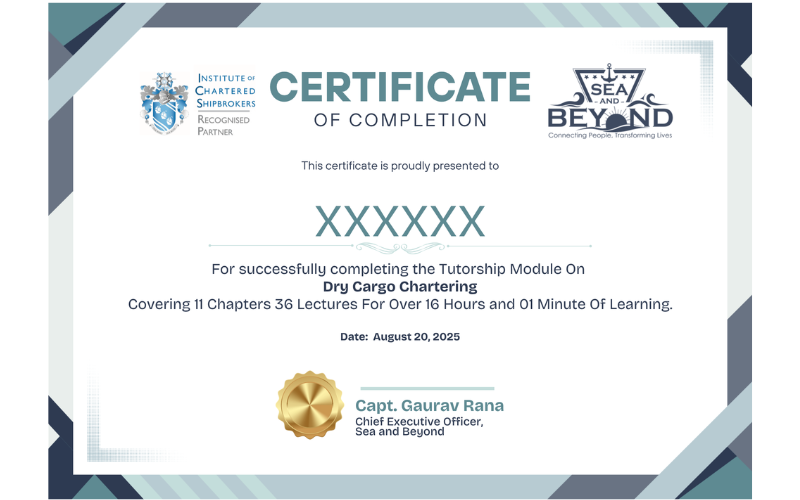
Successful completion of this course will earn you a certificate of completion from Sea and Beyond. This certificate will be emailed to you and you could also share and show it on LinkedIn Please click on the button below to purchase the certificate.
Similar Courses












Contact Us