
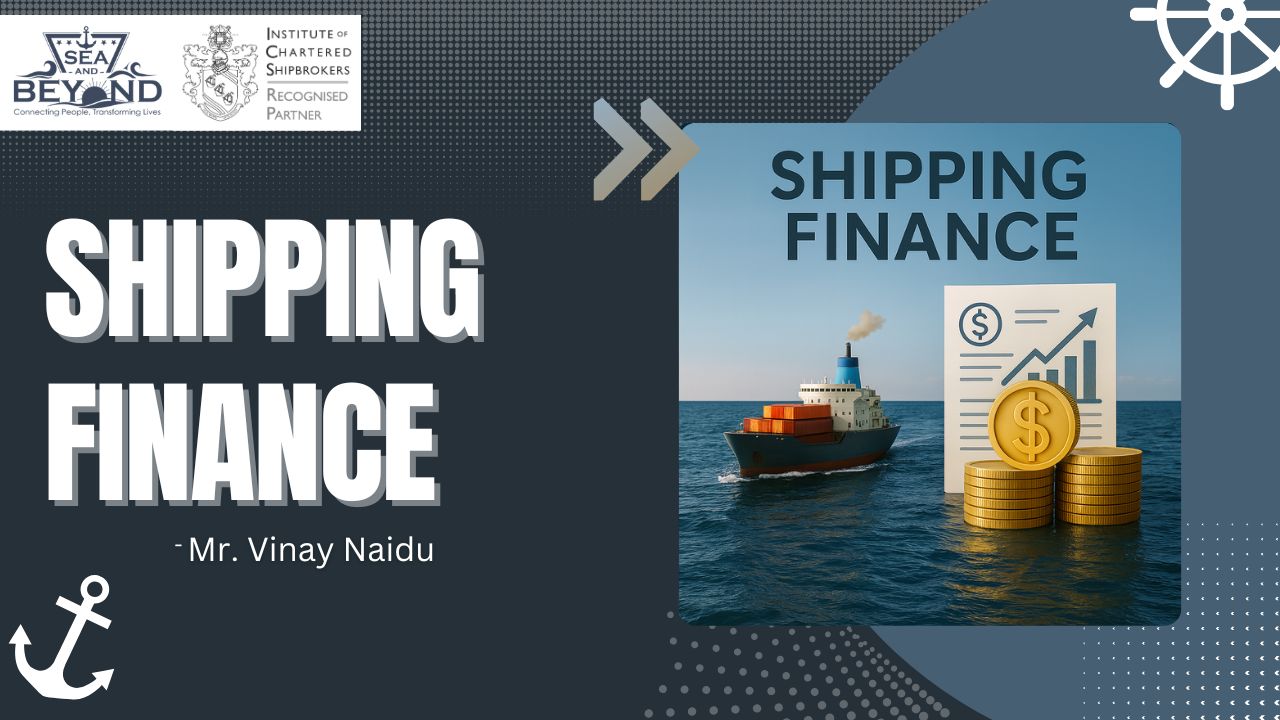
The Shipping Finance Programme, conducted by Mr. Vinay Naidu, is a structured, video-based learning programme designed to provide a clear and practical understanding of shipping finance, ship funding structures, and financial risk management in commercial shipping.
With over four decades of leadership experience in maritime finance, Mr. Naidu delivers an 11-chapter video series that bridges the gap between theoretical knowledge and real-world application, making complex financial concepts easy to understand and apply.
This shipping finance course is ideal for shipbrokers, maritime professionals, and seafarers transitioning to shore-based commercial roles who want to build strong expertise in maritime finance and shipping business operations.
Chapter-wise Breakdown
The programme is structured into 11 comprehensive chapters, each covering key areas of shipping finance and maritime financial management.
Chapters 1 & 2: Market Fundamentals
These chapters introduce the fundamentals of shipping finance, including the relationship between freight and finance and the objectives of lenders and borrowers.
Participants will learn about shipping cycles—trough, recovery, peak, and collapse—and how financing strategies evolve across these phases. The modules also explore risks for both borrowers and lenders and analyze the impact of major financial disruptions, such as the 2008 financial crisis, on the shipping market.
Chapters 3 & 4: Loan and Credit Analysis
This section focuses on loan structuring and credit evaluation. Topics include bank credit policies, Loan-to-Value (LTV), and key credit assessment frameworks such as the Six C’s and CAMPARI.
The chapters also cover loan agreements, covenants, default scenarios, and enforcement processes, including ship mortgages and judicial sales.
Chapter 5: Legal Aspects
This chapter explores the legal framework governing ship finance. It includes ship registration systems, ownership structures, and the role of flag states.
Participants will also understand ship mortgages, enforcement procedures, maritime disputes, Admiralty Jurisdiction, ship arrest processes, and the role of arbitration in shipping.
Chapters 6, 7 & 8: Funding Sources
These chapters examine various sources of finance, including equity (private and public), IPO processes, and debt financing structures.
Participants will learn about different loan types such as senior loans, revolving credit facilities, and mezzanine finance, along with alternative funding methods like seller’s credit and private placements.
Chapters 9, 10 & 11: Specialized Finance & Structures
The final chapters focus on advanced financial instruments and structures, including bond markets, leasing models (operating, financial, and Islamic leasing), securitization, and structured finance models.
The course also covers debt-equity structuring, the impact of global banking regulations, and the strategic use of leverage within shipping cycles.
Practice and Assessment
The programme includes 230+ multiple-choice questions (MCQs) with detailed answers and explanations to reinforce learning. These are integrated within the chapters and also available as a dedicated Q&A module.
The total duration of the video content is approximately 250 minutes, ensuring a comprehensive yet efficient learning experience.
Who This Course is for
- Shipbrokers and shipping professionals
- Maritime professionals seeking financial expertise
- Seafarers transitioning to shore-based commercial roles
- Individuals pursuing careers in shipping finance
- Anyone looking for a shipping finance course or maritime finance training
Learning Outcomes
By the end of the programme, participants will have a strong understanding of shipping finance concepts, the ability to evaluate financial structures and risks, and the confidence to apply these principles in real-world maritime and commercial shipping environments.

Sea and Beyond
At Sea and Beyond we strive for authenticity and honesty in our work. Our mission is to help “You take a well informed decision” and we try and support you through our various services like
- Mentoring
- Skill enhancement/Education
- Job Opportunities and
- Your branding (CV and LinkedIn preparation)
We have a team of writers who conduct thorough research to ensure the accuracy of the content and for the clarity in communication. We will be happy to support you wherever required
Rating:
Price:
₹ 14999
Language:
Length:
07:01:00
Intended for:
Seafarer, Ship Broker, Maritime Professional
Reference:
Topics:
12 Sections . 23 lectures . 7h 1m total length
14 min
1.1 Chapter 1 | Introduction to Shipping Finance
Introduction to Shipping Finance, Connection between Freight and Finance, Lender’s objective, Borrower’s objective, Consensus and Conflict points
21 min
1.2 Chapter 1 | Shipping Cycle, Trough, Recovery
Shipping cycles, Trough, Recovery, Peak and collapse, Characteristic of each phase, Financing strategy for each phase

20 min
1.3 Chapter 1 | Consequences of ignoring shipping cycles
Consequences of ignoring shipping cycles, Borrower risk, Lender’s risks, Market Impact, 10 MCQ’s for practice, Model questions related to subject
13 min
2.1 Chapter 2 | Finance Market & Bank capital erosion 2008
Current status of finance market, Bank capital erosion 2008, Regulatory pressures- Basel III compliance, Ship finance lender’s appetite, Implications for shipowners
13 min
2.2 Chapter 2 | Finance Relationship & 2008 crisis
Shipping markets in Finance-relationship, Double hit in 2008 crisis, Re-enforcing key concepts from Shipping cycles, Demand and Supply, Opportunity and challenges, Dangers of Over-ordering during boom phase
13 min
2.3 Chapter 2 | Mutual Dependence & Risk Oversupply
Finance & shipping tied together, Mutual dependence, Risk-Oversupply of vessels, Impact of this dependence, Ship financing turning unattractive, 10 MCQ’s and answers, Practice questions related to chapt
25 min
3.1 Chapter 3 | Credit Risk Analysis, Repayment Structure
Credit risk analysis, repayment structure, importance of different profiles, Prepayments, Loan pricing, margins, fees, Insurance costs, Interest rates and periods, SOFR/ LIBOR/ EIBOR, Fixed and floating rates,
22 min
3.2 Chapter 3 | Credit Assessment & Six C's Framework
Credit assessment, Six C’s framework, CAMPARI, Customer analysis, Vessel analysis, Transaction analysis, Borrower and guarantor analysis, Charterer analysis, 10 MCQ’s and answers, Practice questions related to chapter
22 min
3.3 Chapter 3 | Loan Documentation, Assessment, Process
Loan documentation, Loan assessment, Loan structuring Process, Bank credit policy, Ratio and loan amount, Loan to value (LTV), Limits & exceptions, LTV implications, Borrower & Guarantor, SPC’s (special purpose companies), Risk Management, Financing secondhand vs newbuild,
23 min
4.1 Chapter 4 | Loan Documentation & Ship Mortage
Loan Documentation, Key elements of loan agreements, English Governing law, Covenants, MVC (Min Value clause)Security package, Ship Mortgage- Core features, Exercising Ship mortgage, case study,
17 min
4.2 Chapter 4 | Judicial Sale & Mortgagee ranking
Loan Default notice and process, Arrest and enforcement, Judicial Sale & Mortgagee ranking, Auction process, Case Study, Assignments & Guarantees, Newbuilding security, MCQ’s and Practice questions related to chapter
20 min
5.1 Chapter 5 | Legal aspects, UK Ship registration, Qualified owners
Legal aspects relating to ship finance, UK Ship registration, Qualified owners, 64 shares rule, managing owner, Flag state & open registries, competitive edge, offshore flags,
Ship mortgages, Ranking of Mortgages, Enforcement of Mortgages, Court sale, Priorities of claims
19 min
5.2 Chapter 5 | Equitable mortgages, Priority & Registration
Equitable mortgages, Priority & Registration, Admiralty Jurisdiction, Maritime disputes, Actions in Admiralty- In Personam, In rem, CPR rules, Jurisdiction rules
21 min
5.3 Chapter 5 | Rem Procedure, Ship arrest, Rem & Finance relation
In Rem Procedure, Ship arrest, In Rem & Finance relation, Liens vs Mortgages,
One ship company-Concept, Legality,
Arbitration Process, Tribunal structure, Benefits of Arbitration, Preferred option in Shipping,
MCQ’s and Practice questions related to chapter
24 min
6.1 Chapter 6 | Source of Finance, Private equity, Public equity
Equity as source of finance, Owner’s equity and its advantages, Private equity, Public equity, IPO process for shipping companies, Stock exchanges, Investor conflicts, factors influencing equity
23 min
6.2 Chapter 6 | Stock exchanges, Payout ratios, shareholders
Choice of stock exchanges for listing, Payout ratios (Dividends), shareholders, equity injections, dilutions, SOX (Sarbanes-Oxley Act), Types of shares, special purpose acquisition companies (SPACS), MCQ’s and Practice questions related to chapter
16 min
7.1 Chapter 7 | Debt & equity, Pre/ Post 2008 models
Difference between Debt & equity, Senior Bank Debt, Ship mortgage seniority, Shipping Finance market participants, Pre/ Post 2008 models, Bank lending policies, Syndicated and Club Loans, MCQ’s and Practice questions related to chapter
20 min
8.1 Chapter 8 | Types of loans, Senior bank loans, Amortising term
Types of loans, Senior bank loans, Amortising term loans, Revolving credit facilities, Bridging Loans-Short term finance, Hunting Licences (Pre approved loans), Junior debt and Mezzanine debt, ECA (Export Credit agencies)
12 min
8.2 Chapter 8 | Seller’s Credit, Yard Credit, manufacturer financing
Seller’s Credit, Yard Credit, Equipment manufacturer financing, Private placements, Alternative finance- Higher risk, MCQ’s and Practice questions related to chapter.
17 min
9.1 Chapter 9 | Debt Financing & bond markets, High Yield bonds
Debt Financing & bond markets, High Yield bonds (144A issues), Institutional trades, Norwegian bonds, Title XI bonds, Govt Guarantee, Under Jones act, Convertible bonds, Case study, MCQ’s and Practice questions related to chapter
22 min
10.1 Chapter 10 | Securitisation, Leasing, Tax benefits
Other forms of finance, Securitisation, Description with case study, Leasing, Tax benefits, Operating Lease, Islamic Leasing, Risk Sharing, KG (German) Financing, Collapse of model post 2008-crisis, KS (Norwegian) Financing, Differences between KG and KS finance, MCQ’s and Practice questions related to chapter
16 min
11.1 Chapter 11 | Debt-Equity structure, Global financial crisis
Debt-Equity structure in shipping finance, Basel Committee, Global financial crisis, Basel III in Shipping, Benefits of Leverage, Leverage & Shipping cycles, MCQ’s and Practice questions related to chapter
8 min
12.1 Q & A | 100 MCQ’s (with correct answers & explanation)
This module contains 100 MCQ’s(with correct answers & explanation) to have conceptual clarity of the subject. Make sure you take your time to pause the video for having a better understanding of the question and explanation given for each question (at the end of each 20 questions set)
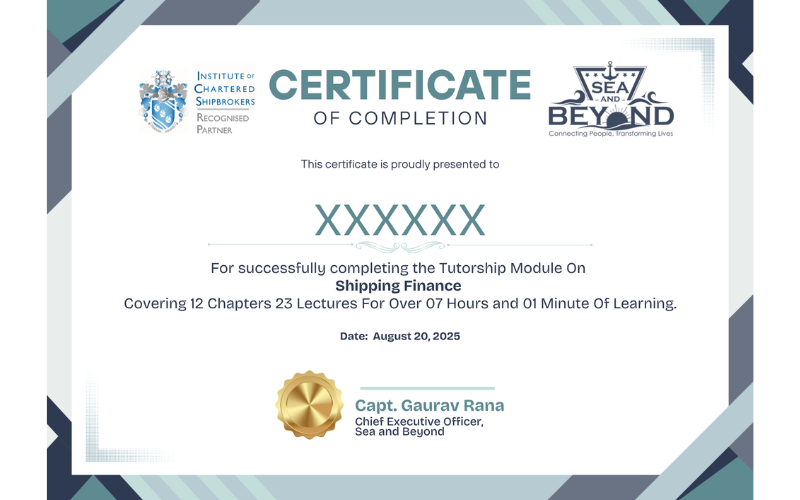
Successful completion of this course will earn you a certificate of completion from Sea and Beyond. This certificate will be emailed to you and you could also share and show it on LinkedIn Please click on the button below to purchase the certificate.
Similar Courses















Contact Us