
The Ship Operations and Management Programme, conducted by Capt. Devasish Basu, is a structured, video-based learning programme designed to provide a clear and practical understanding of commercial ship operations and management.
This ship operations and management course is ideal for aspiring shipbrokers, seafarers transitioning to shore-based roles, and maritime professionals looking to build strong operational and commercial expertise in shipping.
Delivered through 11 comprehensive recorded video chapters, the programme simplifies complex maritime concepts through practical, real-world explanations. It helps learners understand how ships are managed from shore, how voyages are planned and executed, and how cost, risk, compliance, and commercial decisions impact day-to-day shipping operations.
What You Will Learn in This Programme
1. Foundations of Ship Management
- Understanding ship management roles: owners, operators, and managers
- Commercial vs technical management
- Voyage planning, port operations, bunkers, and supply
- Performance monitoring and operational supervision
2. Vessel Types & Design
- Classification of ships and fleet segments
- Ship measurements (GT/NT, DWT, draft, dimensions)
- Bulk carriers, tankers, gas carriers, and multi-purpose vessels
- Matching vessel design with cargo and trade requirements
3. Cargo & Global Trade
- Key cargoes: iron ore, coal, grains, crude oil, and refined products
- Trade routes, market drivers, and seasonal patterns
- Cargo handling and claims
- Regulatory considerations in cargo trade
4. Regulations & Safety Management
- Flag states and registries (including open registries)
- Classification societies and vessel surveys
- ISM Code and Safety Management Systems (SMS)
- Port State Control and MARPOL compliance
5. Ship Management Economics
- Cost structures: fixed vs voyage costs
- Crew, stores, repairs, and dry-docking budgets
- Bunker costs, port charges, and canal dues
- Cost monitoring and variance analysis
6. Commercial Operations
- Freight and hire management
- Laytime, demurrage, and despatch calculations
- Voyage instructions, Notice of Readiness (NOR), Statement of Facts (SOF)
- Charter party compliance and claims handling
7. Crew Management
- Recruitment, training, and scheduling
- Safe manning and certification requirements
- MLC, ITF, and ILO regulations
- Balancing cost efficiency with safety and compliance
8. Marine Insurance & Claims
- Hull & Machinery and P&I insurance
- General and Particular Average
- York-Antwerp Rules
- Salvage, LOF, limitation of liability
- Cargo claims, surveys, and exceptions
9. Vessel Operations
- Pre-fixture, fixture, and post-fixture processes
- Coordination between commercial and technical teams
- Voyage efficiency, routing, and loadline considerations
- Planned Maintenance Systems (PMS)
10. Bunker & Fuel Management
- Bunker procurement strategies
- Onboard bunkering procedures and documentation
- Fuel quality testing, sampling, and dispute handling
- Compliance with environmental regulations
11. Voyage Estimation
- Revenue and cost evaluation
- Route planning and benchmarking
- Practical voyage estimation examples
Practical Learning Support
The programme includes dedicated Q&A modules designed to strengthen understanding and application of key concepts.
- Full solution of a sample question paper covering multiple topics
- Guidance on structuring clear and effective answers
- Practice involving route planning and map-based questions
- Exercises focused on voyage estimation and commercial decision-making
Who This Course is for
- Aspiring shipbrokers and shipping professionals
- Seafarers transitioning to shore-based roles
- Maritime professionals seeking operational and commercial expertise
- Individuals pursuing careers in commercial shipping
Learning Outcomes
By the end of the programme, participants will have a comprehensive understanding of ship operations and management, the ability to apply commercial and operational concepts in real-world scenarios, and the confidence to pursue professional roles in commercial shipping.

Sea and Beyond
At Sea and Beyond we strive for authenticity and honesty in our work. Our mission is to help “You take a well informed decision” and we try and support you through our various services like
- Mentoring
- Skill enhancement/Education
- Job Opportunities and
- Your branding (CV and LinkedIn preparation)
We have a team of writers who conduct thorough research to ensure the accuracy of the content and for the clarity in communication. We will be happy to support you wherever required
Rating:
Price:
₹ 14999
Language:
English
Length:
17:00:00
Intended for:
Reference:
Topics:
12 Sections . 44 lectures . 16h 39m total length
16 min
1.1 Chapter 1 | Introduction to Ship management
Introduction to Ship management, components of Ship management, Ship owners/operators/managers,
20 min
1.2 Chapter 1 | Commercial ship management
Commercial ship management, Operational Ship management, Voyage management and Planning, Cargo & port ops management, Bunker and supply management, Regulatory supervision, Performance monitoring

27 min
1.3 Chapter 1 | Technical Ship management
Technical Ship management, Technical operations, Dry Docking and repair, Spare part management, Crew management & training, Budgeting and cost control, Incident and Claim management, Finance management, Compliance and Audit, HR & Crew management,
Different types of Ship management (Full/partly/3rd Party)
BIMCO SHIPMAN contract
26 min
1.4 Chapter 1 | BIMCO SHIPMAN contract
BIMCO SHIPMAN contract continued, Six disciplines for Ship Broking, Ship management-Crewing, Store supplies, Provisioning, Efficient crew management, Crew scheduling, Recruitment of Crew and Officers, Various nationalities, Advantages and Dis-advantages of Crewing agencies
25 min
1.5 Chapter 1 | STCW- Training & Certifications
STCW- Training & Certifications of crew and officers, International Labour Org (ILO), International Transport worker’s federation (ITF)
Technical Department roles- Ship management, H&M Insurance, Third party- P&I insurance, Clauses in Insurance policies, Calls & Supplementary calls, Types of claims, Limitation of liability, Cargo claims, Contractual exceptions,
Operation department, International Safety management (ISM) code application, ISPS code, Ship security Plan (SSP)
20 min
2.1 Chapter 2 | Classification of Ships, Features of a vessel
Classification of Ships, changes in Ship design, Features of a vessel, Ship tonnage measurement, GRT/NRT to GT/NT, Suez/Panama canal measurements, Canal Dues,
28 min
2.2 Chapter 2 | Deadweight, Displacement, Cubic Capacity
Deadweight (DWT), Displacement, Cubic Capacity, Bale Capacity, Ship’s Draft (Draught), Vessel’s Principal dimensions, Length, Breadth, Height, Air draft, Ship’s Plans (Gen Arrangement, Capacity Plan)
27 min
2.3 Chapter 2 | Types of vessels, Bulk Carriers, Ore Carriers
Types of vessels, Bulk Carriers, Ore carriers (VLOCs), Cape Size, KAMSARMAX, Panamax, Handy/Supra/Ultramax, Internal design,
24 min
2.4 Chapter 2 | Cement Carriers, Multi purpose, Oil Tankers
Cement Carriers, Tweendeckers, Multi purpose, Oil Tankers, Different types of tankers, Oil/Chemical/Gas, ULCC/VLCC, Suezmax/Aframax, Panamax/LR2 tankers, Types of Gas tankers, based on tanks/construction/pressure system
27 min
3.1 Chapter 3 | Cargoes, Mineral Ores, Types of Vessel
Cargoes, Mineral Ores, Common trade patterns, Types of vessels carrying Ores, Market Drivers, regulatory compliance,
Oil cargoes, types of petro products carried, Trade patterns and vessel types, regulatory compliance, Liability and insurance,
22 min
3.2 Chapter 3 | Trade Patterns, Dry Cargo trade
Cargoes Continued- Grains, properties, trade patterns, constraints, hazards, vessel types to carry grains, Exporters and Importers, Market drivers, regulatory compliance, Grain Code, Seasonal peaks, Operational & commercial implications,
Introduction of Dry Cargo trade, Break bulk cargo, Handling of cargo,
20 min
3.3 Chapter 3 | Dry bulk commodities, Iron Ore, Coal & Grain
Dry bulk commodities, Iron Ore, Coal and Grain, Market trends and challenges,
Coal trade details, Importers and Exporters, Grain trade patterns,
Agriculture product trading, Fertilizer and Minerals, Trade patterns,
Oil product trade, routes, Geo-pilotical factors, Choke Points in Oil trade,
18 min
3.4 Chapter 3 | Shipping methods, Trade Routes, Cargo
Forest products, Shipping methods, Primary wood and paper trade routes,
Cargo Out turn, Shortage and damage claims, Stowage factor & stability, Compatibility of cargoes, Hazardous cargoes,
24 min
4.1 Chapter 4 | Vessel registration, Flag state, Open registry
Vessel registration, Flag state, Open registry (FOC), Registration requirements and implications, Marking of registry on ship, Taxation benefit, tonnage benefits, Genuine link test,
10 min
4.2 Chapter 4 | Flag of Convenience (FOC), Tonnage tax
Flag of Convenience (FOC), International Tonnage Certificate (ITC) 1994, Regulation, costs impact of FOCs, Operating costs impact, Tonnage tax,
Port State Control (PSC), Inspection regime, MoUs/Areas of PSC Jurisdiction,
10 min
4.3 Chapter 4 | Classification Societies, Class certificates
Classification Societies, services of Classification societies, IACS (International Association of Classification societies), Class certificates and maintenance plans, PMS implementation, Class Survey process,
25 min
4.4 Chapter 4 | International Safety management code
International Safety management (ISM) code, Key aspects and requirements, Safety Management System (SMS), responsibility, Audits, Objectives of ISM code,
Various Surveys on a vessel, Classification/Condition/Commercial surveys, Environmental
Protection, Compliance with MARPOL, US OPA 90, Liability coverage certificates (CLC)
21 min
5.1 Chapter 5 | Ship management, Types of Companies
Cost in Ship management, Various types of companies, Limited/Private and Public companies, conglomerate & Multi national company, cost categories in Ship mgmt, Fixed costs, Daily Operating costs, Voyage related costs,
21 min
5.2 Chapter 5 | Fixed costs in Ship management
Fixed costs in Ship management, Return on capital, Amortisation, Debt servicing/ Repayment, parts of OPEX, Crew expenses, Victualling cost, Stores supply, Oil & lubricants, Insurance, P&I calls, Repair & management, Corrective/breakdown maintenance, Drydocking & survey costs,
16 min
5.3 Chapter 5 | Drydock cost, Voyage expenses
Cost-continued, Drydock cost, communication costs, Voyage expenses, Fuel/ Bunker costs, Slow steaming, Port costs, Canal dues, Cargo handling costs,
10 min
5.4 Chapter 5 | Budgeting and Cost monitoring
Budgeting and Cost monitoring , Planning & decision making, Operational performance monitoring, Financial result tracking, Deviations between actual and budgeted costs, Budget reviews, Summary
32 min
6.1 Chapter 6 | Accounting, Freight/ Hire, Credit policy/Risks
Accounting, Freight/ Hire collection, Credit policy/Risks, consequences of non collection of Hire, remedies available, Lien on cargo/vessel, Port disbursements, Role of Port agents, PDA/FDA, Disbursement accounts, Advance funds paid,
24 min
6.2 Chapter 6 | Demurrage & Despatch claims, Laytime
Demurrage & Despatch claims, calculation examples for Demurrage & Despatch, Laytime statements, Settlement process,
Compliance & contractual obligations, Risk management, Cost adherence, Operational efficiency, Best practices for account monitoring,
22 min
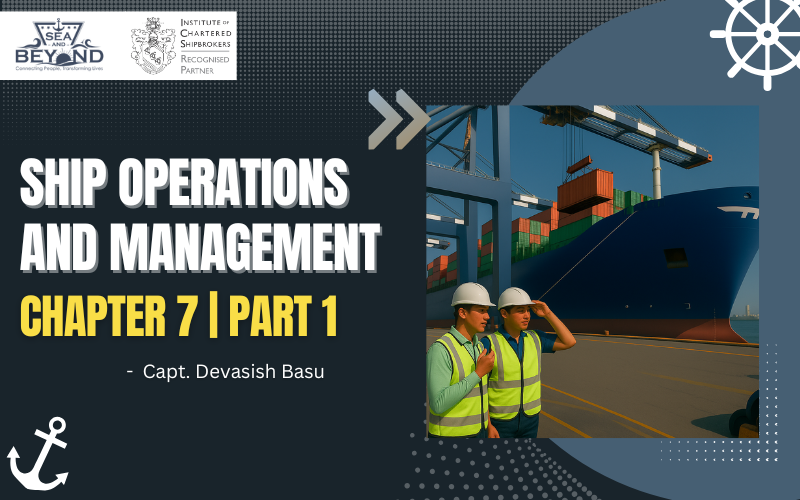
7.1 Chapter 7 | Crew management, Operating cost
Crew management in Shipping, Recruitment, Training and Scheduling of crew, key components of crew management, Operating cost impacts, Crew wages budgeting, Allowances and social costs,
20 min
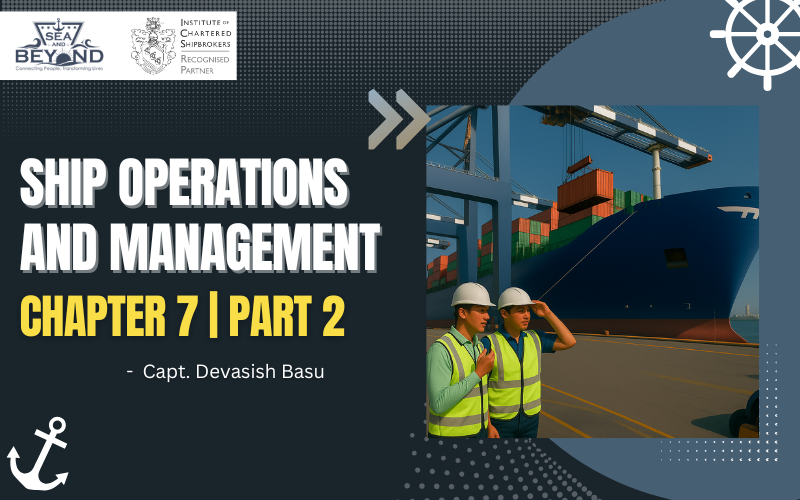
7.2 Chapter 7 | Compliance requirements, Manning levels
Crew management continued, compliance requirements, Manning levels, Safe manning certificate, Certification and endorsements, MLC requirements, cost vs safety balance, Dealing with shortages,
24 min
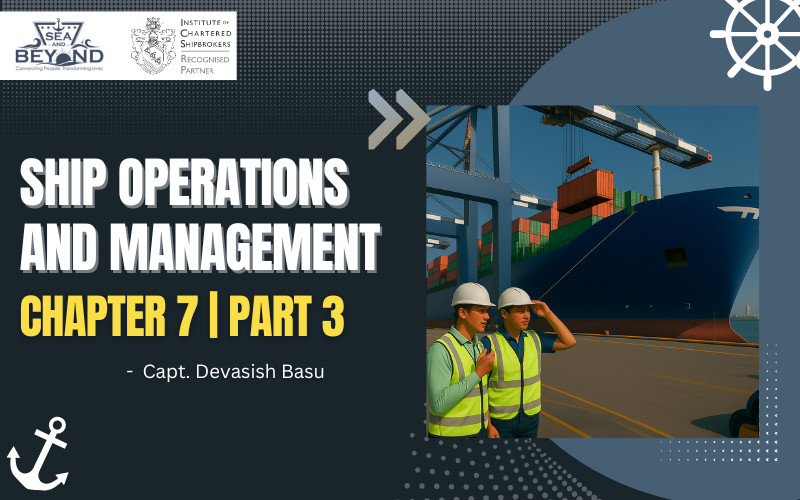
7.3 Chapter 7 | Human resources & Crew administration
Human resources and Crew administration, Support services compliance, communication and coordination,
Various categories of Ship management, Full/Hybrid/3rd party, Organization chart in ship management,
17 min
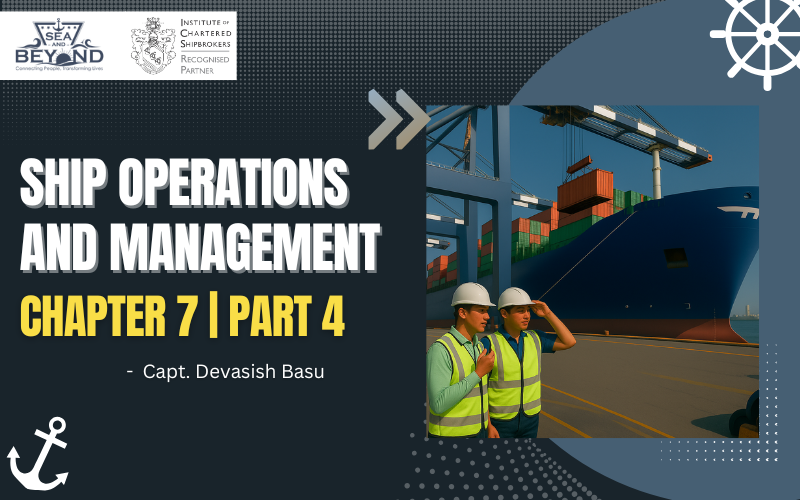
7.4 Chapter 7 | Importance of Crew Management
Importance of efficient in crew management, Advantages of crewing agencies, Disadvantages, STCW requirements, ITF/ILO regulations,
21 min
8.1 Chapter 8 | Hull & Machinery, 3rd Party Insurance
Insurance, Hull & Machinery Insurance, 3rd Party Insurance, claims related to people, cargo etc, P&I Insurance, Institute warranties and clauses, Additional cover, war risk, total loss/ CTL, working of P&I clubs,
19 min
8.2 Chapter 8 | Gen Average, Particular Average
Concept of Gen Average, GA adjusters, Particular Average, Examples of GA adjustments, York Antwerp rules,
16 min
8.3 Chapter 8 | Salvage, Handling of Cargo Claims
Salvage, Limitation of Liability convention (LLMC), Lloyd’s open form (LOF) for salvage, No cure No pay, Handling of Cargo Claims, Surveys for claims verification, Exceptions
35 min
9.1 Chapter 9 | Vessel Operations, Taxation benefits
Vessel Operations, evolution of ship management, Taxation benefits, Technical management of vessel, Commercial management of vessel, Pre-Fixture, operations, Post Fixture, Understanding Commercial operations,
Technical Management, Duties as Technical Managers, Coordination between Commercial & Technical teams,
31 min
9.2 Chapter 9 | Voyage instruction, Discharging operations
Voyage instruction, Implications of incomplete instructions, Key components of voyage instructions, Monitoring of loading & Discharging operations, NOR (Notice of Readiness), SOF (Statement of Facts), Compliance with Charter party terms, Claims, Fuel efficiency,
25 min
9.3 Chapter 9 | Charter Party & Vessel Routing Factors
Charter Party compliance continued, Communication and coordination, Importance of Planned Maintenance (PMS), Minimizing breakdowns, stoppages, Vessel Routing Factors,
Loadline Limitations, Canals and similar waterways,
25 min
10.1 Chapter 10 | Bunker Management, Types of fuels
Bunker Management, Key components, Location/ quantity/ pricing, Onboard procedures for Bunkering, Safety aspects, vessel performance (speed & efficiency) monitoring, Types of fuels used on vessels, Sampling procedures, Quality & Quantity control, Precautions during bunkering, Emission control area (ECA)
10 min
10.2 Chapter 10 | Environmental restrictions, Market Insights
Environmental restrictions, Key players for Bunkering, Market Insights, Bunker contracts, Fuelcon, Disputes in Bunkering, BIMCO bunker terms 2018, Bunker Delivery Note (BDN), Fuel samples,
28 min
11.1 Chapter 11 | Voyage Estimation, Profitability Assessment
Voyage Estimation, Key elements, revenue and costs, Profitability Assessment, Risk management, Performance benchmarking, route planning, Time charter estimate (TCE), worked examples, voyage planning,
33 min
11.2 Chapter 11 | Voyage planning, Cargo calculations
Voyage estimate continued, Voyage planning examples, Loadable cargo calculations, Inputs required for calculations, core calculations, Allowances and Adjustments, worked examples
31 min
11.3 Chapter 11 | Loadline restrictions, Cargo Distribution
Limitations in maximising cargo, Loadline restrictions, Stability issues, Cargo Distribution, Free surface effect, Deck cargo,Practical examples, Arrests and claims, handling cargo claims-Ship manager’s role, legal relationship in Ship management, Liability as Ship Manager, Insurance responsibilities.
35 min
12.1 Q & A | Capesize bulk carrier, Voyage estimation
Question 1: Describe the Characteristics of a Capesize bulk carrier, explain dimensions, tonnage, cargo gear equipment, trading pattern, etc.
Question 2: Voyage estimation, Bunker quantity calculation, Daily net profit calculation
18 min
12.2 Q & A | Role & responsibilities of DPA
Que 3- Role & responsibilities of DPA, Implementation of ISM code, Documentation & Certification under ISM
Que 4- Define and explain- AWRP, IEEC, CII, EEXI, IOPP, IMSBC code, WIBON, NDFFCA PMQS
19 min
12.3 Q & A | How to employ and retain the best crew
Que 5- How to employ and retain the best crew for the ships, result of failure to do so.
21 min
12.4 Q & A | Role of Classification society
Que 6- Role of Classification society, Vessel surveys, certificates & validity
24 min
12.5 Q & A | Operating Budget, operating cost
Que 7- Preparing Operating Budget for second hand vessel for owner, Infor needed to prepare such budget, costs to consider for daily operating cost, Monitoring of the budget
32 min
12.6 Q & A | Route selection for a Supramax Bulker
Que 8- Decision on route selection for a Supramax Bulker, loaded at Philadelphia, USA to discharging at Fremantle, Australia.
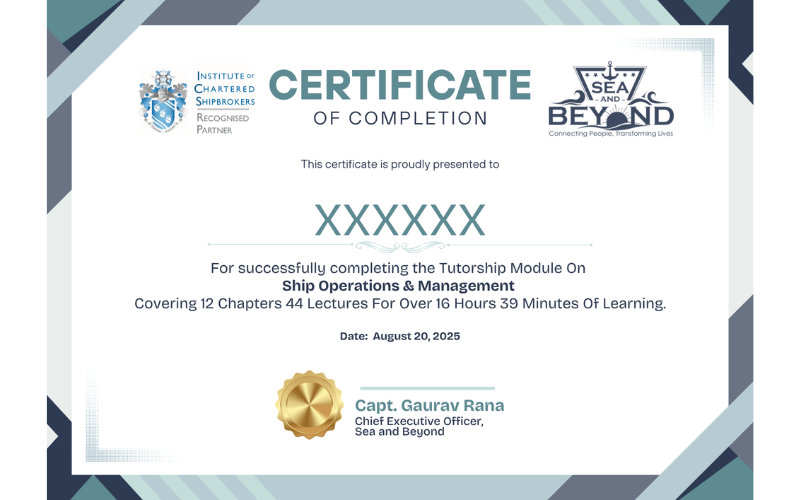
Successful completion of this course will earn you a certificate of completion from Sea and Beyond. This certificate will be emailed to you and you could also share and show it on LinkedIn Please click on the button below to purchase the certificate.
Similar Courses







Reviews...
Brian D almieda On Jun 13th 2026
overall wonderful course ....






Contact Us